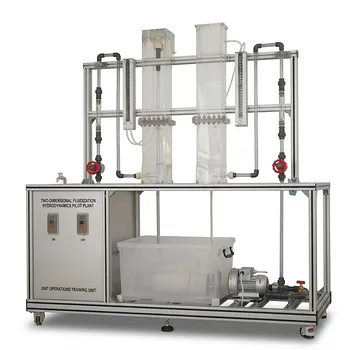
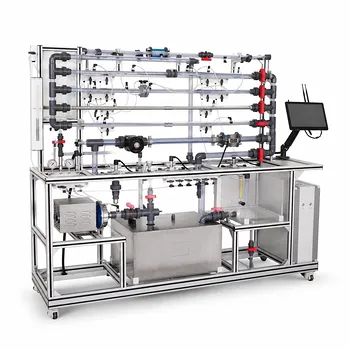
The primary role of a unit operations pilot plant is to function as a technical insurance policy. It bridges the critical gap between laboratory chemistry and industrial manufacturing by proving a process can work safely and economically at an intermediate scale. This controlled environment is where unknown risks are surfaced, flawed assumptions are corrected, and the true data required for large-scale design is gathered, preventing catastrophic and costly failures later on.
While laboratory work proves a chemical reaction is possible, a unit operations pilot plant addresses the deep need to prove it is profitable and safe. It de-risks scale-up by confronting the unpredictable physics of larger volumes, validating mathematical models with empirical data, and exposing hidden failure modes before significant capital is committed.
De-risking the Unpredictable Physics of Scale
The core reason technical risk increases with scale is that physical phenomena do not grow linearly. What works perfectly in a beaker often fails in a reactor that’s thousands of times larger.
The Non-Linear Nature of Scale
Heat transfer, mixing, and fluid dynamics change dramatically with volume. A bench-top flask can easily dissipate heat, but a 10,000-liter reactor might trap it, leading to runaway exothermic reactions.
Similarly, mass transfer and contact patterns that are trivial in the lab become major engineering challenges at scale. A unit operations pilot plant lets you study these specific physical behaviors under conditions that mimic commercial operations, ensuring that increased size does not compromise yield or equipment integrity.
The Scale-Up Factor Limit
Every unit operation has a maximum reliable scale-up factor. Pushing beyond these empirical limits introduces extreme risk because fluid flow characteristics, heat distribution, and mass transfer fundamentally change.
- Low-Risk Scale-Up: Distillation and absorption columns can often scale up by factors of 1,000 to 50,000.
- High-Risk Scale-Up: Gas-solid fluidized bed reactors are limited to factors of 50 to 100.
- Extreme-Risk Scale-Up: Crystallization is limited to factors of just 20 to 30.
A pilot plant allows engineers to isolate these high-risk steps at a relevant intermediate scale. For operations like crystallization, running an experimental program is not optional; it’s mandatory to avoid complete failure at a commercial scale.
Validating Through Controlled Failure
A pilot plant’s most valuable output isn't successful product—it’s the data from intentional and controlled process upsets that reveal a process’s true operating boundaries.
Exposing Hidden Failure Modes
The primary reference emphasizes the need to “identify weak points” and “develop failure scenarios.” This is a proactive, not reactive, exercise. In a pilot plant, you can safely test what happens when a pump fails, cooling water is lost, or a reactant is added too quickly.
This process generates a proven safety framework of backup unit operations and interlocks. These are not theoretical safeguards; they are battle-tested systems designed to prevent hazardous deviations before the process is ever commercialized.
Generating Predictive Data, Not Just Confirmation
Mathematical process models are essential, but they rely on assumptions. A unit operations pilot plant provides the empirical data to validate these models. You can run physical experiments to collect real-world data on material and energy balances, cycle times, and unexpected pressure drops.
This validated model then becomes a powerful predictive tool. It allows engineers to simulate different operating conditions and multivariate designs with confidence, turning the commercial plant design from a best-guess scenario into an engineered certainty.
Understanding the Trade-offs and Where They Fail
An objective advisor must acknowledge that pilot plants are a tool, not a panacea. Their value depends entirely on strategic execution and a clear understanding of their limits.
The Danger of False Positives
A pilot plant that runs perfectly without any upsets may have failed in its core mission. If you don’t test the boundaries to the point of failure, you haven’t defined the safe operating window. The real technical risk transfers directly to the commercial plant. A successful pilot plant program is defined by the knowledge gained from failures, not the absence of them.
They Cannot Eliminate All Risk
Some complex systems, particularly in gas-solid reactions like calcination or catalyst regeneration, defy a single unifying design model. A pilot plant here provides crucial qualitative and semi-quantitative data on gas-solid contact and temperature distribution, but it cannot perfectly predict behavior at a 50,000x scale-up.
For these operations, the pilot plant data reduces the uncertainty to a manageable level but does not eliminate it. It provides the basis for an informed, phased scale-up strategy with wider design margins, rather than a single leap of faith.
Making the Right Choice for Your Goal
How you integrate a pilot plant into your development program should directly reflect your specific technical objective and primary area of risk.
- If your primary focus is de-risking an established technology with aggressive scale: Use the pilot plant specifically to validate process simulation models against empirical data, ensuring your cycle times and throughput calculations hold true before you commit to equipment sizing.
- If your primary focus is implementing a new, unfamiliar technology: Run an extensive experimental program focused entirely on defining failure modes. Deliberately introduce process upsets to gather the data needed for a robust Hazard and Operability (HAZOP) study and to design your interlocks.
- If your primary focus is a high-risk unit operation like crystallization or gas-solid fluidization: Accept that the pilot plant is your mandatory, sole source of design data. Focus less on full process integration and more on isolating this single step to gather hydrodynamic, thermal, and kinetic data, as scaling it up without this step is a financial gamble, not a scientific one.
By shifting the question from "will it scale?" to "what will break when we scale it?", a unit operations pilot plant transforms technical uncertainty from a business-ending threat into a calculated engineering challenge.
Summary Table:
| Unit Operation | Risk Level | Max Scale-Up Factor | Key Focus for Testing |
|---|---|---|---|
| Distillation & Absorption | Low | 1,000 to 50,000 | Mass & heat transfer validation |
| Fluidized Bed Reactors | High | 50 to 100 | Gas-solid hydrodynamics & temperature |
| Crystallization | Extreme | 20 to 30 | Kinetic data & physical boundary testing |
Secure Your Process Scale-Up with LABPARK
Transitioning from lab-scale chemistry to industrial production carries high technical risks. LABPARK helps universities, research institutes, and enterprises bridge this gap safely. We provide state-of-the-art Educational and Vocational Unit Operations Pilot Plants across chemical engineering, bioprocess & biotech, and environmental & water treatment to help you validate process feasibility, collect empirical data, and eliminate costly engineering blind spots.
Ready to de-risk your next project? Contact our application experts today to find the right pilot plant solution for your needs.
Related Products
- General Purpose Cosmetics Production Unit Operations Training Pilot Plant
- Multi Pump Fluid Transport Process Piping Unit Operations Training Pilot Plant
- Multi-Functional Drying Educational Unit Operations Pilot Plant
- Fixed-Bed Chemical Reaction and Gas Dust Tar Removal Unit Operations Pilot Plant
- 100L Continuous Loop Hydrogenation Educational Unit Operations Pilot Plant
People Also Ask
- How do deviations in estimating latent heat impact pilot plant thermal systems? Avoid hardware mis-sizing.
- Why is the chemical plant startup schedule crucial? De-risk scale-up with pilot plants.
- When to transition from PID to adaptive control in pilot plants? Key process indicators.
- Why Compare Predicted and Experimental Excess Enthalpy? Key to Accurate Pilot Plant Scale-up
- Why Use PTFE & Hastelloy in Chemical Pilot Plants? Prevent Corrosion & Ensure Safety