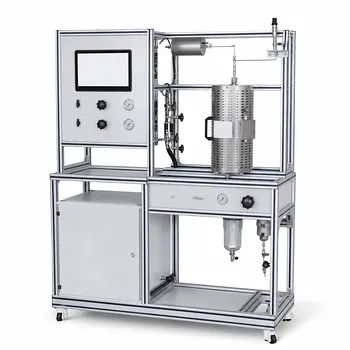
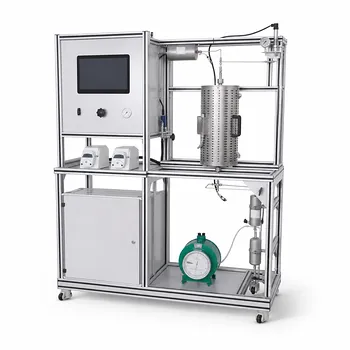
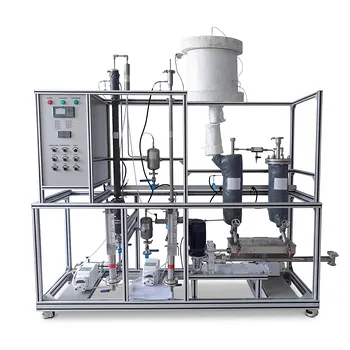
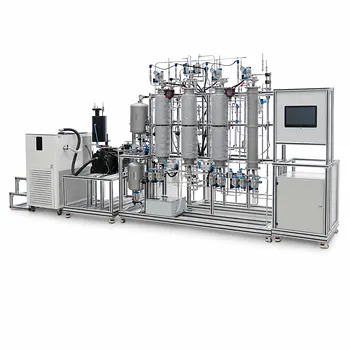
Pilot plants are the financial de-risking engine for bio-refinery scale-up. By generating real-world process data at an intermediate scale, they directly shrink the massive error bars on capital cost estimates. This empirical foundation reduces contingency funds, prevents multimillion-dollar equipment sizing errors, and provides the confidence needed to secure financing for full-scale facilities like ethanol production plants.
The core value of a bioprocess pilot plant is its ability to replace uncertain paper-based assumptions with validated mass and energy balances, proven yield parameters, and identified process bottlenecks. This data is the only reliable way to transform a preliminary cost estimate from a ±50% gamble into a definitive project budget with manageable risk.
How Pilot Plants Eliminate Cost Estimation Uncertainty
Preliminary capital cost estimates for bio-refineries often carry a -30% to +50% margin of error. This uncertainty stems from unknown process performance at scale. A pilot plant directly attacks the root of this problem by generating the precise engineering data that is missing from lab-scale studies.
Turning Lab-Scale Chemistry into Industrial-Scale Material Flows
Laboratory beakers and benchtop fermentors cannot simulate the complexities of 500,000-litre industrial tanks. Fluid dynamics, oxygen transfer, and nutrient distribution change dramatically with vessel geometry.
A pilot plant provides accurate mass and energy balances under realistic flow conditions. This data reveals the exact quantities of corn feed, water, enzymes, steam, and cooling water required per litre of ethanol. Without this measured data, equipment sizes and utility demands are based on educated guesses, inflating both the base cost and the required contingency.
Right-Sizing Equipment and Reducing Contingency Funds
When engineers cannot predict the actual heating and cooling loads or separation duties, they are forced to oversize heat exchangers, distillation columns, and holding tanks. This “safety factor” stacking rapidly escalates the total project cost.
Pilot plant runs produce data that allows for precise specification of each major equipment item. You can size a distillation column based on the actual vapour-liquid equilibrium data from your fermentation broth, not just literature correlations. This shrinks overdesign margins and directly reduces the capital cost estimate. The contingency fund—often a double-digit percentage of total investment to cover unknowns—can be cut dramatically.
Exposing Process Bottlenecks Before They Become Budget Line Items
A laboratory process rarely reveals where the first industrial-scale bottleneck will occur. Is it the enzyme addition rate, the heat removal capacity of the fermentor, or the throughput of the centrifugation step?
A pilot plant operates continuously or in realistic batch cycles, revealing exactly where the flow slows down. You might discover that a particular downstream filtration stage, for example, requires three times the capacity assumed from laboratory leaf tests. Identifying this during piloting allows you to re-design that unit operation and update the cost model before locking in the final equipment list. Catching such a bottleneck after construction would trigger catastrophic change orders.
Addressing the Deep-Seated Technical Risks of Bio-Refinery Scale-Up
Beyond cost estimation, pilot plants mitigate the technical risks that directly translate into financial loss if a commercial plant fails to start up or meet production targets.
Validating the Performance of Biocatalysts at Scale
Industrial fermentation uses whole-cell biocatalysts or enzymes that are sensitive to shear stress, temperature gradients, and pH fluctuations. A pilot bioreactor, with its controlled agitation and aeration, allows you to optimize fermentation parameters under conditions that mimic the large-scale environment.
You can measure the actual oxygen mass transfer coefficient (kLa) required to sustain your organism, confirm enzyme stability over extended runs, and verify that yields remain consistent when moving from a defined lab medium to a variable agricultural feedstock. This validation prevents the financial disaster of discovering that your engineered strain fails under production pressure.
Proving the Feasibility of Difficult Downstream Operations
Bio-refinery products like ethanol, succinic acid, or polylactic acid require multi-step downstream purification from a dilute, complex broth. Operations like continuous centrifugation, membrane filtration, and multistage liquid-liquid extraction pose significant scale-up risks.
Unit operations pilot plants allow you to isolate and test these high-risk steps at a meaningful scale. You can evaluate long-term material corrosion rates, validate the performance of continuous separation equipment, and develop failure scenarios. For example, testing a continuous filtration stage will reveal if the filter media blinds unexpectedly, allowing you to specify a backup system in the design rather than suffering prolonged downtime in the commercial plant.
De-Risking First-of-a-Kind and Non-Established Technologies
If your ethanol process uses a novel continuous saccharification reactor, a high-pressure fluidized bed, or an unfamiliar membrane separation, the scale-up risk skyrockets. Data shows that while a standard distillation column can be scaled up by factors of 1,000 or more, a fluidized bed reactor is limited to a factor of just 50 to 100.
A pilot plant provides the representative hydrodynamic and kinetic data needed to validate mathematical simulations for these unit operations. It becomes the testing ground where you can push the limits safely, identify weak points, and develop interlock logic for hazardous deviations—all before thousands of tons of steel are welded together.
Understanding the Trade-offs and Limitations
A pilot plant is not a magic wand. It reduces risk, but does not eliminate it.
Running a pilot plant is itself a capital and operating expense. You must weigh the cost of a multi-month pilot campaign against the potential reduction in contingency and the cost of a failed start-up. For a well-established, low-risk process, the cost of piloting may not be justified. However, for any bioprocess involving living organisms or new unit operations, the risk of skipping the pilot stage is asymmetric: the downside of failure vastly outweighs the cost of testing.
Additionally, a pilot plant cannot perfectly replicate every commercial-scale phenomenon. Recirculation patterns in a 100,000-litre tank will differ from a 1,000-litre pilot unit. The key is to design the pilot program to answer the specific, critical unknowns—not to build a perfect scale model. Focus your campaign on the highest-risk steps: the fermentation scale-up and the primary separation.
Making the Right Choice for Your Bio-Refinery Project
The decision to invest in a pilot plant program should be driven by your specific risk profile and technical maturity. Here is a framework for approaching it:
- If your project involves a proven, conventional ethanol process: A pilot plant may be unnecessary for core unit operations. Focus your investment on detailed engineering design, but consider a pilot test only for any novel feedstock pre-treatment or waste handling steps.
- If you are scaling a novel biocatalyst or a second-generation feedstock: A pilot plant is not optional—it is your primary risk management tool. Direct your budget toward a campaign that generates the full mass and energy balance and demonstrates stable operation for at least one week of continuous runs.
- If your primary concern is securing financing: The data from a well-designed pilot trial provides the defensible, data-backed cost estimate that investors and lenders demand. It moves your project from a speculative concept to a bankable asset.
By transforming bio-refinery scale-up from a guess into a measured, data-driven engineering exercise, the bioprocess pilot plant becomes the most cost-effective insurance policy you can buy.
Summary Table:
| Scale-Up Challenge | Pilot Plant Solution | Financial & Technical Impact |
|---|---|---|
| Cost Uncertainty (±50% error) | Validates mass & energy balances | Lowers contingency funds |
| Equipment Sizing Errors | Provides realistic flow data | Prevents costly overdesign |
| Biocatalyst Performance | Optimizes parameters (kLa, shear) | Ensures yield stability at scale |
| Downstream Bottlenecks | Tests filtration & separation units | Avoids post-construction changes |
Scale Up with Confidence with LABPARK
Transitioning from lab-scale concept to industrial production requires reliable, real-world data. LABPARK provides state-of-the-art Educational and Vocational Unit Operations Pilot Plants in chemical engineering, bioprocess & biotech, and environmental & water treatment. Custom-built for universities, research institutes, and enterprises, our systems help you validate process designs, train engineers, and eliminate capital risks before commercialization.
Ready to de-risk your next project? Contact LABPARK today to discover how our pilot solutions can secure your scale-up success.
Related Products
- Bio-fermentation Ethanol Production Practical Training Unit Operations Pilot Plant
- Green Anhydrous Ethanol Refining Practical Training Pilot Plant
- Green Anhydrous Ethanol Purification Extractive Distillation Unit Operations Training Pilot Plant
- Ethyl Acetate Synthesis Unit Operations Pilot Plant for Practical Training
- Carbon Dioxide Hydrogen Methanol Synthesis Educational Unit Operations Pilot Plant
People Also Ask
- Why Use PTFE & Hastelloy in Chemical Pilot Plants? Prevent Corrosion & Ensure Safety
- Why Compare Predicted and Experimental Excess Enthalpy? Key to Accurate Pilot Plant Scale-up
- Why is the chemical plant startup schedule crucial? De-risk scale-up with pilot plants.
- When to transition from PID to adaptive control in pilot plants? Key process indicators.
- Why must batch and fed-batch fermentation pilot plants be designed to accommodate changing rheological conditions?