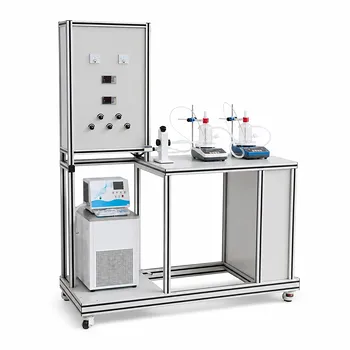
Proper sensor maintenance distinguishes a reliable pilot plant from a perpetual troubleshooting exercise. For pH composite electrodes, the glass membrane must be activated by a 24+ hour soak in 3 mol/L KCl, and response issues call for a brief 3–5 second treatment with 4 % HF or a rinse with 0.1 mol/L HCl. For conductivity cells, the platinized (platinum black) surface is sacred—it must never be wiped, touched, or mechanically scrubbed; use warm water with detergent for organic fouling and 10 % citric acid for inorganic scale, always verifying the cell constant against a 0.01 mol/L KCl standard (1408 μS/cm at 25.0 °C). These protocols, coupled with rigorous temperature control and high‑purity rinse water, preserve both measurement integrity and instrument life in an educational unit‑ops environment.
The core challenge is that every cleaning or storage shortcut that compromises the active sensor surface—whether the hydrated gel layer on a pH bulb or the high‑surface‑area platinum black on a conductivity probe—directly erodes accuracy and shortens the sensor’s life. True longevity comes from treating those delicate interfaces as untouchable and anchoring all maintenance around disciplined calibration and surface‑preservation chemistry.
The Unbreakable Rule: Preserve the Sensing Surface
A sensor’s accuracy and lifespan are governed by a microscopic, chemically active boundary. Once that interface is damaged, no amount of recalibration can fully restore trust in the data.
The pH Glass Membrane: Hydration is Everything
The pH-sensitive glass requires a stable, hydrated gel layer to exchange ions predictably. Activation is mandatory: a new or dry‑stored electrode must soak in 3 mol/L KCl for at least 24 hours before its first use. A quick dip is not enough. Never let it dehydrate in deionized water. Long‑term storage in pure water leaches ions from the gel layer, causing sluggish response and drifting potentials. Instead, keep the bulb in a 3 mol/L KCl storage solution or the manufacturer‑supplied soaking bottle. Sluggish response demands chemical rescue, not abrasion. If the membrane becomes coated or the response slows, a 3–5 second exposure to 4 % hydrofluoric acid etches away a microscopic layer of damaged glass. A rinse with 0.1 mol/L HCl can clean lighter contamination. Both treatments must be followed immediately by thorough rinsing and re‑soaking in KCl.
The Platinized Platinum Coating: An Elusive, Fragile Catalyst
Conductivity cells in pilot plants almost always use platinized electrodes to increase surface area and reduce polarization errors. That sooty‑black layer is the cell’s precision element. It is mechanically untouchable. Wiping, rubbing, or even aggressive liquid jets lift the platinized coating, permanently altering the cell constant. The moment the surface is touched, the probe becomes unusable—or, worse, usable but consistently wrong. Clean chemically, not physically. For organic films, immerse the tip in warm water with a mild detergent or alcohol and let the solution work. For hard‑water scale or inorganic salts, a 10 % citric acid soak dissolves deposits without attacking the platinum. Rinse copiously with high‑purity water afterward. Storage keeps the coating active. Unlike pH glass, platinized platinum electrodes should be stored in deionized water to prevent drying and cracking of the black layer.
Calibration as the Foundation of Accuracy
A sensor that hasn’t been properly calibrated is simply an expensive thermometer. In educational plants where probes see multiple operators and fluid streams, calibration is a constant negotiation between drift and trust.
pH Calibration: Positioning and Slope
Before any measurement run, a two‑ or three‑point calibration with fresh buffer solutions corrects the electrode’s offset (positioning) and slope (sensitivity). Immerse the entire measuring part—the glass bulb and the reference junction—fully in the buffer to avoid unstable liquid‑junction potentials. Rinse with deionized water and gently blot dry between buffers to prevent cross‑contamination. A single drop of pH‑4 buffer carried into a pH‑7 standard can shift the subsequent reading enough to mislead an entire student cohort. If the slope falls below 90 % of the theoretical Nernst value, the electrode needs cleaning or replacement, not just recalibration.
Conductivity Calibration: Verifying the Cell Constant
The cell constant drifts when the platinized surface changes, so periodic verification is non‑negotiable. Use a 0.01 mol/L KCl standard solution that delivers a known conductivity of 1408 μS/cm at 25.0 °C. Measure the solution, compare with the expected value, and adjust the meter’s cell constant accordingly. Temperature compensation is not optional. Conductivity rises roughly 1.9 % per Kelvin. If the standard and the sample aren’t at exactly the same temperature, a thermostatic bath or a properly calibrated temperature‑compensation probe must be used.
Controlling the Invisible Variables: Temperature and Water Purity
In a teaching pilot plant, the most overlooked sources of error live in the water supply and the ambient thermostat.
The 1.9 % Per Kelvin Trap
Even a 5 °C difference between a calibration standard and a process sample injects a roughly 10 % error into a conductivity reading. Always use a thermostatic bath when measuring samples without automatic temperature compensation. For probes with built‑in compensation, verify that the temperature sensor itself is calibrated and in good thermal contact with the liquid.
The Ghost Conductivity in Your DI Water
Standard deionized water from a lab cartridge is not pure enough for precise conductivity work. Dissolved atmospheric carbon dioxide and ammonia contribute a background conductivity that masks the true signal of a dilute process stream. Switch to high‑purity conductivity water—ideally, water redistilled in the presence of potassium permanganate—for standards, dilutions, and final rinses. Rinse the cell thoroughly with this water before every calibration point to eliminate phantom offsets.
Understanding the Trade‑offs and Pitfalls
Every protocol is a choice, and most pitfalls come from well‑intentioned shortcuts.
- HF etches glass, but it’s dangerous and aggressive. A 3–5 second dip works wonders, yet leaving the electrode in the acid for even 15 seconds can ruin the membrane geometry. 4 % HF should be used rarely and only by trained personnel with strict timing.
- Citric acid is gentle, but it’s slow. Heavy scale on conductivity cells may need a longer soak. Impatience often leads to rubbing, which destroys the cell constant.
- KCl storage preserves pH response, but it’s bothersome. A dried‑out electrode from neglect costs more than a properly stored one. If the storage bottle is empty, the commitment to refill it must be institutional, not individual.
- High‑purity water preparation adds complexity. Redistillation takes time and glassware. If the educational goal is simply to demonstrate trends, the extra effort may be justified only for final verification exercises. However, when accurate numerical values are required for grading or process control, cutting this corner undermines the entire sensor chain.
Making the Right Choice for Your Educational Plant
Different teaching objectives demand different maintenance rigor. Align your protocols with your primary goal.
- If your primary focus is steady‑state demonstrations with clear trends: Prioritize temperature control and consistent calibration. Even if water isn’t polished to the highest purity, a thermostatic bath and fresh KCl standards will keep the data directionally trustworthy.
- If your primary focus is hands‑on student training with many rotating users: Lock down the “no‑touch” rules for platinum black and glass bulbs. Create step‑by‑step, laminated checklists for electrode storage (3 mol/L KCl for pH, DI water for conductivity) and enforce them as lab‑entry requirements.
- If your primary focus is precise kinetic or thermodynamic data: Invest in high‑purity conductivity water and conduct pre‑experiment slope checks on pH electrodes. Schedule a weekly cell‑constant verification with 0.01 mol/L KCl as a non‑negotiable task.
- If your primary focus is maximizing sensor lifespan on a limited budget: Obsessive storage is your cheapest insurance. A pH electrode that lives in its soaking bottle will outlast one that dries on the bench by a factor of three or more, and a conductivity cell that is never wiped will hold its cell constant far longer.
Treat the sensing surface as a sacred, hydrated interface, and you turn routine maintenance into a quiet guarantee that every student experiment will read the truth.
Summary Table:
| Sensor Type | Critical Interface | Cleaning Protocol | Storage Medium |
|---|---|---|---|
| pH Sensor | Glass membrane (gel layer) | 0.1 mol/L HCl (light contamination) or 4% HF (3–5s for recovery) | 3 mol/L KCl solution |
| Conductivity Sensor | Platinized platinum (do not wipe/touch) | Warm water + detergent (organic) or 10% citric acid (scale) | Deionized (DI) water |
Keep your lab's student experiments running smoothly with reliable, precise process data. LABPARK provides robust Educational and Vocational Unit Operations Pilot Plants in chemical engineering, bioprocess & biotech, and environmental & water treatment for universities, research institutes, and enterprises. Our systems are engineered with easily maintainable sensor setups to simplify training and maximize equipment longevity.
Ready to upgrade your laboratory capabilities? Contact LABPARK today to consult with our technical experts!
Related Products
- Orifice and Venturi Flowmeter Calibration Educational Pilot Plant for Fluid Mechanics Laboratory
- Ion Exchange Water Purification Educational Pilot Plant for Engineering Unit Operations
- Centrifugal Pump Performance and Orifice Flowmeter Calibration Educational Pilot Plant
- Two Phase Flow Pattern Velocity Resistance Measurement Educational Pilot Plant
- Carbon Dioxide PVT Curve Determination Educational Unit Operations Pilot Plant
People Also Ask
- What is the difference between static and stagnation pressure? Master Pilot Plant Flow Measurement
- How is the hydrodynamic entrance length estimated for high-Re channel flows? Design accurate pilot-plant measurements
- What primary boundary conditions are applied at fluid-solid surfaces when conducting flow experiments on fluid mechanics educational pilot plants?
- How do pilot plants demonstrate siphon pressure variations? Visualizing Bernoulli's Energy Balance
- How does high-frequency pressure oscillation affect velocity distribution and boundary layer behavior? Discover Stokes-layer effects