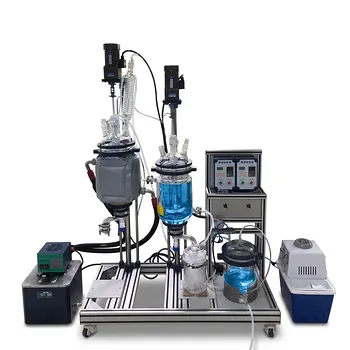
The key parameters are water solubility, soil or sludge sorption, treatment removal efficiency, and degradation rates. Environmental and water treatment pilot plants evaluate how a chemical disperses, partitions between environmental media, persists, and responds to purification processes. The main degradation measurements include aqueous hydrolysis and microbial breakdown.
Chemical risk screening depends on understanding both environmental fate and treatment behavior: whether a substance remains dissolved, binds to soil or sludge, survives treatment, or is transformed before reaching natural ecosystems.
What Pilot Plants Reveal About Chemical Fate
Water Solubility
Water solubility indicates how readily a chemical remains in the aqueous phase. Highly soluble substances may travel with wastewater or surface water, while poorly soluble substances may associate more strongly with suspended solids, sludge, soil, or sediment.
Pilot plants can assess whether treatment processes remove a chemical from water through biological conversion, adsorption, clarification, filtration, or another separation mechanism.
Soil and Sludge Sorption
Sorption describes the tendency of a chemical to bind to soil particles, suspended solids, or treatment sludge. This affects mobility, bioavailability, persistence, and the likely environmental compartment in which the substance will accumulate.
In wastewater treatment pilots, sorption results also help determine whether a chemical leaves the liquid stream with waste sludge rather than being chemically destroyed.
Wastewater Treatment Removal
Treatment removal effectiveness measures how much of the chemical is captured, transformed, or neutralized during a defined purification process. The result is usually evaluated by comparing influent and effluent concentrations.
This parameter is central to risk screening because a chemical that is not effectively removed may pass through a treatment plant and enter receiving waters.
How Persistence Is Evaluated
Aqueous Hydrolysis
Aqueous hydrolysis rates indicate how quickly a chemical reacts with water and breaks down into transformation products. Testing under relevant treatment conditions helps establish whether hydrolysis contributes meaningfully to contaminant reduction.
Hydrolysis is a transformation process rather than a strictly physicochemical property, but it is an important fate parameter in environmental screening.
Microbial Breakdown
Microbial degradation rates show how effectively biological treatment organisms transform or mineralize the chemical. Pilot plants can examine degradation under controlled biological operating conditions and changing influent loads.
The results help distinguish chemicals that are readily biodegradable from those that persist through conventional biological treatment.
Organic Contaminant Removal Kinetics
Removal kinetics describe the rate and progression of contaminant reduction through the treatment system. They can reveal whether removal is rapid, limited by microbial activity, dependent on residence time, or vulnerable to changing feed concentrations.
These measurements complement simple percentage-removal values by showing how process conditions influence treatment performance.
Which Pilot-Plant Conditions Affect the Results?
Hydraulic Retention Time
Hydraulic retention time (HRT) is the average time wastewater remains in a treatment unit. It affects the opportunity for sorption, hydrolysis, biological degradation, and other removal mechanisms to occur.
A chemical may appear adequately removed at a long HRT but persist when the plant receives higher flow or operates at a shorter retention time.
Mean Cell Residence Time
Mean cell residence time (MCRT), also called sludge age, measures how long biomass remains in a biological treatment system. It influences microbial population stability and the system's capacity to degrade slowly biodegradable chemicals.
Comparing HRT with MCRT helps identify whether a substance requires sustained biological activity for effective breakdown.
Sludge Recycle and Settling
Sludge recycle ratios and biomass settling efficiency affect the amount and quality of active biomass retained in the system. These factors can change both biological degradation capacity and the transfer of sorbed chemicals into sludge.
They are primarily operational parameters, but they are necessary for interpreting chemical removal results from biological pilot plants.
Membrane and Pretreatment Performance
In membrane treatment pilots, researchers may evaluate removal across microfiltration, ultrafiltration, and reverse osmosis systems. Feed composition, pressure, energy demand, pretreatment, post-treatment, and membrane fouling can all affect observed removal.
These conditions help determine whether removal reflects membrane separation, chemical transformation, fouling-related retention, or a combination of mechanisms.
Understanding the Trade-offs
Removal Does Not Always Mean Destruction
A high removal percentage does not necessarily mean that a chemical has been rendered harmless. The substance may have been transferred from water to sludge, concentrated in a membrane reject stream, or converted into persistent or toxic transformation products.
Risk screening should therefore distinguish phase transfer, chemical degradation, and true detoxification.
Pilot Results Are Process-Specific
Pilot-plant results depend on hydraulic conditions, biomass characteristics, influent composition, temperature, treatment configuration, and operating stability. Results from one treatment design should not automatically be generalized to every full-scale plant.
Testing under realistic ranges of operating conditions gives a more defensible estimate of expected performance.
Percentage Removal Can Hide Kinetic Limitations
A single removal percentage may conceal slow degradation, short-term adsorption, or performance loss during influent fluctuations. Measuring concentration over time and across operating conditions provides a clearer picture of persistence and process reliability.
Physicochemical Properties Are Only Part of the Screening
Solubility and sorption describe how a substance behaves, while hydrolysis and biodegradation describe how it changes over time. Toxicity, flammability, irritation, and other hazard characteristics may also be required for broader chemical management decisions, but they are separate from the core fate and treatment parameters.
Making the Right Choice for Your Goal
Pilot-plant testing should connect each parameter to the environmental decision it supports.
- If your primary focus is environmental mobility: Measure water solubility and soil, suspended-solid, and sludge sorption to determine where the chemical is likely to travel or accumulate.
- If your primary focus is treatment performance: Compare influent and effluent concentrations to quantify removal, while tracking sludge and concentrate streams to identify where the chemical goes.
- If your primary focus is persistence: Evaluate aqueous hydrolysis, microbial degradation, and removal kinetics under relevant retention times and biological conditions.
- If your primary focus is process reliability: Test HRT, MCRT, sludge recycle, settling, membrane fouling, and changing influent loads to determine whether removal remains stable.
- If your primary focus is ecological risk: Combine fate and treatment results with the chemical's toxicity and the potential hazard of its transformation products.
The most useful screening profile explains not only how much chemical disappears from wastewater, but also whether it is degraded, transferred, or likely to reach the environment.
Summary Table:
| Parameter | What it reveals | Why it matters |
|---|---|---|
| Water solubility | Whether a chemical remains in water or partitions to solids | Predicts mobility through wastewater and surface water |
| Soil and sludge sorption | How strongly a chemical binds to solids or sludge | Indicates accumulation, bioavailability, and phase transfer |
| Treatment removal efficiency | The percentage removed from influent to effluent | Shows whether contaminants may reach receiving waters |
| Aqueous hydrolysis | The rate of chemical breakdown in water | Helps assess transformation during treatment and environmental exposure |
| Microbial degradation | Biological transformation or mineralization rate | Indicates persistence through biological treatment |
| Removal kinetics | How removal changes over time and operating conditions | Reveals residence-time needs and process reliability |
| HRT and MCRT | Effects of hydraulic retention and sludge age | Helps interpret biological treatment performance |
| Sludge, membrane, and concentrate streams | Where removed chemicals are transferred | Distinguishes destruction from concentration or phase transfer |
Need reliable data on chemical fate and treatment performance? Contact LABPARK to discuss Educational and Vocational Unit Operations Pilot Plants for chemical engineering, bioprocess and biotech, and environmental and water treatment. LABPARK helps universities, research institutes, and enterprises evaluate solubility, sorption, biodegradation, hydrolysis, removal kinetics, membrane performance, sludge transfer, HRT, and MCRT under controlled, realistic operating conditions. Build stronger risk assessments, optimize treatment processes, and determine whether contaminants are degraded, transferred, or likely to enter the environment.
Related Products
- Electrochemical Water Treatment Educational Unit Operations Pilot Plant
- Thermal Desorption Exhaust Gas and Tail Water Treatment Educational Pilot Plant
- Ion Exchange Water Purification Educational Pilot Plant for Engineering Unit Operations
- Water Electrolysis Hydrogen Production and Storage Educational Pilot Plant
- Continuous Batch Extractive Distillation Educational Pilot Plant
People Also Ask
- What design features do educational electrochemical pilot plants utilize to manage gas liberation and water loss?
- How can unit operations pilot plants show lead-acid concentration vs state of charge? Real-time monitoring guide.
- How do educational electrochemical pilot plants scale up electrolysis? Master industrial engineering.
- How to Estimate Sulfate in Water Treatment Pilot Plant Deposits: Gravimetric Guide
- How can foaming be managed during steam generation experiments in water treatment unit operations pilot plants? Tips