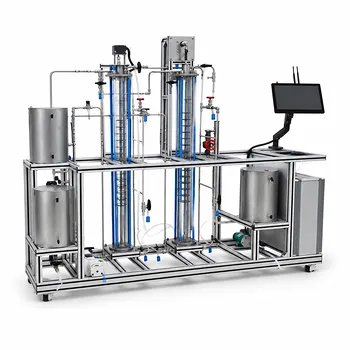
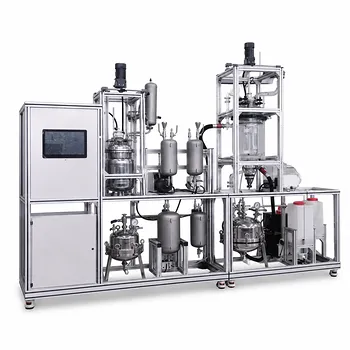
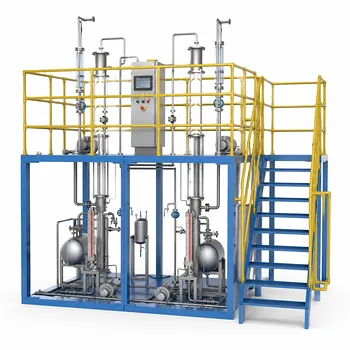
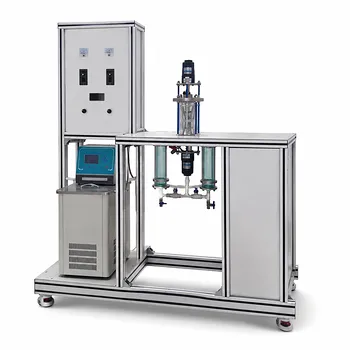
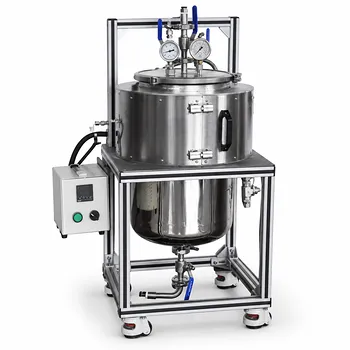
Solvent selection in liquid-liquid extraction isn't guesswork—it's a systematic, data-driven process. The liquid-liquid extraction (LLE) training system gives you a controlled pilot-scale environment to quantitatively validate every critical industrial solvent criterion. By running side-by-side experiments, you can directly measure a solvent’s selectivity and capacity, its solubility in the carrier phase, and practically assess its chemical stability, corrosivity, and phase separation behavior. You also gain crucial insight into the ease of solvent recovery and the inherent safety risks—all under realistic flowing conditions.
The true power of the LLE training system is that it transforms abstract solvent selection criteria into measurable, reproducible data. You can directly compare extraction efficiency, mass transfer, phase disengagement, and regeneration energy, enabling a balanced decision between performance, cost, and safety.
From Abstract Criteria to Empirical Evidence
Industrial solvent selection is never a single-variable problem. A solvent that promises exceptionally high capacity on paper might prove impossible to separate economically, or it might introduce unacceptable safety hazards in operation. The deep need, therefore, is not simply knowing the list of criteria—it is having a reliable method to quantify trade-offs under dynamic conditions that mirror a production plant.
The LLE pilot plant closes the gap between molecular properties and plant performance. You can systematically vary the solvent, adjust operating parameters, and immediately see the impact on solute recovery, phase clarity, and equipment behavior.
Why Static Property Tables Aren’t Enough
A handbook might tell you the solubility parameter or vapor pressure of a solvent. But it cannot tell you how that solvent will behave in a contactor where mass transfer, droplet coalescence, and potential emulsion formation occur simultaneously. The training system validates whether low solubility in the raffinate, for example, translates into acceptable product purity and minimal solvent inventory losses across multiple equilibrium stages.
Turning Solute Affinity into Measurable Metrics
Two of the most vital criteria—selectivity and capacity—become tangible when you run a test. You can sample both the extract and raffinate, generate a ternary phase diagram, and calculate the distribution coefficient (K_D) for your target solute. A solvent with high selectivity will preferentially pull the desired compound, maximizing concentration in the extract while leaving unwanted components behind. The pilot system lets you verify this selectivity not just at a single tie-line, but across a realistic operating band.
Validating Solute Affinity and Loading Limits
The primary reference emphasizes high selectivity and capacity. These are the economic drivers of any extraction process. Without them, your downstream separation and product purity suffer.
Measuring Distribution Coefficients and Selectivity
By running a steady-state experiment at a fixed solvent-to-feed ratio, you can measure the equilibrium concentrations and compute K_D values for both the target solute and potential impurities. The selectivity (α) between the solute and a key impurity is then simply the ratio of their distribution coefficients. A well-designed LLE system provides this direct validation, revealing whether a solvent truly discriminates as anticipated or if co-extraction of other compounds becomes a hidden cost.
Determining Carrying Capacity and Saturation Limits
Capacity is the maximum amount of solute a solvent can hold before equilibrium constrains further transfer. In the pilot plant, you can increase the feed concentration until the extraction curve plateaus. This directly identifies the practical loading limit. You can then compare this measured capacity to theoretical predictions, giving you confidence in scale-up calculations and solvent circulation rate requirements.
Minimizing Cross-Contamination and Solvent Losses
A solvent that dissolves significantly in the carrier phase is an invisible drain on profitability. It leads to product contamination, costly makeup solvent streams, and downstream purification headaches.
Solubility in the Carrier Phase (Raffinate)
The training system lets you quantify exactly how much solvent leaves with the raffinate. A simple mass balance across the unit, combined with analytical measurements, reveals the mutual solubility. A great industrial solvent shows near-zero mutual solubility in the carrier. The pilot plant validates this under real temperature and composition swings, not just at a single equilibrium state.
Impact on Product Purity and Operational Costs
Even a fraction of a percent of solvent loss per hour adds up to significant annual replenishment costs. More critically, it can force you to install an additional stripping column just to clean the raffinate. By monitoring solvent concentration in the raffinate over time, you can calculate the necessary solvent makeup rate and directly assess the economic feasibility of the chosen solvent for a large-scale application.
Ensuring Rapid and Reliable Phase Separation
The best extraction chemistry means nothing if the two liquid phases refuse to disengage. Industrial columns and mixer-settlers rely on density difference and favorable viscosity to keep throughput high and avoid flooding.
The Role of Density Difference and Viscosity
On the pilot unit, you can observe phase separation dynamics in real time. A solvent with a large enough density gap relative to the aqueous phase will settle quickly, allowing high flow rates and compact equipment. You can also validate whether a highly selective but viscous solvent creates excessive frictional pressure drop or retards droplet settling, limiting specific throughput.
Observing Emulsion Formation and Settling Rates
The supplementary references highlight that systems prone to emulsification demand specialized equipment like centrifugal extractors. The training system reveals this tendency early. You can test different agitation speeds and see at what point a stable rag layer forms at the interface. This directly informs the choice of contactor type (e.g., pulsed column vs. mixer-settler) and validates the solvent’s operational robustness—a criterion often overlooked until it causes plant shutdowns.
Chemical Stability, Corrosivity, and Solvent Recovery
A solvent that degrades over time or corrodes wetted materials turns a capex saving into a nightmare of maintenance and safety incidents.
Testing for Degradation and Corrosion
Extended runs on the pilot unit expose the solvent to temperature, light, and chemical impurities. You can periodically analyze the solvent purity to detect decomposition products or, in the case of ethers, dangerous peroxides. Coupons of common metals (stainless steel, Hastelloy) can be inserted into the circulation loop to monitor corrosion rates. A training system allows you to validate that a solvent’s chemical stability holds up over hundreds of operating hours, not just a single batch.
Validating Energy-Efficient Solvent Regeneration
The primary reference names ease of recovery and regeneration as a key criterion. On the pilot scale, this often means coupling the extract stream to a distillation or evaporation step. By measuring the boiling point, heat of vaporization, and any azeotrope behavior, you determine the energy cost to recycle the solvent. A solvent that requires an enormous amount of utility to regenerate may be technically effective but commercially unsound—a fact you can quantify directly through pilot plant data.
Balancing Performance with Process Safety
The supplementary references are unequivocal: a solvent’s toxicity, flammability, and explosion potential can overshadow its extraction prowess, especially in an educational or pilot-plant setting.
Toxicity and Flammability in Practice
You can evaluate safety in a controlled way by measuring a solvent’s vapor pressure at operating temperature and checking its flash point against process conditions. For instance, diethyl ether offers outstanding selectivity for many organic extractions, but its flash point of -45°C and tendency to form shock-sensitive peroxides make it a severe operational hazard. The training system proves that a solution like methyl tert-butyl ether (MTBE) or toluene can often achieve acceptable selectivity without the same level of risk.
Risk Assessment and Solvent Substitution
A core lesson validated on the training unit is the direct substitution of carcinogenic solvents like benzene with safer alternatives. Running parallel trials shows whether toluene or cyclohexane can deliver comparable distribution coefficients and purity while drastically reducing the occupational health burden. The pilot plant thus becomes a risk-assessment laboratory, allowing operators to quantify inventory toxicity potential and ensure all operating concentrations stay below hazardous exposure limits.
Understanding the Trade-offs You Can’t Afford to Ignore
No single solvent wins on every criterion. The LLE training system lays these conflicts bare, making the ranking objective rather than emotional.
- Selectivity vs. Safety: A highly effective solvent like diethyl ether or benzene may show excellent K_D values but introduce unacceptable fire and health hazards. The system forces you to measure the performance hit when switching to a safer but less polar or lower-affinity alternative.
- Capacity vs. Phase Separation: A solvent with high capacity for a polar solute (e.g., a large alcohol) might have a density so close to water that separation times explode, requiring oversized equipment. You can directly observe whether a marginal gain in loading justifies a doubling of the settler footprint.
- Stability vs. Regeneration Energy: A thermally stable, high-boiling solvent solves degradation issues but consumes massive energy during distillation recovery. The pilot plant enables a head-to-head comparison of total lifecycle cost.
- Equipment Selection is a Direct Consequence: The supplementary references note that settling characteristics dictate whether you need a simple column or a complex centrifugal contactor. A solvent that forms a stable emulsion in the pilot unit immediately flags the need for specialized, capital-intensive equipment—a cost that can be factored into the selection process.
How to Translate Pilot-Plant Learning into Industrial Decisions
The LLE training system is not just an academic tool; it’s a decision-support platform. Use it to match the solvent selection to your specific business or research goals.
- If your primary focus is maximizing solute recovery: Run experiments to measure the distribution coefficient and HETS for candidate solvents at various solvent-to-feed ratios, and select the one that reaches target purity with the fewest theoretical stages.
- If your primary focus is minimizing operational costs: Evaluate solvent inventory loss (raffinate solubility), regeneration energy requirements, and phase separation speed; the lowest lifecycle cost often comes from a moderately selective but easily recovered solvent.
- If your primary focus is safety and regulatory compliance: Screen solvents by running mini risk assessments on the unit—measure vapor concentrations, test for peroxide formation, and choose the substitution that maintains adequate extraction performance while eliminating toxic or highly flammable threats.
- If your primary focus is scale-up readiness: Use the pilot data to determine the required number of theoretical stages and observe emulsification tendencies; the solvent that gives predictable, non-emulsifying behavior across a range of industrial feed variations will save months of commissioning time.
Empower your selection process by leveraging the pilot plant not as a chemistry confirmation tool, but as a solvent elimination tool—one that exposes the hidden costs and risks no datasheet will ever reveal.
Summary Table:
| Solvent Criterion | How the LLE System Validates It | Industrial Significance |
|---|---|---|
| Selectivity & Capacity | Measures distribution coefficient ($K_D$) & loading limits under flow | Optimizes extraction stage design and solvent-to-feed ratios |
| Mutual Solubility | Quantifies solvent concentration in the raffinate phase | Determines downstream purification costs and solvent loss |
| Phase Separation | Evaluates settling rates and potential for emulsion formation | Dictates equipment selection (e.g., column vs. mixer-settler) |
| Stability & Recovery | Monitors thermal/chemical degradation and regeneration energy | Lowers maintenance overhead and utility consumption |
| Process Safety | Tests safer chemical substitutes (e.g., MTBE vs. diethyl ether) | Mitigates occupational health hazards and fire risks |
Accelerate Your Process Scale-Up with LABPARK
Ready to bridge the gap between laboratory chemistry and industrial-scale production? LABPARK provides state-of-the-art Educational and Vocational Unit Operations Pilot Plants in chemical engineering, bioprocess & biotech, and environmental & water treatment. Designed specifically for universities, research institutes, and enterprises, our systems enable hands-on validation of solvent selection, mass transfer, and process safety under realistic conditions.
Equip your facility with the tools to make data-driven engineering decisions. Contact LABPARK today to explore our pilot plant solutions.
Related Products
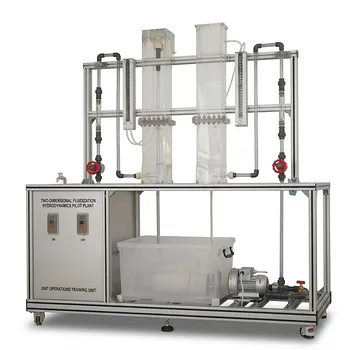
- Two-Dimensional Fluidization Hydrodynamics Educational Pilot Plant for Unit Operations Training
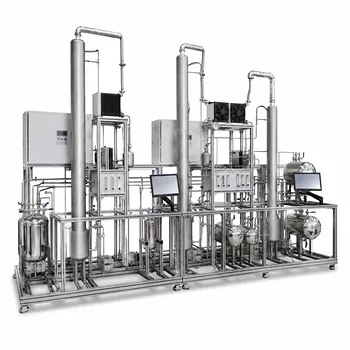
- Multi-Modal Distillation Unit Operations Training Pilot Plant
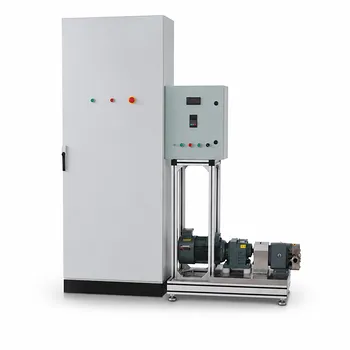
- Quantitative Dosing and Liquid Flow Control Educational Unit Operations Pilot Plant
- Green Anhydrous Ethanol Purification Extractive Distillation Unit Operations Training Pilot Plant
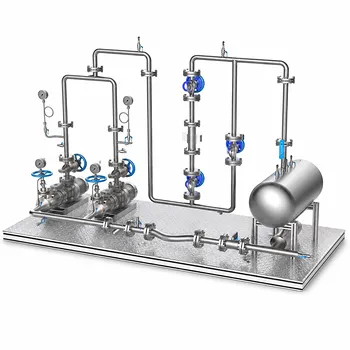
- Multi Pump Fluid Transport Process Piping Unit Operations Training Pilot Plant
People Also Ask
- What pressure drop characteristics should students & researchers monitor in a fluidization pilot plant?
- How does active time pulsing mixing enhance fluid homogenization? Configuration Guide for Educational Pilot Plants
- How can acoustic chemometrics prevent reactor clogging in educational fluidized bed pilot plants?
- What is the operational significance of solids feed rate on emulsion phase dynamics in fluidized bed pilot plants?
- Why is UB/Ui critical in fluidized bed pilot plant modeling? Master Gas-Solid Contact