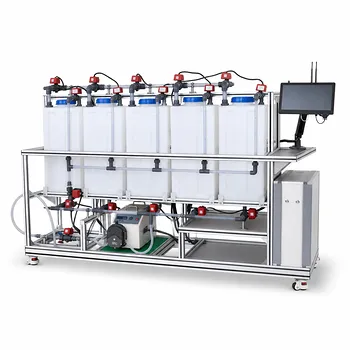
A teaching pilot plant for chemical precipitation isn’t just a scaled-down industrial unit—it’s a hands-on laboratory for physical chemistry. To effectively teach the stages of chemical precipitation and solids separation, the system must integrate precise reagent dosing, controlled rapid mixing, a dedicated flocculation zone, and a sedimentation tank for gravity separation. Equally important are real-time sensors for pH and turbidity, which allow students to observe the process dynamically and calculate removal efficiencies against theoretical solubility product constants ($K_{sp}$). Without these integrated features, the plant remains a black box; with them, it becomes a transparent, quantitative teaching tool.
A truly effective pilot plant bridges theory and practice by combining visual, controllable process stages with data acquisition. The must-have features—from dosing pumps to online monitors—enable students to witness precipitation, correlate observations with $K_{sp}$, and safely manage real chemical systems. The design must also anticipate errors, making safety interlocks and leak containment as critical as the process chemistry itself.
Dosing and Initial Mixing: Making Chemistry Controllable
Precise Chemical Dosing Pumps Drive Reproducibility
Chemical precipitation begins with stoichiometry. Students need to add reagents like barium chloride ($BaCl_2$) or sodium hydroxide ($NaOH$) in exact amounts to achieve target ion removal. Peristaltic or syringe pumps with variable speed control allow them to set molar ratios precisely, linking pump flow rates to theoretical precipitation requirements.
Without this precision, it’s impossible to demonstrate the relationship between reagent dose and residual ion concentration. A simple gravity-fed drip introduces too much variability, obscuring the very $K_{sp}$ principles you aim to teach.
A Rapid Mixing Chamber Ensures Instantaneous Dispersion
Immediately after dosing, the reagent must disperse uniformly into the bulk solution to avoid localized supersaturation. A flash mixer—typically a small, high-shear vessel—achieves this in seconds. This stage is crucial for teaching students that precipitation kinetics and nucleation depend on mixing intensity.
If the reagent is not dispersed quickly, localized high concentrations can produce amorphous precipitates or inconsistent particle sizes, making later separation stages unpredictable and muddying the data.
Reaction and Flocculation: From Ions to Particles
A Dedicated Reaction Vessel Allows the System to Reach Equilibrium
After rapid mixing, the stream needs quiet residence time for the precipitation reaction to go to completion. A gently stirred reaction tank provides this, letting the sparingly soluble salts (like $BaSO_4$ or metal hydroxides) form according to their $K_{sp}$. Students can sample here to measure remaining soluble ion concentrations and verify theoretical predictions.
This vessel also serves as a teaching point for the difference between reaction thermodynamics (what can precipitate) and kinetics (how fast it happens). Without a distinct reaction zone, precipitation overlaps with mixing, confusing cause and effect.
A Flocculation Stage Grows Settleable Solids
Many precipitates start as fine colloids that won’t settle. A flocculation basin with a slow, paddle-type agitator promotes gentle collisions, allowing particles to aggregate into larger, denser flocs. This step is essential for demonstrating the transition from chemical precipitation to physical solids separation.
Here, students can experiment with flocculant aids or simply observe how controlled turbulence improves downstream clarification. It directly connects the chemistry to the engineering goal of producing a clear effluent.
Solids Separation: Turning Principles into Observable Outcomes
A Sedimentation Tank Enables Gravity-Based Clarification
The most direct method to show solids-liquid separation is a quiescent sedimentation tank. As the floc-laden water passes through, particles settle to the bottom as sludge, while clarified water overflows at the top. This makes the concept of surface overflow rate tangible.
Students can measure the sludge blanket depth and correlate it to the flux of solids entering the tank. Combined with turbidity data from the clarified effluent, they can calculate percent removal and diagnose settling problems—key skills for process troubleshooting.
Optional Filtration Expands the Teaching Scope
For more complex separation sequences, like purifying crude salt, a pressure or vacuum filtration unit can follow sedimentation. This mirrors industrial practice where the mixed slurry from a sequential precipitation process (e.g., using $BaCl_2$, $NaOH$, and $Na_2CO_3$ followed by HCl neutralization) must be filtered before crystallization.
Including this stage reinforces that sedimentation alone rarely meets all discharge or reuse standards, and it teaches how different unit operations integrate into a complete treatment train.
Monitoring, Safety, and Integrated Controls
Online Sensors Close the Feedback Loop
A pilot plant without real-time data is like a chemistry lab without a balance. In-line pH probes and turbidity meters installed after the reaction and sedimentation stages let students watch the process unfold. They can plot pH vs. time during an acid neutralization step or track how changes in coagulant dose shift the final turbidity.
This immediacy transforms abstract $K_{sp}$ calculations into observed outcomes. The sensors also serve as teaching tools for process control—how to use measurement to adjust pump speeds or alarm setpoints.
Safety Interlocks and Leak Containment Prevent “Learning by Accident”
Handling chemicals like $BaCl_2$ (toxic) and $NaOH$ (corrosive) demands robust containment and automatic failsafes. The plant should include alarm-triggered pump shutoffs, high-level overflow sensors, and drip trays that channel any leaks to a central wastewater collection tank.
Environmental compliance, such as meeting Clean Water Act standards, isn’t a theoretical exercise here. Students see how engineering controls—not just personal protective equipment—manage process risks. This builds an instinct for safe design that’s as valuable as understanding $K_{sp}$.
Understanding the Trade-offs in Pilot Plant Design
Building a teaching pilot plant is a balance between educational depth and operational complexity. Recognizing trade-offs helps you select the right feature set.
Complexity vs. Conceptual Clarity
A multi-stage plant that replicates an entire brine purification flowsheet (sequential precipitation, filtration, neutralization) is ideal for advanced process engineering students. For an introductory chemistry class, however, too many unit operations could overwhelm. Start with the core chain—dosing, rapid mix, flocculation, sedimentation, and monitoring—and add modules later.
Cost and Maintenance vs. Data Resolution
High-accuracy pumps and continuous online sensors provide rich data but require regular calibration and budget. A more affordable approach uses periodic manual sampling with benchtop meters. The trade-off is lost data density and the inability to capture rapid dynamics. Choose the level that matches your learning objectives about real-time process behavior.
Flexibility vs. Reliability
Designing the plant with removable, reconfigurable modules (e.g., different impeller types, variable tank volumes) encourages experimentation but introduces more potential leak points and inconsistencies. A hard-piped system is more robust but limits the questions students can ask. Balance flexibility with the need for a safe, reliable setup that works every time.
Making the Right Choice for Your Educational Goals
The specific feature mix should reflect the concepts you most want students to internalize.
- If your primary focus is fundamental aquatic chemistry: Prioritize precise dosing pumps and a well-instrumented reaction vessel with pH and turbidity sensors. Let students tinker with stoichiometric ratios and measure equilibrium ion concentrations to calculate $K_{sp}$ values directly.
- If your primary focus is process engineering and design: Include the complete separation train—sedimentation plus filtration—and emphasize flocculation mechanics. Add variable-speed controls so students can optimize mixing intensity and residence times.
- If your primary focus is industrial safety and environmental compliance: Integrate full containment features, alarms, and interlock systems. Use the sequential precipitation example to simulate real-world process flowsheets where leak management is as critical as chemical dosing.
- If your primary focus is troubleshooting and operational skills: Design the plant with easy sampling points and clear sight glasses. Deliberately introduce common upsets (like overdosing or pH swings) and have students use the monitoring system to diagnose and correct them.
A well-designed pilot plant is more than a demonstration—it’s a platform for discovery. Equip it with the features that turn invisible ions into visible lessons, and you’ll teach not just the steps of precipitation, but the mindset of a process engineer.
Summary Table:
| Stage | Key Components | Educational Purpose |
|---|---|---|
| Dosing & Mixing | Peristaltic pumps & high-shear flash mixers | Teach stoichiometry, dosing kinetics, and chemical dispersion. |
| Reaction & Flocculation | Stirred tanks & slow-paddle agitators | Demonstrate chemical equilibrium ($K_{sp}$), particle growth, and aggregation. |
| Separation | Sedimentation tanks & vacuum filtration | Teach gravity settling dynamics, overflow rates, and multi-stage purification. |
| Controls & Safety | Online pH/turbidity sensors & safety interlocks | Enable real-time data acquisition and teach process risk management. |
Bring Hands-On Engineering to Life with LABPARK
Are you looking to bridge the gap between theory and practice in your laboratory? LABPARK provides state-of-the-art Educational and Vocational Unit Operations Pilot Plants designed specifically for universities, research institutes, and enterprises.
Our custom-built systems cover key fields including:
- Chemical Engineering (precipitation, crystallization, and reaction kinetics)
- Environmental & Water Treatment (sedimentation, filtration, and dosing controls)
- Bioprocess & Biotech
Equipped with real-time sensors, precise automation, and robust safety interlocks, LABPARK pilot plants offer students and researchers a safe, quantitative environment to master industrial processes.
Contact LABPARK today to discuss your lab's specifications and get a tailored solution!
Related Products
- Electrochemical Water Treatment Educational Unit Operations Pilot Plant
- Thermal Desorption Exhaust Gas and Tail Water Treatment Educational Pilot Plant
- Ion Exchange Water Purification Educational Pilot Plant for Engineering Unit Operations
- Alkaline Membrane Water Electrolysis Educational Pilot Plant Unit Operations Training System
- Water Electrolysis Hydrogen Production and Storage Educational Pilot Plant
People Also Ask
- What design features do educational electrochemical pilot plants utilize to manage gas liberation and water loss?
- How can unit operations pilot plants show lead-acid concentration vs state of charge? Real-time monitoring guide.
- How do educational electrochemical pilot plants scale up electrolysis? Master industrial engineering.
- How to Estimate Sulfate in Water Treatment Pilot Plant Deposits: Gravimetric Guide
- How can foaming be managed during steam generation experiments in water treatment unit operations pilot plants? Tips