The Transport Disengaging Height (TDH) is not a design luxury; it is the primary operational boundary that prevents your pilot plant from hemorrhaging bed material. In a fluidized bed unit operations pilot plant, the TDH is the critical vertical distance above the dense bed surface where the concentration of entrained solid particles finally stabilizes. Its significance is paramount because sustaining a freeboard height at or above the TDH allows larger particles to disengage from the gas stream and fall back to the bed, which minimizes material loss, drastically reduces the load on downstream cyclones, and ensures the stable, representative fluidization required for reliable research data.
A pilot plant lacking sufficient TDH acts like a separation column without a rectifying section—it fails at its core function. The TDH does not just prevent a mess in your catchpot; it is the geometric guardian of your solids inventory and the primary factor determining if your experimental data represents a steady state or a slow leak of bed material.
Deconstructing the Disengaging Zone
The freeboard region above a fluidized bed is a sorting column where gravity battles drag force. Understanding this separation is fundamental to pilot plant operation and vocational training.
The Battle Against Gravity
When a fluidized bed is operated, gas bubbles erupt at the bed surface, ejecting a broad spectrum of particles into the freeboard. The Transport Disengaging Height (TDH) defines the exact point where this violent ejection is neutralized. Below the TDH, the particle concentration gradually decreases as larger, denser particles—whose terminal settling velocity exceeds the superficial gas velocity—decelerate and fall back into the dense phase. Above the TDH, only the finest, lightest particles remain permanently entrained. This is the process of elutriation, where the escaping fines are lost from the system.
The Economics of Solid Carryover
Failing to account for TDH transforms a temporary entrainment event into a permanent solid loss. The primary reference emphasizes that insufficient height leads directly to material being "carried out by the gas stream" rather than returning to the bed. This constitutes a direct loss of expensive bed inventory or catalysts. Even more critically, this escaped material then becomes a massive operational burden on downstream equipment. By designing the column to meet or exceed the TDH, you ensure that only a minimal amount of the finest particles escape, maintaining a constant solids inventory and preventing the column from draining itself during a run.
The TDH’s Grip on System Design
The TDH is not just an operational metric; it is the decisive factor in pilot plant engineering. It dictates the physical geometry of the reactor and the specification of auxiliary equipment.
Dictating Reactor Freeboard Dimensions
The supplementary references make it explicitly clear that correctly determining the TDH immediately locks in the minimum required height of the freeboard column. In a pilot plant, this is non-negotiable. A reactor cannot be shorter than the TDH if stable operation is to be achieved. If the predicted TDH for your particle size distribution and gas velocity is 2 meters, the straight-side height of the column above the expanded bed must be at least 2 meters. Designing a shorter vessel guarantees that the particle concentration profile will never stabilize, creating an uncontrollable process.
Sizing Downstream Separation Equipment
The TDH directly dictates the load specification for particle capture systems. Cyclone separators and hot-gas filters are often specified based on the inlet dust loading. If you operate with a freeboard height below the TDH, your cyclones are forced to handle a huge mass flux of coarse particles that should never have left the dense bed. This often leads to cyclone erosion, chocking in diplegs, or blinding of filter elements. A proper TDH pre-separates the coarse material for free, allowing you to correctly size cyclones for the fine elutriable fraction only.
Understanding Operational Boundaries
The TDH exists within a larger operating window defined by the minimum fluidization velocity (umf) and the terminal velocity (ut) . The ratio of these velocities (ut/umf) gives the fluidization index. For fine, Geldart A-type particles, this index is wide, creating a large safe operating zone where the TDH can be managed. For large particles, this window shrinks dramatically. Operating near the terminal velocity while having insufficient TDH is a classic pilot plant failure mode where the bed inventory vanishes in minutes.
Understanding the Trade-offs
Trust is built on objectivity. While hitting the TDH is critical, there are practical downsides to a "bigger is always better" design philosophy.
The Capital Cost Penalty
The most significant trade-off is physical. A very tall vessel dramatically increases the cost of structural support, especially if the pilot plant is housed indoors with limited ceiling height. Adding unnecessary freeboard beyond the TDH yields diminishing returns on particle retention while inflating the budget.
Thermal and Residence Time Effects
In reactive systems, an excessively tall freeboard zone above the TDH is not inert space. It represents a region of dilute-phase flow where fine particles can undergo secondary gas-phase reactions at long residence times. This can lead to coking, unwanted side reactions, or heat loss that complicates the interpretation of the bed’s kinetic data. The goal is sufficient height to stabilize concentration, not a vacuum column.
Making the Right Choice for Your Goal
Your optimal approach to TDH depends entirely on what you are trying to achieve in the pilot plant, from industrial research to vocational education.
- If your primary focus is experimental repeatability and mass balance: Ensure your freeboard height strictly exceeds the calculated TDH. A closed-system mass balance is impossible if coarse material is constantly bleeding out of the bed into the cyclone.
- If your primary focus is scale-up risk assessment: Deliberately operate slightly below the TDH to study the failure mode. This teaches operators how to recognize entrainment floods and validates the efficiency of your secondary capture systems under worst-case scenarios.
- If your primary focus is vocational training and education: Use the TDH as a dynamic teaching tool. Vary the gas velocity and measure the static pressure profile in the freeboard, allowing students to visualize the boundary between the dense and dilute phases and link the abstract concept of terminal velocity to a tangible bed height.
Mastering the Transport Disengaging Height transforms a fluidized bed from a source of frustration into a controlled physical model, proving that in gas-solid systems, free space is the most valuable operational asset you can design.
Summary Table:
| Operational Zone | Particle Concentration | Downstream Equipment Load | Recommendation |
|---|---|---|---|
| Below TDH | High & unstable; coarse particles ejected | Extremely high; risks cyclone choking & erosion | Avoid; leads to rapid material loss |
| At/Above TDH | Stabilized; only fine particles entrained | Minimal & manageable; optimal dust loading | Target operating design for reliable data |
| Excessive Height | Stabilized but long gas residence times | Low; potential for secondary reactions | Avoid; increases capital cost unnecessarily |
Optimize Your Process Engineering Lab with LABPARK
Are you looking to equip your laboratory or training center with reliable, high-performance pilot plants? LABPARK provides state-of-the-art Educational and Vocational Unit Operations Pilot Plants in chemical engineering, bioprocess & biotech, and environmental & water treatment for universities, research institutes, and enterprises.
Whether you need to teach complex fluidization principles or conduct advanced scale-up research, our systems are engineered to deliver precise control, stable operations, and accurate data.
Ready to elevate your training and research capabilities? Contact our engineering experts today to find the ideal pilot plant solution for your facility!
Related Products
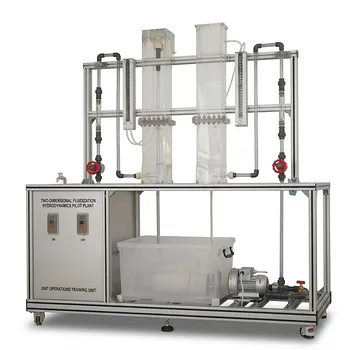
- Two-Dimensional Fluidization Hydrodynamics Educational Pilot Plant for Unit Operations Training
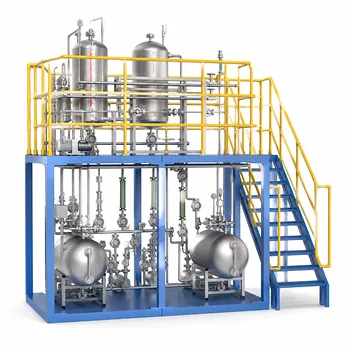
- Multi-Reactor Educational Pilot Plant for Reaction Engineering Unit Operations
- Fluidized Bed Gas Solid Catalytic Reaction Educational Pilot Plant
- Multi Functional Catalytic Reaction and Reactor Evaluation Educational Unit Operations Pilot Plant
- Multi-Functional Drying Educational Unit Operations Pilot Plant
People Also Ask
- What pressure drop characteristics should students & researchers monitor in a fluidization pilot plant?
- How does active time pulsing mixing enhance fluid homogenization? Configuration Guide for Educational Pilot Plants
- How can acoustic chemometrics prevent reactor clogging in educational fluidized bed pilot plants?
- What is the operational significance of solids feed rate on emulsion phase dynamics in fluidized bed pilot plants?
- How can inline NIR & microwave sensors study fluidized bed drying dynamics? A Real-Time Guide