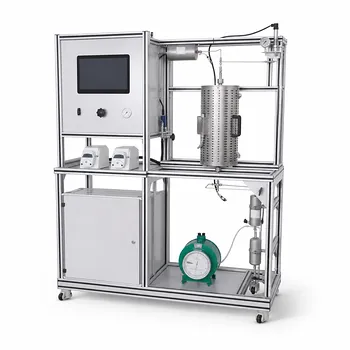
Your packed column’s physical height is meaningless without HETP. The Height Equivalent to a Theoretical Plate is the essential conversion factor that transforms a theoretical process design into a working pilot plant. It quantifies how efficiently your packing transfers mass between vapor and liquid, dictating the actual column height you need to achieve a target separation. In a pilot plant, HETP isn’t merely a design parameter—it’s a real-time performance indicator that reveals the health of your column and guides scale-up.
HETP is the critical link between a distillation column’s thermodynamic requirements and its physical construction. In a pilot plant, measuring and controlling HETP under varying conditions is the key to optimizing packing performance, diagnosing operational issues, and generating reliable scale-up data.
Why HETP is the Cornerstone of Packed Column Piloting
Bridging Theory and Reality
Process simulation tells you how many theoretical stages you need, but it doesn’t tell you how tall to make the column.
HETP bridges that gap.
A theoretical stage is an idealized equilibrium contact.
The HETP is the actual packed height that delivers that same separation power.
Packing Height = Number of Theoretical Stages × HETP
This simple equation turns a thermodynamic requirement into a physical dimension.
Without a reliable HETP value, you cannot size the column correctly, and your pilot plant risks being too short to meet purity targets or wastefully tall.
The Direct Measure of Mass Transfer Efficiency
HETP isn’t just a conversion factor; it’s a direct metric of packing efficiency.
A lower HETP means the packing is more efficient—less height is needed for each equilibrium step.
In pilot plants, you evaluate different packings by comparing their HETP values under identical operating conditions.
Typical HETP ranges illustrate this:
- 25 mm (1 in) Pall ring: ~0.4–0.5 m
- 38 mm (1.5 in) Pall ring: ~0.6–0.75 m
- 1‑inch metal ring (50% tray efficiency equivalent): ~0.64 m (2.1 ft)
Smaller packings usually yield lower HETP, but at the cost of higher pressure drop.
This trade-off is central to column configuration.
Decoding HETP: What It Tells You During Operation
A Diagnostic Tool for Column Health
In a properly instrumented pilot plant, measured HETP is far more valuable than a catalog number.
By sampling the composition at the top and bottom and calculating the actual number of theoretical stages (via McCabe‑Thiele or VLE calculations), you can back‑calculate the operating HETP.
If the measured HETP is significantly higher than the manufacturer’s quoted value, something is wrong.
Common culprits include:
- Liquid maldistribution (channeling or wall flow)
- Insufficient liquid load (dry spots on the packing)
- Flooding or foaming (excessive back‑mixing)
HETP thus acts as a sensitive diagnostic, alerting you to hydrodynamics issues that compromise separation performance.
The Visual Feedback Loop in a Training Environment
Educational pilot plants thrive on the HETP concept.
Students can deliberately change the reflux ratio, boil‑up rate, or vapor velocity and directly observe how HETP responds.
This transforms abstract mass‑transfer theory into visual, measurable reality.
A single experiment that plots HETP against vapor load teaches more about column capacity and efficiency than hours of classroom slides.
That hands‑on feedback is the core purpose of vocational distillation units.
Configuring Your Pilot Plant: The Practical Math Behind HETP
Calculating the Required Packing Height
The design process begins with a known HETP for your chosen packing under expected conditions.
Multiply the required number of theoretical stages by the HETP, then always add a safety margin.
Example: If your separation demands 10 theoretical stages and you select 1‑inch metal rings with a design HETP of 0.64 m (2.1 ft), the minimum packed height is 6.4 m (21 ft).
Adding a 6‑inch (0.15 m) safety margin increases the total to about 6.55 m.
For pilot‑scale columns, this conservative approach ensures that inevitable inefficiencies don’t prevent you from meeting the separation target.
How to Determine HETP Experimentally
A well‑designed pilot plant enables you to measure your own HETP.
You need:
- Sampling ports (or in‑line sensors) to obtain top and bottom liquid‑phase compositions.
- Accurate measurement of the reflux ratio and feed thermal state.
- Pressure and temperature profiles along the column.
Using these data, apply the McCabe‑Thiele graphical method or a rigorous simulator to find the number of theoretical stages actually achieved.
HETP = Measured packed height / Determined theoretical stages.
This empirical approach yields a performance benchmark specific to your physical system, packing, and operating window—critical for scale‑up.
Mastering the Factors That Control HETP
Liquid Distribution: The Overlooked Hero
HETP soars when liquid isn’t spread evenly across the packing.
Wall‑side channeling and dry cones create bypass paths where no mass transfer occurs.
If your packed bed exceeds 9 meters or 20 theoretical stages, you must install liquid redistributors.
In pilot plants, even a small misalignment of the distributor can double the apparent HETP.
The Pressure Paradox: Vacuum vs. High Pressure
Operating pressure has a non‑linear effect on HETP.
Vacuum operation (below 10 kPa): HETP tends to increase because the reduced liquid flow rate fails to fully wet the packing.
High‑pressure operation: Increased vapor density promotes back‑mixing and can cause foaming, also pushing HETP up.
There is an optimal pressure window where HETP is minimized; pilot‑plant experiments can pinpoint it.
The Crucial Minimum Wetting Rate
Every packing requires a minimum liquid load to maintain an active mass‑transfer film.
Drop below this Q_min, and dry spots form instantly, causing HETP to skyrocket.
Material matters greatly:
- Rough ceramic: Q_min ≈ 0.49 m³/(m²·h)
- Surface‑treated stainless steel: ≈ 0.98 m³/(m²·h)
- Polypropylene: ≈ 3.91 m³/(m²·h)
In a pilot plant, checking that your liquid flow rate stays above Q_min is non‑negotiable.
Understanding the Trade-offs
When Lower HETP isn’t Always Better
A packing with an ultra‑low HETP seems ideal—until you consider pressure drop.
Very small packings achieve spectacular efficiency but choke early.
They create high gas‑phase resistance, which can push the column into flooding at moderate vapor loads.
In pilot‑scale configuration, you must balance HETP against capacity. A slightly higher HETP with a far lower pressure drop often wins for overall operability.
The Pitfall of a Static HETP Value
One of the most common mistakes is treating HETP as a fixed property.
HETP is a dynamic performance indicator, not a constant.
It varies with boil‑up rate, reflux ratio, fluid composition, and even age of the packing.
Relying on a single catalog HETP without verifying it under your actual conditions can lead to undersized columns or failed scale‑up.
A well‑run pilot plant tests HETP across the whole operating envelope.
Making the Right Choice for Your Pilot Plant Goal
- If your primary focus is educational demonstration: Choose a packing with a moderate, well‑documented HETP that visibly responds to reflux and boil‑up changes. This allows students to see the immediate effect on separation and grasp the mass‑transfer principles hands‑on.
- If your primary focus is research and efficiency characterization: Outfit the column with precise flow controllers, multiple sampling points, and redistributors. Measure HETP as a function of vapor velocity, liquid load, and pressure to map the full performance landscape of the packing.
- If your primary focus is scale‑up validation: Generate HETP data under conditions that mirror the intended full‑scale operation (similar liquid rates and pressures). Use that empirical value plus a safety margin to size the commercial column, thereby de‑risking the investment.
When you treat HETP not as a number to look up but as a critical behavior to measure and control, your pilot plant becomes a powerful engine for process understanding, optimization, and successful scale‑up.
Summary Table:
| Parameter / Metric | Typical Value / Range | Operational Significance |
|---|---|---|
| 25 mm (1 in) Pall Ring HETP | 0.4–0.5 m | High separation efficiency; moderate pressure drop. |
| 38 mm (1.5 in) Pall Ring HETP | 0.6–0.75 m | Higher throughput; requires greater column height. |
| Ceramic Wetting Rate ($Q_{min}$) | ~0.49 m³/(m²·h) | Low minimum liquid load required to wet packing. |
| Stainless Steel Wetting Rate ($Q_{min}$) | ~0.98 m³/(m²·h) | Moderate wetting rate; standard industrial benchmark. |
| Polypropylene Wetting Rate ($Q_{min}$) | ~3.91 m³/(m²·h) | High liquid load required to prevent dry spots and HETP spikes. |
Optimize Your Mass Transfer Research and Training with LABPARK
Ready to turn distillation theory into practice? LABPARK designs and manufactures premium Educational and Vocational Unit Operations Pilot Plants in chemical engineering, bioprocess & biotech, and environmental & water treatment.
We help universities, research institutes, and enterprises build highly instrumented, reliable systems that make measuring HETP, evaluating packing efficiency, and validating scale-up data seamless and precise.
Contact LABPARK today to find the ideal pilot plant configuration for your facility!
Related Products
- Packed Bed Absorption Educational Unit Operations Pilot Plant
- High-Gravity Emulsification and Mass Transfer Educational Pilot Plant
- Micro-Scale Gas-Solid Catalytic Reaction Educational Pilot Plant
- Continuous Sieve-Plate Distillation Pilot Plant for Unit Operations Laboratory Education
- Absorption and Desorption Educational Unit Operations Pilot Plant
People Also Ask
- How Do Flow Regimes Transition in Packed Bed Pilot Plants? Key Scale-up Insights
- How does reactant concentration determine absorption column control? Gas-film vs. dual-film.
- How is the packing height of an absorption column calculated? Master HTU & NTU Concepts
- How does static vs. operating holdup affect pilot plant calibration? Avoid Critical Scale-Up Errors
- Why is counter-current flow selected for gas absorption? Maximize Pilot Plant Efficiency