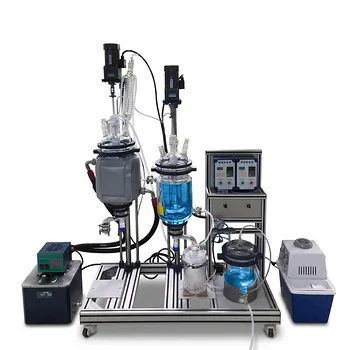
The defining characteristic of a successful crystallization process isn't just about making crystals; it's about precisely controlling the thermodynamic "fuel" that builds them. In a pilot plant, controlling supersaturation—the condition where a solution holds more dissolved solute than its thermodynamic equilibrium allows—is the single most critical factor that determines whether you produce a high-purity, easily processable product or a useless mass of impure, filter-clogging fines.
The core challenge is managing a fundamental trade-off: supersaturation is the essential driving force for crystal formation, but too much of it triggers an explosive, uncontrolled nucleation event. In a crystallization pilot plant, management is achieved not through a single magic setting, but by choreographing a delicate balance of precise thermal control, strategic seeding, and maintaining a pristine operating environment, all to keep the system within a narrow, "metastable" sweet spot.
The Fundamental Role of Supersaturation: The Engine with No Brakes
Understanding the Metastable Zone
You cannot form a crystal from a stable solution. Supersaturation is the required driving force that pushes solute molecules out of solution to form a solid phase. Think of it like a car's accelerator. A controlled press makes the car move. Without it, you're parked. However, there's a critical zone of operation: the metastable zone. Within this zone, the solution is supersaturated, and existing crystals can grow, but new crystals will not spontaneously form.
Your primary operational goal is to stay inside this zone.
The Competing Mechanisms: Growth vs. Nucleation
Supersaturation is consumed by two competing kinetic processes:
- Crystal Growth: The desired process where solute molecules orderly deposit onto existing crystal surfaces. This builds size and purity.
- Nucleation: The creation of brand-new, tiny crystal nuclei. This generates new particles.
The level of supersaturation dictates which process dominates. High supersaturation favors rapid nucleation; low, controlled supersaturation favors growth.
Key Strategies for Managing Supersaturation in a Pilot Plant
The Primary Tool: Precise Cooling Rate Control
In cooling crystallization, temperature is the master control for solubility. As you lower the temperature, the solution's capacity to hold solute drops, generating supersaturation. A cooling rate that is too aggressive is the most common cause of process failure.
- If you cool faster than the existing crystals can absorb the solute via growth, supersaturation spikes.
- A rapid spike pushes the concentration out of the metastable zone, triggering a flood of spontaneous secondary nucleation.
In a pilot plant, this is managed by programming specific temperature trajectories using high-precision jacketed reactors and PLC systems. The cooling curve is not always linear; it's often gentler at the start when the crystal surface area for growth is low.
The Critical Metric: Under-Cooling (ΔT)
Operators translate the abstract concept of supersaturation into a measurable, controllable variable: the degree of under-cooling (ΔT), the difference between the saturation temperature and the actual solution temperature. This metric directly predicts crystal quality:
- Low Under-Cooling (e.g., ΔT < 4°C): This represents a low-supersaturation regime. The outcome is the growth of high-quality, transparent, well-formed crystals with minimal new nucleation.
- Excessive Under-Cooling (e.g., ΔT ≥ 8°C): This represents a high-supersaturation regime. It triggers catastrophic, uncontrolled nucleation. The result is dendritic or needle-like growth, crystal fragmentation, and a product that is difficult to filter and dry.
The pilot plant’s high-precision temperature control jackets are essential to maintain the system within the required, often very narrow, ∆T window.
The Secondary Controls: Seeding and Purity
While temperature is primary, two other factors are crucial for managing supersaturation:
- Strategic Seeding: Adding a precise mass of seed crystals of a known size distribution is a critical management tool. Seeding provides a controlled surface area for growth, allowing supersaturation to be consumed in a predesigned way. This prevents supersaturation from building to the point of spontaneous, uncontrolled nucleation. The seeds act as a "relief valve," directing the supersaturation toward the desired growth mechanism.
- Maintaining a Pristine System: Uncontrolled supersaturation is highly sensitive to foreign particles. Dust or other particulate matter can act as accidental nuclei. This random "dust-induced nucleation" can cause sudden nucleation events, completely overriding a carefully planned cooling curve. Clean solutions are a foundational control strategy.
Understanding the Trade-offs and Pitfalls
The Danger of "Playing it Too Safe"
While high supersaturation is dangerous, the solution is not to eliminate it. Without sufficient supersaturation, you have zero driving force, leading to unacceptably long batch times and no process efficiency. The art is operating persistently and safely within the metastable zone.
The "Oiling Out" Trap
A specific failure mode occurs when supersaturation is generated too rapidly at certain concentrations. Instead of crystallizing, the solute can crash out of solution as a secondary liquid phase—a phenomenon called oiling out. This traps impurities and ruins the product. A controlled, growth-dominated trajectory prevents this by ensuring supersaturation is consumed by the crystal lattice, not by a chaotic phase separation.
Nucleation is Unavoidable, but Manageable
The goal isn't to prevent all nucleation. Secondary nucleation from crystal-crystal collisions or shear from agitation is inevitable. The objective is to manage the balance so that growth is the dominant, process-defining kinetic pathway, superseding the catastrophic, uncontrolled primary nucleation that destroys batch-to-batch consistency.
Making the Right Choice for Your Goal
By bridging lab-scale chemistry with industrial-scale processing, a pilot plant allows you to define your operational strategy based on your end goal.
- If your primary focus is product purity and crystal quality: Prioritize slow cooling rates and low under-cooling (ΔT) to operate deep within the metastable zone. Use a heavy, high-quality seed load to direct almost all supersaturation towards controlled growth on clean crystal surfaces.
- If your primary focus is process robustness and repeatability: Implement a model-driven seeding and cooling curve. Use the pilot plant's PLC system to automate the temperature trajectory, eliminating operator variability. Focus on systematically measuring and controlling for secondary nucleation effects from agitation.
- If your primary focus is preventing downstream processing bottlenecks: Focus single-mindedly on a growth-dominated process to avoid the fine particles from excessive nucleation. Large, uniform crystals, produced by controlling supersaturation for growth, are non-negotiable for efficient filtration, washing, and drying.
Controlling supersaturation is not a single step but the central governing principle of crystallization; mastering it in a pilot plant transforms the process from a chaotic precipitation into a designed, predictable unit operation.
Summary Table:
| Control Parameter | Target/Range | Primary Impact on Crystallization |
|---|---|---|
| Low Under-Cooling (ΔT) | < 4°C | Promotes high-quality, pure crystal growth |
| High Under-Cooling (ΔT) | ≥ 8°C | Triggers rapid, uncontrolled nucleation & fines |
| Strategic Seeding | Controlled surface area | Prevents spontaneous, chaotic nucleation events |
| Cooling Rate | Programmed trajectories | Avoids sudden supersaturation spikes in the jacketed reactor |
Scale Up Your Crystallization Process with LABPARK
At LABPARK, we design and deliver advanced Educational and Vocational Unit Operations Pilot Plants spanning chemical engineering, bioprocess & biotech, and environmental & water treatment. Built for universities, research institutes, and enterprises, our pilot plants provide the high-precision temperature control and automation needed to master critical crystallization parameters.
Enhance your research, training, or process development—contact our technical experts today to find the perfect pilot plant configuration for your facility!
Related Products
- Multi Functional Membrane Crystallization Educational Unit Operations Pilot Plant
- Potassium Salt Thermal Dissolution and Crystallization Separation Educational Unit Operations Pilot Plant
- Multi-Functional Special Distillation Educational Pilot Plant
- Ethyl Acetate Synthesis Unit Operations Pilot Plant for Practical Training
- Multi-Modal Distillation Unit Operations Training Pilot Plant
People Also Ask
- Why is precise temperature control critical in crystallization pilot plants? Key to Scale-Up Success
- Control Crystallization Pilot Plant Secondary Nucleation: 4 Key Adjustments
- What key factors should be considered when configuring a crystallization unit operations pilot plant?
- What are the benefits of integrating online PAT tools like ATR-FTIR into crystallization unit operations pilot plants?
- How to use crystallization pilot plant agitation speed to identify diffusion vs reaction growth?