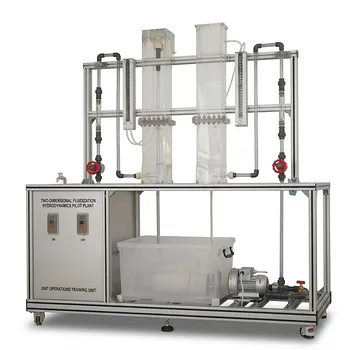
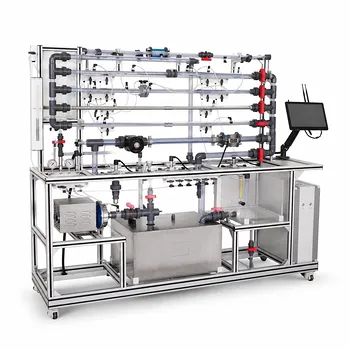
Integrating preheaters, reactors, flash drums, and distillation columns is fundamentally about creating a miniature industrial plant—one where students confront the messy, interconnected reality of real chemical processes. Rather than studying each unit in isolation, a linked train forces them to see how a pressure drop in the preheater cascades into the reactor, how recycle loops alter steady-state conditions, and how the control of a flash drum’s level directly impacts the distillation column’s feed composition. In short, the role is to bridge the gap between theoretical knowledge of individual operations and the system-level thinking required in professional practice.
While a single-unit experiment teaches what a component does, an integrated pilot plant teaches how processes behave when everything interacts. It transforms learning from memorizing equipment functions to managing mass and energy flows across a whole system, which is the core skill of a process engineer.
The Deep Need: Why a Single Unit Experiment Isn’t Enough
The Illusion of the Steady-State Component
In a typical unit operations lab, a distillation column or a reactor is studied under carefully controlled, isolated conditions. Feed compositions, flow rates, and utility supplies are fixed by the instructor or a local controller.
This approach is excellent for understanding the first principles of that specific equipment. However, it creates a false sense of simplicity.
In a real plant, no piece of equipment exists in a vacuum. The “input” to the reactor is the “output” of a preheater, and any disturbance in that preheater’s performance instantly becomes a disturbance in the reactor—often with delayed, non-linear effects that cannot be taught from a textbook diagram.
The Hidden Skill: Dynamic System Perception
The crucial skill a process engineer develops is the ability to “feel” how a change in one place propagates through an entire flowsheet. This perception cannot be built by analyzing a pump curve or a McCabe-Thiele diagram alone.
It requires hands-on experience with mass and energy recycle loops, where a small accumulation of an intermediate in a surge tank can slowly shift the whole plant toward an unforeseen operating point. An integrated pilot plant is the only safe, scalable way to compress years of industrial trial-and-error into a few lab sessions.
The Anatomy of an Integrated Pilot Plant
The Essential Unit Operations
A typical integrated educational plant mirrors the skeleton of many oil, gas, and chemical processes. The preheater conditions the feedstock, demonstrating the critical principle of bringing a stream to the exact thermal or phase state required for a downstream reaction or separation.
The reactor then performs the chemical conversion, its performance directly tied to the outlet temperature of that preheater. The flash drum provides a brutal, low-cost initial separation, often vaporizing light components or unreacted material. Finally, the distillation column performs the high-resolution purification, but now it must handle a feed whose flow and composition are a function of everything that happened upstream.
Closing the Loop: The Power of Recycle
The real educational value explodes when a recycle stream is added. In an integrated setup, the unreacted material leaving the flash drum or the column overhead is sent back to the reactor.
Students then face a non-intuitive truth: the concentration of inert components can build up over time, shifting the reactor’s kinetics. They must learn to balance the purge rate against yield loss, experiencing firsthand a classical optimization problem that sits at the heart of every petrochemical plant.
System-Wide Control: A Single Brain for Many Muscles
In a standalone experiment, a PID controller on a water heater is a trivial exercise. In an integrated train, the control challenge becomes multi-variable and deeply coupled.
A student might try to manage the flash drum level by manipulating the bottoms valve. But that changes the downstream column feed rate, which the column’s own control system then tries to correct, potentially conflicting with the drum’s loop. This teaches the irreducible complexity of plant-wide control strategies far more effectively than any simulation.
Comparing Integration Approaches
The Modular Train: Learning by Linking
The primary reference’s approach of linking discrete units—preheater, reactor, flash drum, column—excells at teaching the logistics of material movement. It makes every intermediate stream visible, measurable, and controllable.
Students physically trace a liquid from a heating bath, through a catalytic bed, into a vapor-liquid separator, and finally into a packed or trayed column. Each boundary is a lesson in how energy and composition are handed off from one step to the next. This modularity makes the system’s thermodynamics transparent.
Reactive Distillation: Learning by Intensification
The supplementary reference highlights a different kind of integration: combining reaction and separation within a single column. This configuration teaches a more subtle chemical engineering truth—that process boundaries are design choices, not natural laws.
By removing a product directly from a reaction zone, reactive distillation shatters equilibrium conversion limits. It uses the heat of reaction to drive the separation, demonstrating energy “integration” as an inherent physical phenomenon rather than an external heat-exchange network. Pilot-scale setups running MTBE or ethyl acetate synthesis condense lessons in thermodynamics, kinetics, and process intensification into a single, elegant piece of equipment.
The Educational Mirror
Both approaches serve a profound role. The modular train teaches system sequencing and dynamic coupling.
Reactive distillation teaches functional merging and constraint breaking. A complete engineering education needs both: one to understand how a plant’s components fight or harmonize, and the other to understand that a “reactor” and a “column” never had to be separate boxes in the first place.
Understanding the Trade-offs
The Hidden Cost of Integration
A fully integrated pilot plant is a maintenance and diagnostic nightmare compared to standalone units. When the product is off-spec, the root cause could be anywhere from a fouled preheater to a weeping distillation tray.
This diagnostic ambiguity is realistic, but it can overwhelm students who haven’t yet mastered the individual units. There’s a real pedagogic risk: the student learns to tune controllers by feel without understanding the underlying physics, because the system is too complex to mentally simulate.
Safety Amplification
Interconnected equipment multiplies the consequences of a mistake. A runaway reaction in the reactor doesn’t just ruin a single experiment; it can over-pressurize the flash drum and send contaminated vapor into a column not rated for that surge.
Integrated laboratory training therefore demands a much higher level of procedural discipline and safety system design (relief valves, check valves, interlock logic) than a simple heat exchanger test rig. This is invaluable training for the real world, but it consumes significant instruction time and budget.
Scalability vs. Authenticity
A small-scale modular train often operates with such low flow rates that its dynamics are dominated by heat loss to the environment, not process kinetics. This can create a disconnect from industrial reality.
Conversely, the reactive distillation unit, while physically compact, accurately reflects a genuine industrial intensification strategy. The choice between authentic fluid dynamics (best seen in larger, modular loops) and authentic process intensification concepts (best seen in reactive columns) must align with the curriculum’s goal.
Making the Right Choice for Your Goal
Based on whether your educational program prioritizes operational reality or process design philosophy, the integration strategy should shift.
- If your primary focus is plant operations and control dynamics: Use a modular, multi-unit pilot plant with clear recycle loops. Ensure every duct, valve, and sensor is visible, forcing students to confront the physical reality of delay, accumulation, and coupling.
- If your primary focus is advanced process synthesis and energy efficiency: Incorporate a reactive distillation or similar intensified unit. It forces a mindset shift from “what equipment do I have” to “what function do I need, and can one vessel perform two roles.”
- If your primary focus is foundational mass and energy balances: Start with the modular train, but keep the recycle loop closed for initial experiments to avoid distracting complexities. Introduce the recycle only after students can accurately close a steady-state balance across the entire system.
Ultimately, the role of integrating these unit operations is not to teach any single piece of hardware. It is to make the plant—the living, breathing, interconnected system—the true subject of study.
Summary Table:
| Integration Approach | Key Mechanism | Primary Educational Value | Best Suited For |
|---|---|---|---|
| Modular Integrated Train | Linking discrete units (preheater, reactor, flash drum, column) | Teaches material logistics, recycle loops, and system-wide control coupling | Programs focusing on plant operations, dynamics, and control |
| Reactive Distillation | Combining reaction and separation in a single column | Teaches process intensification, equilibrium breaking, and energy integration | Programs focusing on advanced process synthesis and green chemistry |
Bring Industrial-Scale Realism to Your Laboratory with LABPARK
Ready to transform theoretical lessons into hands-on mastery? LABPARK provides state-of-the-art Educational and Vocational Unit Operations Pilot Plants in chemical engineering, bioprocess & biotech, and environmental & water treatment.
We help universities, research institutes, and enterprises design and implement highly integrated training systems—from modular pilot loops to reactive distillation setups—ensuring your students and operators gain the system-level engineering skills required in professional practice.
Contact LABPARK today to discuss your curriculum requirements and get a customized pilot plant solution!
Related Products
- General Purpose Cosmetics Production Unit Operations Training Pilot Plant
- Multi Pump Fluid Transport Process Piping Unit Operations Training Pilot Plant
- Multi-Functional Drying Educational Unit Operations Pilot Plant
- Fixed-Bed Chemical Reaction and Gas Dust Tar Removal Unit Operations Pilot Plant
- 100L Continuous Loop Hydrogenation Educational Unit Operations Pilot Plant
People Also Ask
- Why is the chemical plant startup schedule crucial? De-risk scale-up with pilot plants.
- How do deviations in estimating latent heat impact pilot plant thermal systems? Avoid hardware mis-sizing.
- When to transition from PID to adaptive control in pilot plants? Key process indicators.
- Why Compare Predicted and Experimental Excess Enthalpy? Key to Accurate Pilot Plant Scale-up
- How to study gasification in pilot plants? Compare exit gas composition & efficiency