Knowledge Chemical Engineering Education What is the physical significance of the vena contracta? Master Fluid Flow Calibration
Author avatar

Tech Team · LABPARK

Updated 5 days ago

What is the physical significance of the vena contracta? Master Fluid Flow Calibration


The vena contracta represents the point of ultimate aerodynamic efficiency in a constricted flow, and ignoring it turns a precision calibration experiment into a guess. It is the physical location downstream of an orifice where the fluid streamlines become parallel, causing the jet to narrow to its minimum cross-sectional area and achieve maximum velocity. In educational calibration experiments, it must be accounted for because the jet’s actual flow area is physically smaller than the geometric hole drilled in the plate. If a student assumes the flow simply fills the orifice, they will systematically overestimate the discharge rate, rendering their calculated coefficient of discharge fundamentally incorrect.

The vena contracta is the physical proof that fluid inertia cannot bend at a sharp 90-degree angle. The core educational lesson is that a geometric measurement (the orifice diameter) is not a fluid dynamic measurement. Calibration is the act of reconciling these two conflicting realities.

The Physical Nature of the Contraction

The vena contracta exists due to the inertia of the fluid particles. Understanding this physical behavior is the first step to understanding why discharge coefficients exist at all.

Why the Streamlines Can’t Turn Instantly

As fluid approaches a sharp-edged orifice from a reservoir, it converges radially from all directions toward the opening. The fluid particles possess mass and velocity; they cannot execute a perfect, sharp right-angle turn at the edge of the hole.

This momentum causes the flow to continue converging, or "necking down," even after it passes through the geometric plane of the orifice. The point where this inward momentum finally dissipates and the streamlines become parallel is the vena contracta.

The Analogy of a Crowd

Think of a crowd of runners funneling from a wide field into a narrow gate. They don't run perfectly straight along the fence line the instant they pass the gate posts. Their forward inertia carries them inward, and the tightest packing of bodies occurs a few steps beyond the gate.

That point of tightest packing is analogous to the vena contracta. The actual width of the dense runner stream is smaller than the gate itself.

The Calibration Error: Why Theory Fails Reality

The primary reference confirms a critical gap: the flow area A is not the orifice area Ao. Students must bridge this gap with empirical coefficients to avoid a fundamental calculation error.

The Overestimation Problem

The volumetric flow rate Q is the product of area and velocity. If a student uses the geometric area of the hole (Ao) but the fluid is actually flowing through a much smaller area (A at the vena contracta), their velocity calculations become physically meaningless.

They will record a pressure drop, calculate a theoretical velocity, and multiply it by an area that is too large. The resulting "calculated" flow rate will be significantly higher than what a weigh tank or flow meter actually captures downstream.

Introducing the Coefficient of Contraction (Cc)

To correct for this physical narrowing, we use the coefficient of contraction. The relationship Cc = A / Ao is not just an abstract ratio; it is a quantifiable property of the orifice geometry.

A sharp-edged orifice will have a Cc of approximately 0.61 to 0.64. This means the actual flowing jet at the vena contracta has less than two-thirds the area of the hole itself. Ignoring this factor doesn't just introduce a small error—it introduces a catastrophic one.

Understanding the Trade-offs

While pinpointing the vena contracta is essential for theoretical accuracy, its location and measurement introduce practical difficulties that highlight the value of a compound discharge coefficient.

The Measurement Challenge

The exact location of the vena contracta varies with the flow rate and the orifice geometry. It typically occurs a short distance downstream, roughly half the orifice diameter away from the plate.

In a teaching lab, physically inserting a probe to measure the jet diameter exactly at this narrowest point is intrusive and disturbs the very flow you are trying to measure.

Why We Use the Compound Coefficient (Cd)

This physical measurement difficulty is precisely why engineers and students rely on the coefficient of discharge (Cd). Cd is a composite term that hides the complexity by combining the contraction effect (Cc) with the velocity reduction caused by friction (Cv).

Rather than trying to physically measure the vena contracta diameter for every single data point, the calibration experiment flips the equation. Students use the known Q (from a weigh tank) and the known Ao to back-calculate Cd. This single value quantifies the total deviation caused by the vena contracta and viscous effects combined.

Making the Right Choice for Your Goal

A student’s approach to the vena contracta depends entirely on whether the experiment aims to prove a physical principle or to simply characterize a flow meter.

  • If your primary focus is visualizing fluid dynamics: Set up a shadowgraph or use a clear section of pipe. Measure the physical contraction and observe how the vena contracta moves as the pressure ratio changes. This proves the existence of the phenomenon.
  • If your primary focus is calibrating a flow measurement device: Do not attempt to measure the vena contracta directly. Use a calibrated gravimetric standard (weight/time) downstream. Compare this true flow rate against the theoretical flow rate calculated using the geometric orifice area to derive the Cd. The difference between theory and reality is the physical signature of the vena contracta, captured in a single coefficient.

By acknowledging that the fluid jet narrows, you are not just correcting a math error; you are learning that a flow measurement is never a purely geometric problem, but a negotiation between physics and hardware.

Summary Table:

Parameter Symbol Physical Meaning Typical Value (Sharp-Edged Orifice)
Vena Contracta - Point downstream where flow streamlines become parallel and jet area is minimized ~0.5 times the orifice diameter downstream
Coefficient of Contraction Cc Ratio of the minimum jet area (A) to the geometric orifice area (Ao) 0.61 - 0.64
Coefficient of Velocity Cv Ratio of actual jet velocity to theoretical frictionless velocity 0.97 - 0.99
Coefficient of Discharge Cd Combined correction factor representing actual vs. theoretical flow (Cd = Cc × Cv) 0.60 - 0.62

Equip Your Lab for Fluid Dynamics Excellence with LABPARK

Precise fluid calibration experiments require high-quality, reliable hardware. LABPARK provides state-of-the-art Educational and Vocational Unit Operations Pilot Plants in chemical engineering, bioprocess & biotech, and environmental & water treatment designed specifically for universities, research institutes, and enterprises.

Our systems help students bridge the gap between theoretical physics and real-world calibration by visualizing complex phenomena like the vena contracta.

Ready to upgrade your laboratory training capabilities? Contact us today to discover the perfect pilot plant for your curriculum!

Related Products

People Also Ask

Related Products

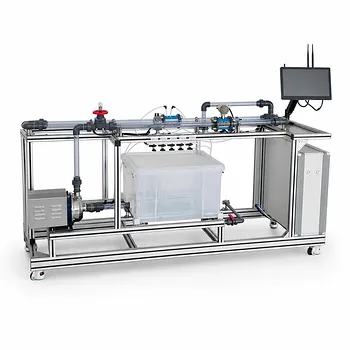
Orifice and Venturi Flowmeter Calibration Educational Pilot Plant for Fluid Mechanics Laboratory

Orifice and Venturi Flowmeter Calibration Educational Pilot Plant for Fluid Mechanics Laboratory

Enhance fluid dynamics education with the Orifice and Venturi Flowmeter Calibration Educational Unit Operations Pilot Plant, featuring transparent orifice and Venturi meters, industrial sensors, touchscreen interface for real-time data analysis and automatic coefficient calculations in engineering student laboratories.

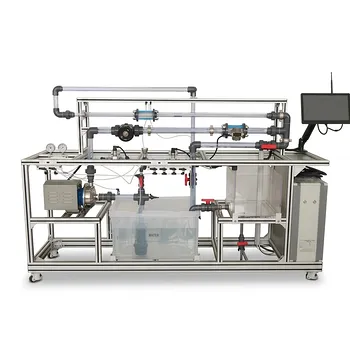
Centrifugal Pump Performance and Orifice Flowmeter Calibration Educational Pilot Plant

Centrifugal Pump Performance and Orifice Flowmeter Calibration Educational Pilot Plant

This versatile educational pilot plant enables engineering students to conduct centrifugal pump performance tests, orifice flowmeter calibration, and fluid mechanics experiments using a transparent flow loop, industrial HMI, and 3D virtual simulation for a comprehensive hands-on learning experience.

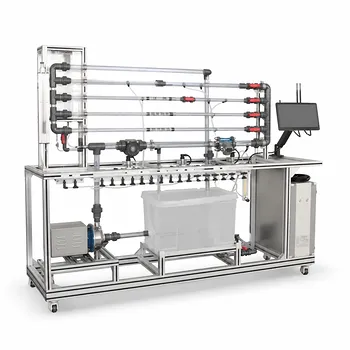
Fluid Friction Resistance Determination Educational Unit Operations Pilot Plant

Fluid Friction Resistance Determination Educational Unit Operations Pilot Plant

Engineered bench-scale system for university engineering labs. Provides hands-on fluid mechanics experience: quantitative energy loss analysis, flow regime observation, friction coefficient determination. Features four-point pressure measurement, transparent sections, industrial touchscreen PLC, 3D virtual simulation. Ideal for chemical, mechanical, civil engineering.

Fluid Reynolds Number Demonstration Educational Unit Operations Pilot Plant

Fluid Reynolds Number Demonstration Educational Unit Operations Pilot Plant

Visual fluid dynamics pilot plant for engineering education demonstrating laminar, transitional, and turbulent flow regimes via dye injection in circular conduits. Verifies Reynolds number transitions and teaches dimensionless analysis. Modular design with digital simulation software enhances hands-on learning

Quantitative Dosing and Liquid Flow Control Educational Unit Operations Pilot Plant

Quantitative Dosing and Liquid Flow Control Educational Unit Operations Pilot Plant

Explore industrial fluid transport and automated process control with this quantitative dosing and liquid flow control educational pilot plant, featuring local and remote control cabinets, variable speed metering pump, high-precision flow sensors, and PLC-based SCADA integration for engineering students.

Two Phase Flow Pattern Velocity Resistance Measurement Educational Pilot Plant

Two Phase Flow Pattern Velocity Resistance Measurement Educational Pilot Plant

Benchtop educational pilot plant for university labs studying gas-liquid two-phase flow patterns, velocity, and resistance across circular, square, and rectangular conduits. Features 15.6-inch touchscreen, 5G connectivity, differential pressure sensors, safe water-air operation. Supports chemical engineering curricula.

Throttling Effect Determination Educational Unit Operations Pilot Plant

Throttling Effect Determination Educational Unit Operations Pilot Plant

Investigate the Joule-Thomson throttling effect with this educational unit operations pilot plant. Designed for engineering students, it enables hands-on comparative analysis of adiabatic gas expansion using precise process control, interactive digital interface, and eco-friendly operation, ensuring safe repeatable thermodynamic experiments.

Comprehensive Fluid Mechanics Educational Unit Operations Pilot Plant

Comprehensive Fluid Mechanics Educational Unit Operations Pilot Plant

Hands-on fluid mechanics pilot plant for engineering education covering over 13 principles including pipe flow, minor losses, flowmeter calibration, and pump performance with industrial-grade components, smooth and rough piping, venturi and orifice flowmeters, and centrifugal pump testing and analysis.

Liquid-Liquid Mass Transfer Coefficient Determination Educational Pilot Plant

Liquid-Liquid Mass Transfer Coefficient Determination Educational Pilot Plant

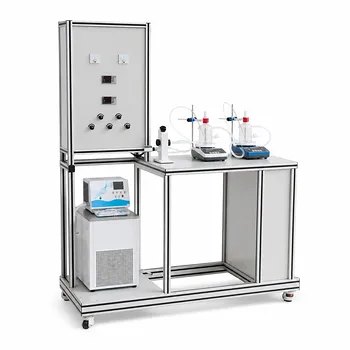
This bench-scale educational pilot plant for liquid-liquid mass transfer coefficient determination offers precise control of phase boundary, temperature, and agitation, enabling hands-on study of transport phenomena and unit operations in chemical engineering labs for teaching.

Ternary Liquid-Liquid Equilibrium Educational Pilot Plant

Ternary Liquid-Liquid Equilibrium Educational Pilot Plant

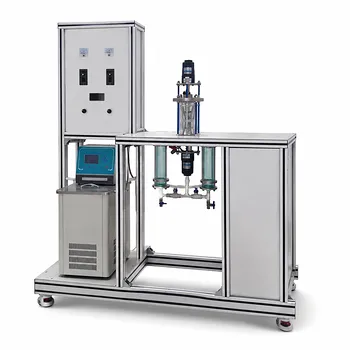
An integrated laboratory training system for engineering students to determine ternary liquid-liquid equilibrium data, construct phase diagrams, and gain hands-on experience with industrial instrumentation, including Abbe refractometer and magnetic stirrers, for precise data acquisition and curriculum-aligned experiments.

Shell and Tube Heat Exchanger Heat Transfer Coefficient Determination Educational Pilot Plant

Shell and Tube Heat Exchanger Heat Transfer Coefficient Determination Educational Pilot Plant

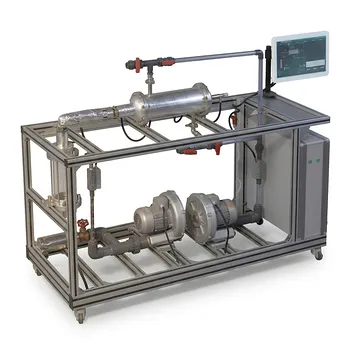
LABPARK's shell and tube heat exchanger pilot plant enables students to investigate heat transfer coefficients, LMTD, co-current vs counter-current flow, bridging theory and industrial practice. Customizable for chemical, mechanical, environmental engineering curricula. Ideal for unit operations and process engineering labs.

Multi-Functional Special Distillation Educational Pilot Plant

Multi-Functional Special Distillation Educational Pilot Plant

Versatile multi-functional special distillation pilot plant for chemical engineering education. Supports continuous, vacuum, azeotropic, reactive, extractive distillation. Transparent glass columns enable real-time visual observation of hydrodynamics and separation processes.

Constant Pressure Filtration Educational Unit Operations Pilot Plant

Constant Pressure Filtration Educational Unit Operations Pilot Plant

Hands-on educational pilot plant for constant pressure filtration. Classic plate and frame filter press allows students to study kinetics, determine specific cake resistance, perform cake washing and evaluate washing rates. Ideal for chemical engineering curriculum. Mobile, customizable, safety-compliant design.

Two-Dimensional Fluidization Hydrodynamics Educational Pilot Plant for Unit Operations Training

Two-Dimensional Fluidization Hydrodynamics Educational Pilot Plant for Unit Operations Training

Explore gas-solid and liquid-solid fluidization hydrodynamics with our transparent 2D educational pilot plant. Ideal for chemical engineering unit operations labs, it demonstrates fixed to fluidized bed regimes, measures pressure drop, and integrates QR-code digital learning for enhanced student training.

Circulating Wind Tunnel Drying and Convective Heat Transfer Coefficient Determination Educational Pilot Plant

Circulating Wind Tunnel Drying and Convective Heat Transfer Coefficient Determination Educational Pilot Plant

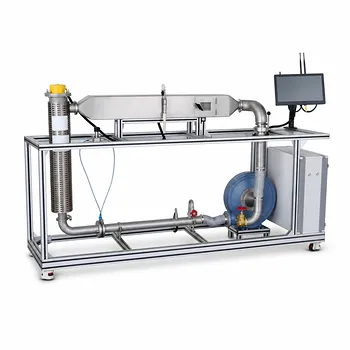
This educational pilot plant enables engineering students to study convective drying, air-water vapor systems, and heat transfer by determining drying curves, drying rate curves, and convective heat transfer coefficients under variable conditions.

Cavitation Phenomenon Demonstration and Analysis Educational Unit Operations Pilot Plant

Cavitation Phenomenon Demonstration and Analysis Educational Unit Operations Pilot Plant

Advanced educational pilot plant for demonstrating and analyzing cavitation phenomena in fluid systems. Features a transparent acrylic Venturi test section, high-precision pressure and flow sensors, digital data acquisition, and integrated safety relief valves for engineering curricula.

Tubular Reactor Flow Characteristics Determination Educational Unit Operations Pilot Plant

Tubular Reactor Flow Characteristics Determination Educational Unit Operations Pilot Plant

Educational pilot plant for investigating tubular reactor flow characteristics and residence time distribution Features adjustable recycle for plug flow and backmixing studies industrial touchscreen interface and real-time data acquisition Ideal for chemical engineering unit operations laboratory training and education

Fluidized Bed Gas Solid Catalytic Reaction Educational Pilot Plant

Fluidized Bed Gas Solid Catalytic Reaction Educational Pilot Plant

Our educational fluidized bed gas-solid catalytic reaction pilot plant is ideal for chemical engineering labs. Students study fluidization dynamics, catalyst evaluation, and process control hands-on. Features include a customizable reactor, touchscreen HMI, and safety interlocks for safe, curriculum-aligned experiments.

Fluid Transport and Piping Dynamics Practical Training Unit Operations Pilot Plant

Fluid Transport and Piping Dynamics Practical Training Unit Operations Pilot Plant

This industrial-scale fluid transport and piping dynamics training pilot plant provides essential hands-on experience with pump operations, cavitation, piping resistance, flow metering, and process control. Customizable to fit specific academic engineering curricula.

Chemical Pipeline Assembly and Fluid Transport Practical Training Unit Operations Pilot Plant

Chemical Pipeline Assembly and Fluid Transport Practical Training Unit Operations Pilot Plant

Integrated skid-mounted engineering training pilot plant for university labs offers hands-on experience in chemical pipeline assembly, fluid transport, centrifugal pump operation, and pressure testing. Customizable system bridges academic theory and industrial practice with digital pre-lab resources and comprehensive tools.


Leave Your Message