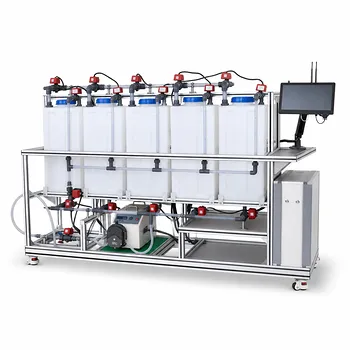
COD and TOD measurements quantify the oxygen demand of wastewater and help pilot-plant operators determine whether a treatment process is working. COD provides a rapid estimate of the oxygen needed to chemically oxidize mainly organic pollutants, while TOD estimates the oxygen required to completely oxidize both organic and inorganic oxidizable substances. Together, they support treatment-performance evaluation, process design, aeration and chemical-demand calculations, and discharge-control decisions.
COD is the practical, rapid indicator of chemically oxidizable wastewater strength; TOD provides a broader measure of the sample’s total oxidation burden. Comparing influent and effluent values shows how effectively a pilot process removes oxidizable pollutants and helps translate test results into full-scale design decisions.
Why Oxygen-Demand Measurements Matter
They quantify wastewater strength
Wastewater contains compounds that consume oxygen during oxidation. Measuring COD and TOD converts that pollutant load into a common oxygen-equivalent quantity, usually reported as milligrams of oxygen per liter, or mg/L.
This gives operators a standardized way to compare different wastewater streams, operating conditions, and treatment stages.
They reveal treatment performance
Operators measure oxygen-demand values at the pilot plant influent, intermediate stages, and final effluent. The reduction between sampling points indicates how much oxidizable material the process has removed.
A typical removal calculation is:
[ \text{Removal efficiency (%)} = \frac{\text{Influent concentration} - \text{Effluent concentration}} {\text{Influent concentration}} \times 100 ]
The result helps assess whether biological reactors, chemical oxidation units, filtration systems, or combined processes are achieving their intended function.
They support process optimization
Pilot plants allow researchers to vary aeration rate, hydraulic retention time, organic loading, chemical dose, and operating conditions. COD and TOD measurements show how those changes affect oxidation and pollutant removal.
This makes the measurements useful for identifying operating conditions that improve removal without unnecessarily increasing energy use, chemical consumption, or reactor volume.
What COD Measures
COD measures chemically oxidizable demand
COD is the amount of oxygen equivalent needed to oxidize pollutants in a sample using a strong chemical oxidant. Standard procedures commonly use potassium dichromate in a strongly acidic, heated digestion.
COD captures readily biodegradable organic matter as well as many recalcitrant or non-biodegradable organic compounds. Depending on the test chemistry, some inorganic reducing substances can also contribute to the measured value.
COD provides rapid process feedback
COD testing is much faster than BOD testing and is therefore suitable for frequent pilot-plant monitoring. A conventional COD digestion can provide results in approximately a few hours.
This allows operators to identify loading changes, process deterioration, or treatment improvements while the pilot unit is still running.
COD helps assess biological treatability
COD can be compared with BOD to estimate biodegradability. A higher BOD/COD ratio generally indicates that a larger fraction of the organic load is biologically degradable, while a lower ratio suggests a greater proportion of slowly biodegradable or refractory material.
This comparison helps determine whether biological treatment is appropriate or whether chemical, physical, or advanced oxidation stages may be required.
What TOD Measures
TOD measures the total oxidation requirement
TOD represents the oxygen required to completely oxidize organic and inorganic oxidizable compounds in a sample. The analysis generally uses thermal combustion or another complete oxidation procedure.
Because TOD is intended to capture the total oxidation burden, it can provide a broader picture than a COD test when inorganic oxidizable substances are significant.
TOD supports total pollutant-load assessment
In pilot operations, TOD can be used to compare the overall oxidation demand entering and leaving a treatment stage. This is valuable when the wastewater contains both organic pollutants and inorganic reducing compounds.
The measurement can also support oxygen-demand mass balances across a process, provided sampling and analytical conditions are consistent.
TOD complements, rather than replaces, COD
COD and TOD are based on different analytical principles and do not necessarily produce identical values. COD is often more familiar for wastewater-treatment control and regulatory reporting, whereas TOD can provide an independent or broader assessment of total oxidizable material.
The appropriate parameter depends on the pollutants present, the treatment objective, and the applicable discharge requirements.
How Pilot Plants Use COD and TOD
Evaluating removal efficiency
The primary operational use is comparing oxygen demand before and after treatment. Declining COD or TOD indicates removal or oxidation of the corresponding pollutants, although the result does not by itself identify which compounds were removed.
Operators should combine these measurements with flow, pH, suspended solids, dissolved oxygen, and other process data to interpret performance accurately.
Sizing aeration systems
Biological treatment systems require sufficient oxygen for microbial oxidation and, in some cases, nitrification. Influent COD provides an important estimate of the oxygen demand associated with organic loading.
Pilot data helps determine oxygen-transfer requirements, aeration capacity, reactor volume, and expected energy consumption. The final design must also account for factors such as biomass synthesis, endogenous respiration, ammonia oxidation, oxygen-transfer efficiency, and peak loading.
Establishing chemical requirements
Chemical oxidation, disinfection, and other treatment stages may require oxidants in proportion to the wastewater’s oxidizable load. COD and TOD trends help operators estimate demand and evaluate whether a chemical dose is achieving meaningful pollutant reduction.
They should not be treated as a direct dosing formula without accounting for oxidant selectivity, competing reactions, toxicity, residuals, and contact time.
Monitoring process stability
Consistent COD or TOD measurements help identify changes in influent composition and reactor behavior. A sudden increase may indicate an industrial discharge, an organic loading shock, inadequate pretreatment, or sampling error.
A gradual increase in the effluent can signal insufficient aeration, poor settling, inadequate retention time, toxic inhibition, or loss of active biomass.
Supporting scale-up decisions
Pilot plants generate the operating data needed to design larger treatment systems. Oxygen-demand removal, loading rates, reaction times, and oxygen requirements can be related to flow and reactor volume to estimate full-scale performance.
The reliability of that scale-up depends on representative wastewater, adequate sampling frequency, and operation across realistic loading and environmental conditions.
Interpreting COD, TOD, and BOD Together
COD is faster than BOD
BOD measures the oxygen consumed by microorganisms as they biologically degrade organic material, commonly during a five-day test at 20°C. It reflects biological degradability but is slow and sensitive to the microbial population and test conditions.
COD chemically oxidizes material much faster and includes compounds that microorganisms may degrade slowly or not at all. COD is therefore typically higher than BOD, although the relationship depends on the wastewater and analytical method.
Ratios indicate biodegradability
The BOD/COD ratio is often used as a screening indicator for biological treatability. It is most useful for comparing streams or tracking changes over time, rather than as an absolute classification independent of process conditions.
A low ratio can indicate refractory organics, toxicity, or other material that is not readily available to biological treatment.
TOC provides a different perspective
Total Organic Carbon measures the amount of organic carbon rather than the oxygen needed to oxidize all oxidizable substances. It can help distinguish changes in carbon concentration from changes caused by inorganic reducing compounds or differences in oxidation chemistry.
Using COD, TOD, BOD, and TOC together gives a more complete view of wastewater composition and treatment behavior than relying on any single measurement.
Understanding the Trade-offs
COD does not identify specific pollutants
A COD result is an aggregate oxygen-equivalent value. Two samples with the same COD may contain very different compounds and may respond differently to biological treatment, adsorption, filtration, or chemical oxidation.
Chemical analysis and toxicity testing may be needed when pollutant identity or inhibition risk matters.
TOD can include inorganic interference
Because TOD includes organic and inorganic oxidizable substances, it may be influenced by compounds that are not the primary treatment target. This broader scope is useful for total oxidation accounting but can complicate interpretation of organic-removal performance.
Operators should understand the wastewater matrix before assigning a TOD change solely to organic pollutant removal.
Results depend on analytical quality
Sampling errors, poor homogenization, improper preservation, digestion conditions, and chemical interferences can produce misleading values. Chloride and other substances may interfere with some COD procedures, while incomplete oxidation can affect results from oxidation-based tests.
Consistent methods, blanks, standards, duplicate samples, instrument checks, and documented sampling locations are essential for dependable pilot-plant decisions.
Low oxygen demand does not prove safe discharge
COD or TOD reduction does not establish compliance with every discharge requirement. Toxic compounds, nutrients, pathogens, metals, pH, salinity, and residual oxidants may remain even when oxygen demand is low.
These measurements should therefore be used alongside the specific parameters required by the permit or process objective.
Making the Right Choice for Your Goal
Use the measurements as complementary process indicators, selecting the method that matches the wastewater and the decision being made.
- If your primary focus is rapid routine process control: Use COD to track influent strength, effluent quality, and treatment removal while the pilot plant is operating.
- If your primary focus is total oxidation demand: Use TOD when both organic and inorganic oxidizable substances must be included in the oxygen-demand estimate.
- If your primary focus is biological treatability: Compare COD with BOD, and use the BOD/COD relationship as a screening indicator for biological-process suitability.
- If your primary focus is aeration-system design: Use COD removal and loading data with oxygen-transfer, biomass-growth, and nitrification requirements to estimate aeration demand.
- If your primary focus is chemical-treatment design: Use COD or TOD trends to estimate oxidant demand, then verify the required dose through pilot testing and residual analysis.
- If your primary focus is regulatory compliance: Use the parameter specified by the applicable discharge standard and supplement it with the other measurements needed to characterize treatment performance.
Used with sound sampling and supporting analyses, COD and TOD turn wastewater oxidation demand into actionable evidence for operating, optimizing, and scaling treatment systems.
Summary Table:
| Measurement | What it indicates | Main pilot-plant uses | Key consideration |
|---|---|---|---|
| COD | Chemical oxygen demand from mainly organic and some inorganic oxidizable substances | Routine process control, removal-efficiency tracking, biological treatability screening, and aeration estimates | Fast and practical, but does not identify specific pollutants |
| TOD | Total oxygen demand from organic and inorganic oxidizable compounds | Total oxidation-load assessment, oxygen-demand mass balances, and process comparison | Broader than COD, but inorganic compounds may affect interpretation |
| BOD | Biologically degradable organic load | Biological treatability assessment and comparison with COD | More representative of biodegradability, but requires a longer test |
| TOC | Organic carbon concentration | Carbon-load tracking and supplementary wastewater characterization | Measures carbon rather than oxygen demand |
| Supporting data | Flow, pH, dissolved oxygen, suspended solids, nutrients, and toxicity | Accurate performance evaluation, process optimization, and scale-up decisions | COD or TOD alone cannot confirm complete treatment or discharge compliance |
Planning a wastewater treatment pilot plant or upgrading an existing process? Contact LABPARK to discuss your application. LABPARK provides Educational and Vocational Unit Operations Pilot Plants for environmental and water treatment, as well as chemical engineering and bioprocess & biotech training and research. Our pilot-scale systems help universities, research institutes, and enterprises evaluate COD and TOD removal, optimize aeration and chemical dosing, compare treatment conditions, and generate reliable data for full-scale design. Tell us your wastewater characteristics, treatment objective, required capacity, and testing goals so we can help develop a practical pilot-plant solution.
Related Products
- Electrochemical Water Treatment Educational Unit Operations Pilot Plant
- Thermal Desorption Exhaust Gas and Tail Water Treatment Educational Pilot Plant
- Ion Exchange Water Purification Educational Pilot Plant for Engineering Unit Operations
- Water Electrolysis Hydrogen Production and Storage Educational Pilot Plant
- Alkaline Membrane Water Electrolysis Educational Pilot Plant Unit Operations Training System
People Also Ask
- What design features do educational electrochemical pilot plants utilize to manage gas liberation and water loss?
- How can unit operations pilot plants show lead-acid concentration vs state of charge? Real-time monitoring guide.
- How do educational electrochemical pilot plants scale up electrolysis? Master industrial engineering.
- How to Estimate Sulfate in Water Treatment Pilot Plant Deposits: Gravimetric Guide
- How can foaming be managed during steam generation experiments in water treatment unit operations pilot plants? Tips