The relationship is decidedly non-linear. Introducing solid particles into a slurry bubble column does not produce a simple, monotonic change in the volumetric mass transfer coefficient (kLaL). Instead, you see an initial, modest enhancement of 10–20% at low concentrations, followed by a plateau and then a steep decline once a critical solids loading is exceeded, driven by a sharp rise in the slurry’s apparent viscosity that chokes bubble movement and shrinks the gas-liquid interfacial area.
The central insight: For fine particles (typically <50 µm), kLaL can improve slightly up to roughly 15 wt% solids, but pushing beyond that threshold causes the turbulent, bubbly flow to become viscous and dampened. The slurry thickens, bubbles coalesce, and the interfacial area collapses, sending the overall mass transfer coefficient into a steep drop. Particle size is the decisive switch: smaller particles promote coalescence, while larger ones can break bubbles but introduce axial segregation.
The Dual-Phase Impact of Solids on kLaL
The effect of solid concentration on kLaL is a two‑stage phenomenon. Understanding both phases is essential for reactor design and scale‑up.
The Surprising Boost at Low Concentrations
At low solid loadings (typically below 15‑16 wt% for small particles under 50 µm), the presence of solids can actually increase the volumetric mass transfer coefficient by 10–20% at a given stirrer power input and superficial gas velocity.
The enhancement stems from a subtle change in bubble dynamics. At these concentrations, the slurry remains effectively pseudohomogeneous, and the particles do not yet significantly alter the liquid‑phase viscosity.
The exact mechanism is often attributed to improved gas–liquid mixing from mild turbulence modulation or to particles scraping the bubble surface, which temporarily boosts kL. The effect is small but measurable and can be exploited in lightly loaded systems.
The Viscosity‑Driven Decline Beyond the Critical Threshold
As more solids are added beyond the critical concentration, the apparent viscosity of the slurry begins to rise sharply.
This thicker, more viscous medium hinders bubble movement, dampening turbulence and promoting bubble coalescence. Larger, fewer bubbles mean a drastically reduced gas‑liquid interfacial area (a), which is directly proportional to kLaL.
The net result is a steep decline in the volumetric mass transfer coefficient. The initial slight gain is erased, and the reactor can suffer a severe drop in oxygen or reactant transfer rates.
Why Particle Size Is the Decisive Factor
The critical concentration threshold and the underlying mechanism depend not just on solids loading, but on particle size. Supplementary observations from pilot‑plant experience show that size governs both slurry homogeneity and bubble‑breakup behaviour.
Small Particles (Pseudohomogeneous Slurry) Promote Coalescence
Particles smaller than 100 µm tend to form a pseudohomogeneous slurry in cocurrent columns. They remain well suspended and do not segregate axially.
Crucially, small particles promote bubble coalescence. This is why at higher solids fractions the kLaL drops catastrophically: the coalescence‑prone environment consumes small bubbles, slashing interfacial area.
For particles under 50 µm, the beneficial low‑concentration window can extend up to roughly 15 wt%, but once the viscous threshold is crossed, the decline is particularly rapid because of intense coalescence.
Larger Particles Disintegrate Bubbles but Pose Distribution Challenges
Particles larger than 100 µm reverse the bubble‑breakup behaviour. Their inertia causes them to disintegrate bubbles, which can maintain or even increase interfacial area.
However, these larger particles do not form a pseudohomogeneous slurry. Instead, they create an axial solids distribution, potentially leading to stagnant zones, uneven catalyst exposure, and lower effective reactor volume.
This introduces a serious engineering trade‑off: good bubble dispersion comes at the cost of slurry homogeneity, complicating scale‑up and continuous operation.
Understanding the Trade‑offs
When designing a slurry bubble column, you are constantly navigating a delicate balance. The effect of solids concentration on kLaL forces you to weigh mass transfer efficiency against other performance metrics.
- Catalyst loading vs. mass transfer rate: A higher solids concentration means more catalyst (higher reaction capacity), but if you cross the viscosity threshold, the mass transfer rate plummets, starving the catalyst of reactant and negating the gain. The optimum loading sits right at the onset of the viscosity‑driven decline.
- Slurry homogeneity vs. bubble behavior: Fine particles (<100 µm) give a uniform suspension and predictable flow, but they amplify coalescence and viscosity issues. Coarse particles break bubbles and can preserve kLaL, but they segregate axially, making reliable scale‑up far more difficult.
- Operational stability: Operating near the critical solids concentration can make the reactor extremely sensitive to slight changes in feed, temperature, or gas velocity. A small increase in solids can push you over the cliff into a catastrophic drop in kLaL, so a robust control strategy is mandatory.
Making the Right Choice for Your Slurry Column
Your optimal operating point depends on what you are trying to maximize. Use the following goal‑oriented guidelines to align your solids concentration strategy with your primary metric.
- If your primary focus is achieving the highest possible catalyst loading: Identify the critical solids concentration experimentally for your exact particle‑size distribution and liquid phase. Operate just below that threshold, where kLaL has not yet started to decline, so you can maintain reasonable mass transfer while maximizing the catalyst inventory.
- If your primary focus is maximizing volumetric mass transfer rate: Stay well within the low‑concentration enhancement region (typically <10 wt% for sub‑50 µm particles). Accept a lower catalyst loading in exchange for a highly efficient gas–liquid transfer and a wide safety margin against viscosity‑induced collapse.
- If your primary focus is process robustness and scalability: Choose particle sizes above 100 µm only if you are prepared to manage axial solids distribution with advanced internals or fluidization strategies. Otherwise, stick with fine particles and operate conservatively below the known critical concentration to avoid the steep kLaL decline.
The effect of solids concentration on mass transfer in slurry bubble columns is a double‑edged sword—small additions can help, but the wrong loading will silently strangle your reactor’s performance. Master this non‑linear curve, and you turn a simple operating parameter into a precise lever for process control.
Summary Table:
| Parameter / Range | Impact on $k_L a_L$ | Primary Mechanism / Behavior |
|---|---|---|
| Low Solids (<15 wt%, <50 µm) | 10–20% Increase | Mild turbulence modulation; pseudohomogeneous slurry. |
| High Solids (>15 wt%) | Steep Decline | Viscosity rises sharply, promoting bubble coalescence. |
| Small Particles (<100 µm) | High Decline at high wt% | Uniform suspension but accelerates bubble coalescence. |
| Large Particles (>100 µm) | Maintains/Improves | Particle inertia breaks bubbles; risk of axial segregation. |
Optimize Your Multiphase Reactor R&D with LABPARK
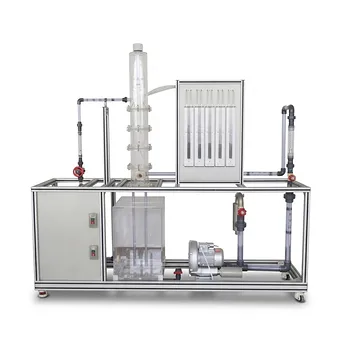
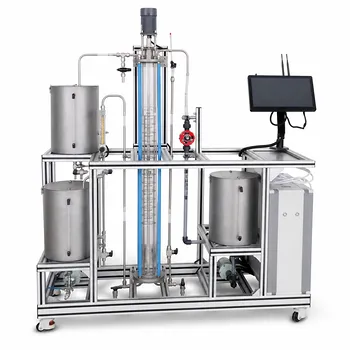
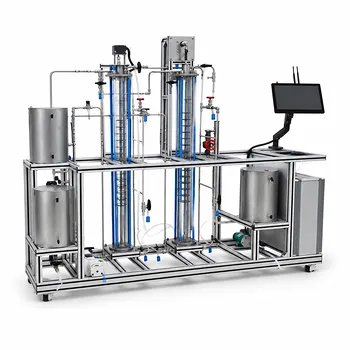
Are you scaling up chemical processes or training the next generation of engineers? LABPARK provides state-of-the-art Educational and Vocational Unit Operations Pilot Plants in chemical engineering, bioprocess & biotech, and environmental & water treatment. Designed specifically for universities, research institutes, and enterprises, our pilot plants enable precise control and empirical testing of complex dynamics—like solid concentration effects on $k_L a_L$ in slurry bubble columns.
Contact us today to discover how our tailored pilot plants can elevate your research, training, and process development.
Related Products
- Multi-Stage Stirred Tanks in Series Residence Time Distribution and Mixing Performance Determination Educational Pilot Plant
- Plate Column Hydrodynamics Tray Demonstration Educational Pilot Plant
- Multi-Functional Special Distillation Educational Pilot Plant
- Educational Rotary Disc Liquid-Liquid Extraction Pilot Plant
- Dual-Mode Rectification Pilot Plant for Practical Training Unit Operations
People Also Ask
- How does MRF model impeller rotation in CFD? Key Boundary Conditions Explained
- How can a CSTR pilot plant demonstrate reactor staging? Visualize volume savings.
- How does steady-state multiplicity affect the operation and safety of exothermic reactions within a CSTR pilot plant? - Guide
- What parameters to monitor transitioning from Batch to CSTR? Master Pilot Plant Setup
- Why is temperature regulation via a cooling jacket a critical feature in CSTR pilot plants used for laboratory training?