The core design principles for minimizing electrochemical interference in bioprocess pilot plants center on two strategies: deliberate sensor surface engineering and rigorous system-level environmental control.
At the sensor level, you must teach physical barrier methods using hydrophobic self-assembled monolayers (SAMs) to block polar interferents like ascorbic acid. This surface engineering alone can slash measurement error from 80% down to below 10% in real-world media like fruit juice. At the system level, the plant itself must be designed to suppress electrochemically-driven thermal convection through precise temperature control and power regulation.
The central teaching takeaway is this: Reliable analytical data in a pilot plant is not just about choosing the right electrode, but about creating a controlled electrochemical micro-environment—both on the sensor surface and within the process fluid—to physically exclude interferents and dampen thermal noise before it becomes measurement error.
Engineering the Sensor Interface to Block Interferents
The most common failure in pilot-plant electrochemical analysis is crosstalk from non-target polar molecules. The educational focus must move beyond simple calibration curves and into the physical chemistry of the electrode surface itself.
The Mechanism of Selective Blocking
Many interferents, like ascorbic acid in fermentation broths or fruit juices, are small, highly polar molecules. They oxidize readily at a bare electrode surface, generating a strong false signal.
A bare, unmodified electrode is an indiscriminate sensor. It will measure the total redox activity of the fluid, not the concentration of your target analyte like fructose. Students must learn that electron transfer is a surface phenomenon, and controlling that surface is the first design principle.
Implementing Hydrophobic SAM Barriers
The foundational teaching example is embedding a detection enzyme within a mostly hydrophobic, insulating self-assembled monolayer (SAM) on a gold substrate.
This design leverages solubility physics. A hydrophobic, non-polar barrier actively rejects the approach of polar molecules. The interferent is physically hindered from reaching the electrode surface and transferring its charge, while the encapsulated enzyme can still facilitate the target reaction. It’s a lesson in creating a gated interface where the sensor’s selectivity is built into its physical structure, not just post-processed in software.
Quantifying the Performance Gain
The educational impact comes from the raw numbers. On an unmodified carbon paste electrode, an interferent like ascorbic acid can contribute up to an 80% measurement error. After applying the SAM surface-blocking design, this error is suppressed to approximately 9%.
This represents a design principle with a near-order-of-magnitude improvement in selectivity. Students must internalize that this is how you move a sensor from a controlled lab buffer to a complex, "dirty" pilot-plant stream without losing the signal in the noise.
Architecting the Pilot Plant to Dampen Thermal Noise
Sensor design is only half the battle. The plant-scale environment around the sensor is a generous source of interference, and the second design principle is mitigating this systemic "electrochemical noise."
The Problem of Self-Inflicted Thermal Convection
High currents in electrochemical unit operations generate Joule heating. This is not an external disturbance; it’s a physical consequence of the measurement or process itself. This heating creates thermal convection and concentration gradients in the liquid.
These chaotic, non-steady-state fluid movements directly disrupt the controlled ion migration you are trying to measure. Teaching this coupling—that the act of measurement can destroy the measurement's validity—is critical for training engineers who will design and operate electrodialysis or electro-fermentation systems.
Design Specifications for a Reproducible System
To minimize this, the pilot plant must be a precision thermal instrument, not just a reaction vessel. When selecting or designing an educational pilot plant, you must teach the following non-negotiable hardware requirements derived from electrochemical first principles:
- Integrated, Responsive Temperature Control Jackets: These are the primary defense, meant to instantly dissipate Joule heat and enforce an isothermal state, preventing density-driven convection rolls from forming.
- Stabilized DC Power Supplies: Any ripple or instability in the driving voltage translates directly into fluctuating current, which modulates the heat generation. A clean, constant power source is a noise-suppression tool.
- Optimized Flow-Channel Geometries: The physical path of the fluid past the sensor must enforce laminar, steady flow. Sharp bends or expansions cause fluidic perturbations that mimic electrochemical signals, creating a design problem that is solved with fluid dynamics, not chemistry.
Grounding Design in Electrochemical Fundamentals
All of these design choices tie back to the foundational theory students must master: the Nernst equation and its sensitivity. The electrode potential is a logarithmic function of ion concentration and pH at the surface.
Thermal convection doesn't just add random noise; it systematically shifts the local concentration at the electrode surface away from the bulk solution value. When a student sees a drift in their measurement, they must be trained to first diagnose a thermal or fluidic design flaw—Joule heating disrupting their steady-state—before questioning the sensor chemistry itself. Similarly, a firm grasp of oxidation state changes is essential for calculating overall mass balances and identifying where unintended side-reactions (and their interference products) could originate from the process scale-up.
Understanding the Trade-offs
Teaching only the benefits of these designs without their costs provides an incomplete education. An honest technical advisor must present the inherent compromises.
Sensor Robustness vs. Sensitivity
A hydrophobic blocking layer like a SAM is a physical barrier. While it effectively excludes polar interferents, it also creates a diffusional barrier for the target analyte. This can reduce the sensor’s raw current output and slow its response time. The design choice is a trade-off: you give up some raw sensitivity and speed to gain an order of magnitude in selectivity in a complex matrix.
Complexity in Pilot Plant Design
Building a perfectly isothermal, laminar-flow pilot plant is expensive and operationally rigid. A jacketed vessel with a bespoke flow channel cannot be easily repurposed for a different process. The pedagogical design must balance the need for "perfect" data on transport properties, like transference numbers, with the practical skill of performing a robust analysis in a more flexible, noisier system. The goal is to teach the student to recognize and quantify the interference, not just eliminate it entirely.
Building the Right Educational Pilot Plant Program
Your curriculum should not treat sensor design and plant design as separate topics. They are two integrated layers of the same interference-minimization strategy.
- If your primary focus is on biosensor selectivity: Center the hands-on lab around fabricating SAMs on gold electrodes. Have students measure a fructose/ascorbic acid mixture on bare and modified electrodes to directly visualize the reduction in error, proving that surface engineering is the most powerful design lever for chemical selectivity.
- If your primary focus is on unit operation scale-up: Ground the entire exercise in thermal management. Use an electrodialysis pilot plant with variable temperature control and power supplies. Task students with measuring a membrane's transport properties under deliberately poor thermal control and then under precise control, so they can quantify the measurement error induced by Joule heating alone.
- If your primary focus is on foundational troubleshooting: Integrate the fundamentals. Create a diagnostic exercise around the Nernst equation where an unexpected voltage drift must be traced to either a buildup of a reaction byproduct (a chemical interferent) or a local pH shift at the electrode surface caused by poor thermal mixing, teaching a systematic logic for separating causes.
An engineer trained in these principles doesn't just get better data; they understand the physical origins of bad data and can therefore design the system that preempts it entirely.
Summary Table:
| Design Level | Primary Method | Key Action | Expected Impact |
|---|---|---|---|
| Sensor Level | Hydrophobic SAM Barriers | Blocks polar interferents (e.g., ascorbic acid) | Reduces measurement error from 80% to < 10% |
| System Level | Precision Thermal Control | Suppresses Joule heating & thermal convection | Eliminates fluidic noise and sensor voltage drift |
Elevate Your Engineering Curriculum and Research Precision
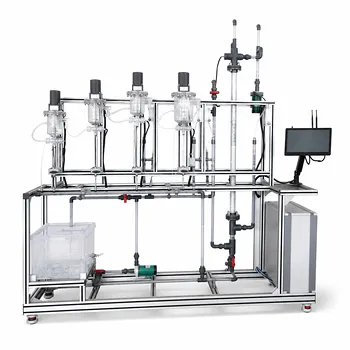
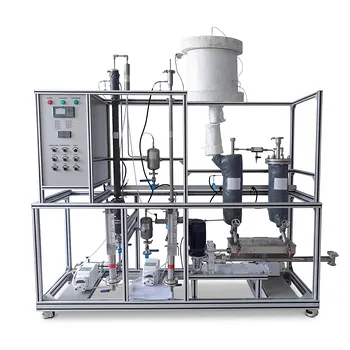
Teaching student engineers to mitigate process-level interference requires state-of-the-art educational systems. LABPARK provides premium Educational and Vocational Unit Operations Pilot Plants in chemical engineering, bioprocess & biotech, and environmental & water treatment for universities, research institutes, and enterprises.
Ensure your students master real-world troubleshooting with robust, precision-controlled systems designed for accurate analytical data. Contact LABPARK today to customize your pilot plant setup!
Related Products
- Natural Product Extraction Unit Operations Training Pilot Plant
- Ethyl Acetate Synthesis Unit Operations Pilot Plant for Practical Training
- Residence Time Distribution and Reactor Flow Characteristics Determination Educational Pilot Plant
- Fixed Bed Gas Solid Catalytic Reaction Educational Pilot Plant
- Bio-fermentation Ethanol Production Practical Training Unit Operations Pilot Plant
People Also Ask
- How to Demo Solubility Sensitivity in SFE Pilot Plants? Practical Thermodynamics
- How do pilot plants differentiate physical vs chemical extraction? Enhance Chemical Engineering Training
- How are HTU and NTU applied to determine extraction column height? Guide to Pilot Plant Scaling
- Why use step disturbance in pilot plants? Master process control dynamic response.
- Why use split-plot designs in pilot plants instead of CRD? Optimize process parameters effectively.