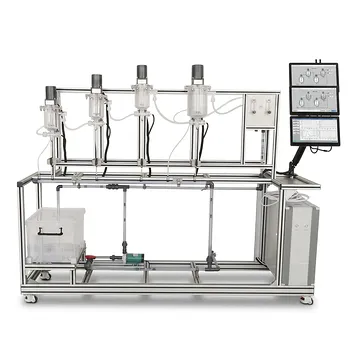
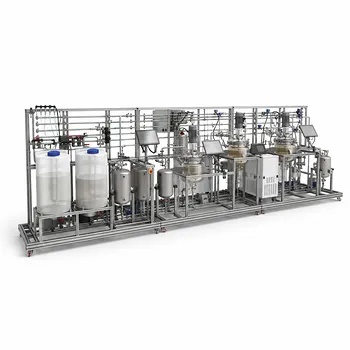
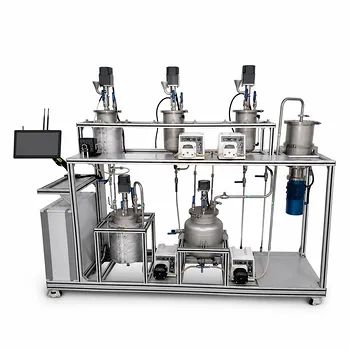
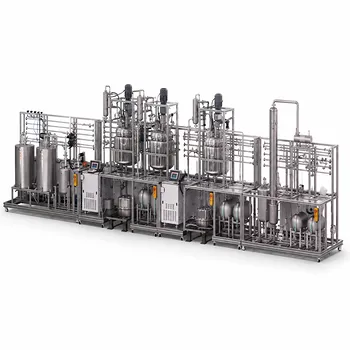
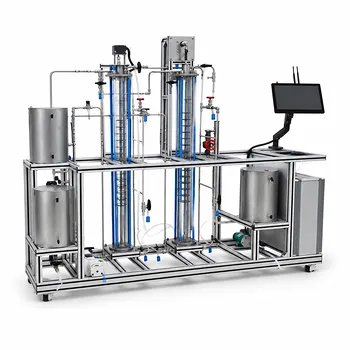
A mixing and formulation pilot plant’s core teaching power comes from its ability to let students manipulate process variables directly. For vocational training, the facility must include variable-speed agitation, modular vessel configurations, and precise heating/cooling jackets as standard. These features enable students to investigate shear rate effects, assess emulsion stability, and practice rapid product changeovers—mirroring how real industrial plants control formulation quality and efficiency.
True vocational mastery isn’t taught by a single piece of equipment. The design must embed the full formulation lifecycle—from raw material pretreatment to final product separation—so students learn how mixing and formulation integrate into a complete industrial process.
The Essential Mixing and Formulation Toolkit
Any pilot plant aimed at vocational education must first provide robust, industrial-style mixing and formulation capabilities. This is the hands-on core where students build intuition for dispersion, emulsification, and homogenization. The equipment design should force them to think about energy input, thermal management, and mechanical setup just as a production engineer would.
Variable-Speed Agitation: The Heart of Shear Control
Industrial mixers are defined by their ability to deliver precise shear rates. A pilot plant must offer variable-speed drives that allow students to sweep from low-shear blending to high-shear dispersion within the same vessel.
This direct control lets learners correlate rotational speed with droplet size in emulsions or particle dispersion in suspensions. They can then connect that mechanical input to the sensory outputs they observe—viscosity changes, phase separation, or color shifts—building a deep, embodied understanding of product stability.
Without it, the relationship between mixing energy and final product texture remains an abstract concept rather than a skill they can tune on the shop floor.
Modular Vessel Configurations: Teaching Flexibility and Changeover
No single vessel geometry suits every formulation. A vocational plant should include interchangeable tanks, impellers, and baffle arrangements. Students can then configure the equipment for different product types, whether a thin lotion or a viscous paste.
This modularity also forces them to confront changeover time. By timing how long it takes to drain, clean, and reconfigure between batches, they experience the real-world tension between product mix flexibility and cost efficiency. Minimising that time becomes a practical design constraint, not just a footnote in a textbook.
Precise Heating and Cooling Jackets: Thermal Stability as a Formulation Tool
Temperature profiles make or break many chemical formulations. A jacketed vessel with accurate temperature control lets students study how heat affects reaction rates, viscosity, and emulsion breakdown.
They can deliberately create failures—overheating a sensitive ingredient, for instance—and then diagnose what went wrong. This experiential learning around thermal sensitivity translates directly to troubleshooting in a production environment, where a poorly controlled cooling ramp can spoil an entire batch.
Moving Beyond the Mixer: Why Process Integration Matters
Vocational training fails if students only see formulation as an isolated mixing step. Real industrial chemical products travel through a chain of unit operations. The pilot plant must reflect this, connecting the mixing stage to upstream and downstream processes so learners grasp the full operational workflow.
The Upstream View: Feed Pretreatment
Before anything is mixed, raw materials often need physical preparation. Including simple pretreatment units—like a filtration skid or a preheating vaporizer—teaches learners that formulation success starts with clean, consistent inputs.
They see firsthand how particle size distribution in a solid additive or the temperature of a liquid feed can disrupt the mixing step. This builds a mindset of total process control, where variability is managed before it enters the mixer.
The Downstream View: Product Separation and Purification
The product leaving the mixer is rarely ready to sell. A vocational pilot plant should link the mixing vessel to a separation unit, such as a liquid-liquid extraction column, a crystallization unit, or a membrane filtration module.
By operating this sequence, students learn that formulation decisions—for example, creating a stable emulsion—directly affect the difficulty of downstream purification. If the emulsion is too tight, a subsequent extraction step becomes sluggish and costly. This full-process perspective closes the loop between mixing and commercial viability.
Understanding the Trade-Offs
No single pilot plant design is perfect. Educators must balance realism with safety, cost, and pedagogical clarity. Being transparent about these trade-offs is essential.
Complexity vs. Throughput
Highly modular systems teach flexibility but demand more maintenance and cleaning time. If groups of students rotate through, lengthy changeovers can eat into hands-on learning time. A plant manager must decide whether the lesson of changeover minimization is worth the penalty of reduced throughput per class session.
Fidelity vs. Scale
Industrial mixers often operate at speeds and pressures that are impractical in a teaching lab. A vocational plant might use a 50-litre vessel instead of a 5,000-litre one. While students can still learn the principles, they miss out on scale-up phenomena like heat transfer limitations or powder wetting challenges. Acknowledge this gap explicitly, and supplement it with data from full-scale operations.
Integration Depth vs. Focus
Linking pretreatment, mixing, and separation creates a powerful systems view, but it can dilute deep practice on mixing alone. A curriculum must ensure that students first master the mixing variables before being asked to troubleshoot the entire chain. Otherwise, they may become lost in the complexity.
Actionable Recommendations for Your Vocational Plant
How to Apply This to Your Project
- If your primary focus is formulating liquid emulsions and dispersions: Prioritize variable-speed agitators, multiple impeller options, and jacketed vessels. Build the curriculum around shear rate experiments and stability testing.
- If your primary focus is teaching the full product lifecycle: Connect the mixing vessel to a pretreatment filter and a downstream separation unit. Have students map how an upstream change (like a coarser filter) affects the final product purity.
- If your primary focus is operability and waste minimization: Include quick-connect sanitary fittings and clean-in-place capabilities. Use the time students spend on changeovers as a metric they must track and improve.
- If your primary focus is troubleshooting and process resilience: Design the plant to safely allow intentional failures, such as temperature excursions or ingredient variance. Debrief these failures to build diagnostic skills.
A thoughtfully designed mixing and formulation pilot plant transforms abstract chemical theory into the concrete, hands-on judgment that defines a skilled operator.
Summary Table:
| Key Feature | Educational Value | Industrial Application |
|---|---|---|
| Variable-Speed Agitation | Teach shear control & droplet size correlation | Adjusting emulsion/suspension stability |
| Modular Vessels | Practice configuration changes & track downtime | Adapting to different product viscosities |
| Jacketed Systems | Explore thermal sensitivity & failure analysis | Managing reaction rates & cooling ramps |
| Upstream/Downstream Integration | Connect mixing to filtration and separation | Optimizing the entire manufacturing line |
Elevate Your Chemical Engineering Vocational Training with LABPARK
Building a hands-on learning environment requires equipment that behaves like a real industrial plant. LABPARK provides state-of-the-art Educational and Vocational Unit Operations Pilot Plants in chemical engineering, bioprocess & biotech, and environmental & water treatment. Designed specifically for universities, research institutes, and enterprises, our modular plants help students master process control, formulation, and system troubleshooting.
Ready to design your ideal training facility? Contact LABPARK today to discuss your customized pilot plant requirements!
Related Products
- Electrolyte Distillation Purification and Formulation Educational Pilot Plant
- Multi-Stage Stirred Tanks in Series Residence Time Distribution and Mixing Performance Determination Educational Pilot Plant
- Ethyl Acetate Synthesis Unit Operations Pilot Plant for Practical Training
- Methanol Synthesis and Catalyst Performance Evaluation Educational Unit Operations Pilot Plant
- Bio-fermentation Ethanol Production Practical Training Unit Operations Pilot Plant
People Also Ask
- Why does simple distillation yield higher efficiency than flash distillation? Key thermodynamic differences.
- How to Integrate Spectroscopy in Distillation Pilot Plants for Advanced Process Control
- How does the feed thermal state influence distillation pilot plant design and utility consumption?
- How to Verify Distillation Boundary Lines & Composition Regions with Pilot Plants
- How to Configure a Distillation Pilot Plant? Key Steps for Multi-Mode Setup