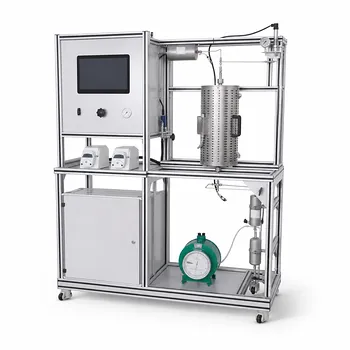
The most dangerous assumption in emergency shutdown design is that simply stopping everything is safe. For chemical process reactors and pilot plants, the critical design consideration is that an emergency trip must execute a carefully sequenced transition to a safe state, not just an abrupt halt. For highly exothermic reactions, this often means maintaining coolant flow or a specific reactant feed to remove residual heat and prevent an even more hazardous thermal runaway.
The paradox at the heart of a safe emergency shutdown is that total isolation can be the cause of a catastrophe, not the solution. A well-designed system must use multiple independent layers of protection, ensuring that the automatic trip sequence actively manages residual energy—thermal, chemical, or kinetic—rather than just trapping it.
Architecting a Reliable Shutdown Sequence
A robust trip system is built on a three-part foundation: sensing the hazard, deciding on the action, and executing it reliably. The design must anticipate that any single component can fail, and therefore, critical protection layers must be independent.
Building Layers of Independent Protection
Your primary control system manages uptime, but it cannot be the sole guardian for safety. A safety instrumented system (SIS) must have its own dedicated path from sensor to actuator.
The Sensor: Seeing the Unthinkable
The first physical element in the chain is the sensor. For a critical hazard like low reactor liquid level exposing a heating coil, a separate, independent low-level switch is mandatory. Relying only on a software alarm from the primary control loop’s level transmitter creates a single point of failure. If that transmitter or the logic solver fails, your protection disappears. The design must specify separate physical sensors for the safety function, hardwired into the shutdown logic.
The Logic Solver: Forcing the Right Decision
The decision-maker, typically a safety PLC, must enforce a safe sequence and resist human error. Critical design steps include:
- Implement Hard Interlocks: Program the PLC to make operator deviations from standard operating procedures impossible, especially during high-risk phases like startup or batch transitions. The logic should force the correct valve sequence regardless of what an operator tries to do in a stressful moment.
- Validate by Testing: Every interlock and trip sequence must be thoroughly tested during commissioning and after any control system update. Untested logic is a theoretical safety net with unknown holes.
Beyond Simple Shutdown: Managing the Aftermath
Stopping the feed is often just the first step in a chain of events. Your design must account for what happens next in the reactor physically.
The Thermal Management Imperative
The primary reference highlights a critical case: highly exothermic reactions. If you simply cut all feeds and isolate the jacket, the reaction mass still generates heat. The safest action is often to maintain the flow of a cooling stream or one reactant to consume the energy. Your trip system must be designed to execute this sequence, transitioning the reactor to a stable, low-temperature condition rather than a sealed, runaway state.
Safe Disposal of Effluents and Overpressure
An emergency shutdown frequently triggers venting, and your design must safely manage the result. The discharge system must route flammable, explosive, or toxic gases to a safe location via an exhaust vent with sufficient height for dispersion. For toxic materials like chlorine, a caustic scrubber must be integrated into the vent path. For multi-phase flows, a knockout drum is essential to separate liquids before gases reach a flare or vent stack.
The volume of vapor from a runaway reaction can overwhelm standard condensers in seconds. This is why a properly sized relief system is the final mechanical safeguard. For pilot plants, this means:
- Selecting the Right Device: Use a bursting disc for rapid pressure spikes or corrosive service, and a pressure safety valve where resealing after a controlled vent is needed.
- Sizing for a Worst-Case Scenario: Calculations must consider the "worst credible case"—a runaway reaction, blocked outlet, or external fire. Sizing is not generic; it must distinguish between gas, liquid, and flashing two-phase flow to ensure the vent line and downstream containment can handle the release volume.
Design for Complex Physical Systems
For three-phase reactions where a product crystallizes, a shutdown presents a clogging hazard. The reactor needs a bottom-discharge design and a temperature control system that can immediately begin cooling. This often involves a Temperature Control Module (TCM)—a skid integrating pump, heat exchanger, and valves to precisely ramp temperature down using a dedicated heat transfer fluid. This closed-loop system prevents a solidified, un-drainable mass from forming inside the reactor after a trip.
Understanding the Trade-offs and Pitfalls
A safety system that causes spurious trips is itself a hazard, as it breeds operator distrust and the temptation to bypass it. The classic trade-off is safety integrity vs. operational availability.
- Independence vs. Complexity: Adding separate sensors for a safety function increases reliability but also adds cost, maintenance, and another device that could fail spuriously. Clarity on when true independence is needed is key.
- Oversizing Relief Systems: A vastly oversized relief vent can be just as dangerous as an undersized one, leading to mechanical instability, flange leakage, or excessive reaction mass ejection. The design must be a calculated fit, not a “safe” guess.
- The Inert Gas Trap: Purging with inert gas is a standard trip action, but the design must account for where that purge exits. If it dead-ends against a closed block valve, it can overpressure the system it was meant to protect.
How to Apply This to Your Project
The right design approach depends on your primary hazard profile and operational context.
- If your primary focus is preventing a thermal runaway: Design your trip sequence to maintain maximum cooling first and cut reactants second. The system logic must prioritize removing heat over immediate chemical isolation.
- If your primary focus is training operators safely: Build multiple independent protection layers that prevent a single manual error from escalating. Make hard interlocks a central feature to illustrate the principle of forcing functions over administrative controls.
- If your primary focus is building or upgrading a pilot plant for multi-phase chemistry: Design for what happens after the trip, including bottom-discharge nozzles, knockout drums, and scrubbing systems that prevent a secondary containment failure.
The goal of an emergency shutdown is not just to halt the reaction, but to orchestrate a controlled, safe, and survivable handover to physics.
Summary Table:
| System Component | Critical Design Consideration | Safety Objective |
|---|---|---|
| Sensors | Physical independence from control loop | Prevents single points of failure |
| Logic Solver | Hardwired interlocks & safety PLC | Restricts manual operator deviations |
| Thermal Control | Sustained cooling fluid flow post-trip | Prevents exothermic thermal runaway |
| Relief & Venting | Sizing for worst-case multi-phase flow | Safely disperses overpressure & toxins |
Elevate Your Process Safety with LABPARK
Designing reliable emergency shutdown systems is vital for safe scaling, research, and training. LABPARK provides state-of-the-art Educational and Vocational Unit Operations Pilot Plants in chemical engineering, bioprocess & biotech, and environmental & water treatment. Specially designed to meet the rigorous safety standards of universities, research institutes, and enterprises, our pilot plants ensure controlled transitions to safe states during critical trips.
Explore how LABPARK can enhance your laboratory's safety and operational efficiency — contact us today!
Related Products
- Residence Time Distribution and Reactor Flow Characteristics Determination Educational Pilot Plant
- Fixed-Bed Chemical Reaction and Gas Dust Tar Removal Unit Operations Pilot Plant
- Ethylbenzene Dehydrogenation Educational Unit Operations Pilot Plant
- 100L Continuous Loop Hydrogenation Educational Unit Operations Pilot Plant
- Multi-Reactor Educational Pilot Plant for Reaction Engineering Unit Operations
People Also Ask
- Why is temperature regulation via a cooling jacket a critical feature in CSTR pilot plants used for laboratory training?
- How does steady-state multiplicity affect the operation and safety of exothermic reactions within a CSTR pilot plant? - Guide
- What parameters to monitor transitioning from Batch to CSTR? Master Pilot Plant Setup
- What role do customizable reactor pilot plants play in evaluating heat and catalyst performance? Scale-up Guide
- How Does Backmixing Affect 1st vs 2nd-Order Reaction Conversions in Pilot Plants?