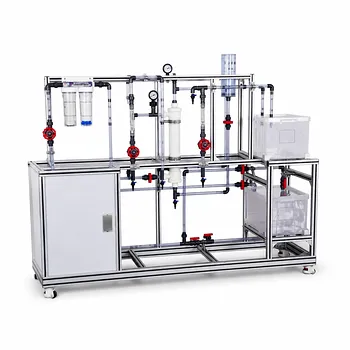
The non-negotiable foundation for any educational PEM fuel cell pilot plant is a design that puts safety and the integrity of its core chemical components above all else. You must prioritize features that protect the membrane electrode assembly (MEA) from contamination, enable precise data collection to illuminate electrochemical principles, and enforce foolproof operational safety protocols. The goal isn't just to generate power, but to do so in a way that teaches fundamental engineering truths without damaging the equipment or endangering the operator.
Selecting the right educational pilot plant is not about finding the most powerful unit; it's about choosing the most pedagogically transparent and chemically resilient system. The optimal design seamlessly integrates three pillars: uncompromising safety architecture, meticulous reactant purity control, and rich diagnostic instrumentation, all while allowing students to interact with and understand every critical balance-of-plant component.
The Core Chemical Requirements: Protecting the Heart of the System
The MEA is the pilot plant's most expensive and delicate asset. Every design choice must revolve around preserving its function.
The Absolute Necessity of Water Purity
The electrolysis module must operate exclusively on deionized or distilled water. This is not a suggestion; it is a fundamental chemical requirement. Tap water or standard electrolytes contain metal ions and organic contaminants that will irreversibly poison the platinum (Pt) catalyst, disabling the MEA. An ideal educational unit will feature a dedicated, clearly labeled deionized water reservoir and a resistivity meter to verify water quality before it enters the cell.
Optimized Membrane and Catalyst Selection
For low-temperature PEM operation, the system should utilize a Nafion-based or similar sulfonated polymer membrane with platinum catalysts on both the anode and cathode. This standard configuration ensures stable proton transport. From a design perspective, the unit should allow students to access the MEA (if feasible and safe) to physically observe the catalyst layer, connecting the abstract concept of a three-phase boundary to a tangible component.
Instrumentation and Design for Measurable Learning
A true educational pilot plant must translate theoretical electrochemical reactions, like hydrogen oxidation (H2 -> 2H+ + 2e-) and oxygen reduction (1/2 O2 + 2H+ + 2e- -> H2O), into observable, quantifiable data.
Essential Integrated Diagnostics
The system must be an instrumented, not just operational, platform. Look for these non-negotiable components:
- Variable Load Units: A programmable or stepped load (e.g., a resistance decade box, small motor, or lightbulbs) allows students to draw different currents and plot the characteristic polarization curve of the fuel cell.
- Volumetric Gas Collectors: Clear, graduated cylinders for both hydrogen and oxygen provide direct visual proof of Faraday’s laws. Students can measure the volume of gas produced and consumed to calculate Coulombic and energy efficiency in real-time.
- Built-in Multimeters and Flow Meters: Integrated sensors for voltage, current, and gas flow rate are crucial for collecting the data needed to calculate the efficiency gap between the theoretical 80%+ potential and the actual net system output after accounting for auxiliary losses.
The Critical Role of Gas Purging
Designing a safe start-up sequence is mandatory. Before applying an electrical load, the fuel cell stack must be purged with an inert gas (like nitrogen) or the reactant gases themselves to expel any air pockets. A system without accessible purge valves is a safety hazard and an educational failure. This step demonstrates the real-world engineering challenge of maintaining high-purity reactant feeds and preventing explosive hydrogen-oxygen mixtures in the gas collectors. The design must include dedicated, clearly marked exhaust/purge valves on both the anode and cathode loops.
Operational Priorities: Building a Safe and Industrial-Relevant Workflow
The operational requirements are where the educational unit bridges theory and real-world chemical engineering practice. Safety is the absolute baseline, overlaid with the logic of unit operations.
Uncompromising Safety Architecture and Protocols
The pilot plant's design must make safe operation intuitive.
- Utility Integration: The laboratory must be prepared for the plant's utility needs—specifically a dedicated and verified electrical supply and stable cooling water if required. The plant itself should feature a prominent master emergency shut-off for electricity and gas flow.
- Connection Foolproofing: The gas lines must be mechanically keyed or color-coded to prevent a catastrophic error: connecting water or the wrong gas line to the hydrogen side of the electrolyzer, which can instantly destroy the sensitive PEM. The oxygen exhaust must only link to the oxygen collector, and the hydrogen exhaust to the hydrogen collector.
- Mandatory PPE and Training: A formal operation protocol is as crucial as the hardware. This must include mandatory safety training, signage for emergency eyewash stations and showers, and a strict PPE policy (lab coat, chemical-resistant gloves, impact-resistant goggles) before system access is granted.
Process Flow and Modular Design
To teach unit operations principles, the plant layout should visually map the process flow: raw material (deionized water) -> reaction (electrolyzer) -> separation (gas drying, if equipped) -> product storage (gas collectors) -> energy conversion (fuel cell stack). A modular stack design is highly valuable, as it allows students to configure cells in series to increase voltage, directly linking physical configuration to electrical output. This teaches the concept of scale-up and capacity balancing that is central to industrial chemical engineering.
Understanding the Trade-offs and Common Pitfalls
No pilot plant design is perfect; objective evaluation requires acknowledging the challenges.
- Cost vs. Diagnostics: High-precision digital sensors and programmable loads significantly increase capital cost. A purely manual system with analog meters is cheaper but limits the quality of data and the types of dynamic experiments students can perform.
- Simplicity vs. Industrial Realism: A basic "Transparent Cell" design with a single cell and manual purge valves offers exceptional pedagogical clarity. However, it shields students from the complexity of a multi-cell stack with automated thermal and water management systems. The trade-off is between teaching a core concept with perfect clarity and simulating a real-world, complex system with its associated control challenges.
- The Efficiency Trap: Be wary of chasing published "maximum" efficiencies. A simple educational unit will have low efficiency due to significant power consumption by auxiliary components (pumps, fans, controllers). The key lesson is measuring and calculating the net system efficiency, which teaches the harsh but vital reality of the parasitic power loads that all real fuel cell systems must manage.
Making the Right Choice for Your Educational Goal
Your selection must be driven by a clear teaching objective. Match the pilot plant's design complexity to your core curriculum.
- If your primary focus is teaching core electrochemical fundamentals: Choose a highly transparent, manually operated single-cell unit. Its value lies in its simplicity for plotting polarization curves and visually measuring gas volumes without the cognitive load of a complex control system.
- If your primary focus is process safety and industrial operations: Select a unit with a robust safety system, a closed-loop control architecture, and a multi-cell stack. Prioritize the complexity of the start-up, purge, and shut-down sequences as primary learning outcomes.
- If your primary focus is renewable energy systems integration: Secure a fully instrumented unit with a programmable load and computer-based data acquisition. This design allows for dynamic testing under simulated variable loads, mirroring the real-world challenge of grid integration.
The ultimate test of a well-chosen educational pilot plant is not just that it runs, but that it makes the fundamental science visible, quantifiable, and safe for every student who operates it.
Summary Table:
| Priority Area | Key Requirements | Pedagogical Value |
|---|---|---|
| Chemical Protection | Deionized water use, Nafion-based membrane, platinum catalysts | Protects MEA from poisoning; demonstrates three-phase boundaries |
| Diagnostics | Variable loads, volumetric gas collectors, flow meters | Enables polarization curve plotting and Faradaic efficiency calculations |
| Operational Safety | Inert gas purge valves, color-coded lines, emergency shut-offs | Teaches industrial safety protocols and prevents reactant mixing |
Bring Industrial-Scale Learning to Your Laboratory
Equip your students and researchers with the tools they need to master electrochemical engineering and process safety. LABPARK provides high-quality Educational and Vocational Unit Operations Pilot Plants in chemical engineering, bioprocess & biotech, and environmental & water treatment.
Tailored for universities, research institutes, and enterprises, our systems prioritize safety, durability, and transparent diagnostics to maximize learning outcomes.
👉 Contact LABPARK today to discuss your custom laboratory requirements and request a quote!
Related Products
- Polymerization Granulation and Pellet Processing Educational Unit Operations Pilot Plant
- Water Electrolysis Hydrogen Production and Storage Educational Pilot Plant
- Multi Functional Membrane Crystallization Educational Unit Operations Pilot Plant
- Methanol Synthesis and Catalyst Performance Evaluation Educational Unit Operations Pilot Plant
- Bio-fermentation Ethanol Production Practical Training Unit Operations Pilot Plant
People Also Ask
- How to configure a polymerization pilot plant for molecular weight control? Key Setup Guide
- How do educational unit operations pilot plants bridge theory and industrial process development? Hands-On Learning
- How do educational unit operations pilot plants bridge theory and design? Bridge the Engineering Gap
- How do educational unit operations pilot plants address safety and waste management when scaling up?
- How do unit operation requirements differ between traditional chemical processes and bioprocesses? Build Better Pilot Plant Curricula