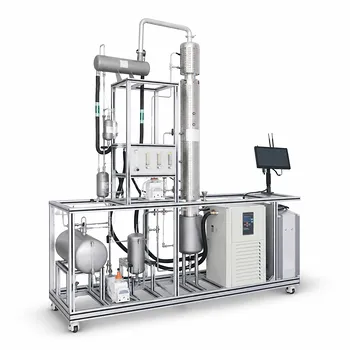
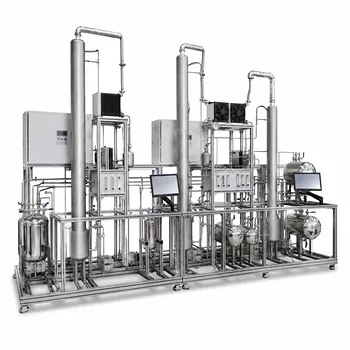
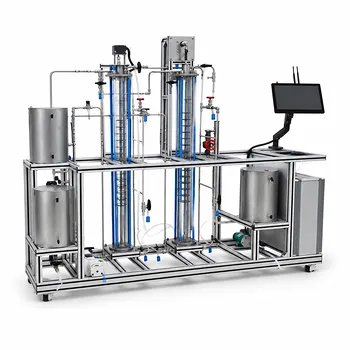
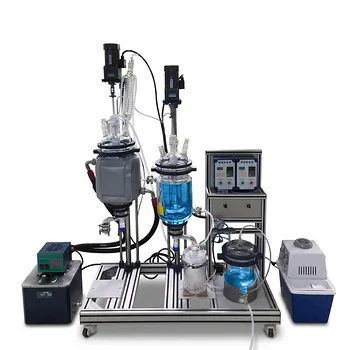
The overriding design imperative for carbon disulfide distillation is total containment. Processing a solvent with a boiling point of just 46 °C demands a pilot plant engineered to eliminate any possible vapor release, inert the atmospheric oxygen that could ignite it, and use materials and control systems that remove all ignition sources. Everything from the heating source to the condenser vent must be treated as a potential hazard and addressed through multiple, independent safety layers.
While carbon disulfide amplifies the risks due to its extreme volatility, toxicity, and low auto-ignition temperature, the core philosophy applies to all low-boiling, flammable solvents: design the system so that no vapor-air mixture can reach its flammable limit and no ignition source can co-exist with the solvent. This means closed-loop condensation, inert gas blanketing, explosion-proof components, and rigorous ventilation are not optional add-ons—they are the foundational requirements.
Understanding the Specific Risks of Low-Boiling Solvents
Why Carbon Disulfide is a Unique Hazard
Carbon disulfide is not just flammable; it is extremely volatile. At room temperature, even a small open container can quickly fill a laboratory space with vapor above the lower flammability limit (LFL).
Its low auto-ignition temperature (around 100 °C) means a hot surface—such as an unshielded pipe or a heating element not designed for the duty—can cause spontaneous ignition. Additionally, CS₂ is toxic, impairing the nervous system, and only slightly soluble in water, making scrubbers and closed handling essential to protect operators.
The Cascading Failure Mode with Volatile Solvents
With low boilers, the dominant risk is vapor breakthrough. If condensation fails, even momentarily, high-concentration vapors escape into the workspace. Because these solvents often have narrow flammable ranges, a leak can rapidly create an explosive atmosphere.
A standard teaching pilot plant, built with open flanges, rubber seals, and a non-rated heating mantle, is fundamentally unsafe for this service. The equipment must be designed from the ground up to assume that leaks will be prevented, not just managed.
Core Design Considerations for the Pilot Plant
Material Selection: Chemical and Mechanical Integrity
Stainless steel (Grade 304 or 316) is the workhorse for column shells, reboilers, and packing. These alloys resist corrosion from trace acids that can form when CS₂ degrades, and they maintain mechanical strength under thermal cycling.
Avoid materials that can embrittle or catalyze decomposition. All seals and gaskets must be PTFE or Kalrez®—not standard rubber—to prevent swelling and loss of containment. Glass components, if used, must be borosilicate and inspected for micro-cracks before each run to prevent catastrophic breakage under vacuum.
Explosion-Proof Heating and Electrical Systems
Every electrical component within the flammable zone must be ATEX/IECEx rated. This includes the reboiler heating elements, pump motors, and instrumentation. Enclosed electric heating mantles with tight temperature control are acceptable, but prefer steam or a secondary fluid heating loop that keeps the heating surface below the solvent’s auto-ignition temperature.
Nitrogen purge panels, solenoid valves, and the control cabinet itself should be placed outside the classified area or housed in a purged enclosure. Any wiring must be intrinsically safe or explosion-proof conduit.
Closed-Loop Condensation with Full Vapor Recovery
The concept is simple: vapors that cannot escape cannot burn. The pilot plant must use a high-efficiency condenser (glass coil or stainless shell-and-tube) sized to deliver at least 150% of the anticipated vapor load. The cooling medium—typically chilled water or glycol—must be capable of sub-cooling the condensate to well below the boiling point.
The vent line must never open directly to atmosphere. It should route through a closed-loop scrubber (e.g., oil absorption or activated carbon) and then into a nitrogen-blanketed vessel. A pressure control valve on the process side maintains slight positive nitrogen pressure to prevent air ingress.
Vacuum Operation: Lowering the Risk Profile
Operating under mild vacuum (100–300 mbar absolute) lowers the distillation temperature, moving it further from the auto-ignition point and reducing the thermal stress on the solvent. However, this introduces implosion risks and requires careful pressure control.
Before the vacuum pump, a sequential absorption tower (drying agent, NaOH, paraffin wax) must be installed to remove water vapor, acid gases, and organic carryover. The system must be slowly vented with nitrogen after cooling to prevent thermal shock and oil suck-back. Only heavy-walled glass or metal receivers designed for vacuum service should be used.
Integrating Safety Systems: Layers of Protection
Inert Gas Blanketing and Purging
The single most effective measure is maintaining an oxygen concentration below the limiting oxygen concentration (LOC) throughout the system. Use nitrogen purging on all feed tanks, product receivers, and the column itself. The purge rate must be monitored with a mass flow controller, and the vessel vapor space should be held at a slight positive pressure (a few millibar) to block air intrusion.
High-Integrity Containment and Low-Leak Fabrication
Minimize flange connections and use welded joints wherever possible. When flanges are unavoidable, specify raised-face, spiral-wound gaskets. All fittings and valves should be fire-safe rated. This approach follows the principle of “inherently safer design”—eliminating leak paths rather than just detecting them.
Advanced Ventilation and Fume Extraction
Even with closed-loop design, the pilot plant should sit within a well-ventilated open-frame structure or inside a walk-in fume hood with a face velocity of at least 0.5 m/s. Local exhaust ventilation must be positioned at every potential leak point, such as sample ports and pressure relief valves. This captures fugitive emissions before they can pool and reach dangerous concentrations.
Fixed Gas Detection and Automated Shutdown
Install point-type infrared or electrochemical CS₂ detectors near the plant floor and at breathing-zone height. These must be linked to a safety PLC that activates an alarm at 10% LFL and automatically shuts off heating, closes isolation valves, and increases purge flow at 25% LFL. Manual gas checks with a portable detector before startup are an additional layer.
Pressure Relief and Deflagration Prevention
In accordance with NFPA 68 and 69, each pressure vessel must have a relief valve or rupture disc that vents to a safe, vented location—possibly through a flame arrester. The relief path must be sized for the worst-case fire exposure scenario. Flame arresters on tank vents prevent external ignition from propagating into the vapor space.
Understanding the Trade-offs
The complete safety package adds significant capital cost and operational complexity. An ATEX-rated reboiler, high-alloy vessels, and a sophisticated interlock system can make a pilot unit three to five times more expensive than a bare-bones glass column. Moreover, the nitrogen purge and scrubbing media add ongoing consumable costs.
Over-reliance on active systems can create a false sense of security. A blocked nitrogen line or a frozen condenser can defeat multiple safety layers. Therefore, passive safety—metal construction, welded joints, cooling water fail-safe valves—should always be prioritized over purely active controls. Routine maintenance and rigorous pre-startup safety reviews are non-negotiable, even in educational settings.
Making the Right Choice for Your Goal
- If your primary focus is educational training with minimal hazard: Use dilute, non-flammable surrogate mixtures to teach VLE and column operation. Avoid carbon disulfide entirely unless you have a dedicated, engineered pilot plant.
- If your primary focus is pilot-scale CS₂ purification for research: Invest in an ATEX-rated, closed-loop stainless steel system with nitrogen inerting, vacuum capability, and a gas detection interlock. Operating under vacuum is strongly recommended.
- If your primary focus is multi-purpose solvent recovery: Design a flexible plant that can handle a range of low-boilers by standardizing on 316L stainless steel, inert gas panels, and a universal scrubber system—then lock out operation for specific chemicals without the required safety configuration.
Above all, treat the design not as a cost to be minimized, but as the immutable boundary that allows you to extract meaningful data without risk.
Summary Table:
| Hazard / Risk | Engineered Safety Solution | Key Operational Benefit |
|---|---|---|
| Toxic Vapor Escape | Closed-loop condensation & scrubbers | Prevents hazardous emissions |
| Auto-Ignition | ATEX-rated/steam secondary heating | Eliminates high-temp hot spots |
| Flammable Atmosphere | Nitrogen gas purging & blanketing | Maintains oxygen below limiting levels |
| Thermal Decomposition | Vacuum operation (100–300 mbar) | Lowers distillation boiling point |
Are you planning to build or upgrade a safe, compliant distillation system? LABPARK provides state-of-the-art Educational and Vocational Unit Operations Pilot Plants in chemical engineering, bioprocess & biotech, and environmental & water treatment for universities, research institutes, and enterprises. Our systems are engineered with advanced safety containment, explosion-proof controls, and nitrogen blanketing to ensure reliable, risk-free operation.
Contact LABPARK today to discuss your custom pilot plant requirements!
Related Products
- Continuous Sieve-Plate Distillation Pilot Plant for Unit Operations Laboratory Education
- Multi-Functional Special Distillation Educational Pilot Plant
- Continuous Batch Extractive Distillation Educational Pilot Plant
- Electrolyte Distillation Purification and Formulation Educational Pilot Plant
- Multi-Modal Distillation Unit Operations Training Pilot Plant
People Also Ask
- How does catalyst water concentration affect distillation pilot plant design? Key separation train choices.
- How can real-time carbon number prediction improve distillation pilot plants? Optimize control.
- How to select the right activity coefficient model (Wilson, NRTL, UNIQUAC) for distillation pilot plants?
- What are the primary reflux ratio control strategies? Master Distillation Unit Operations
- Why is vacuum operation capability an essential feature for a distillation unit operations pilot plant? Unlock Efficiency