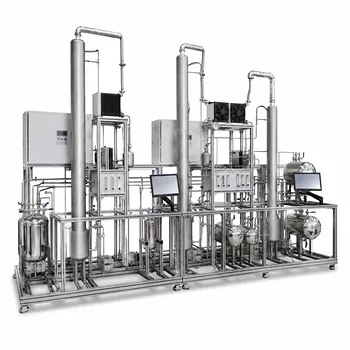
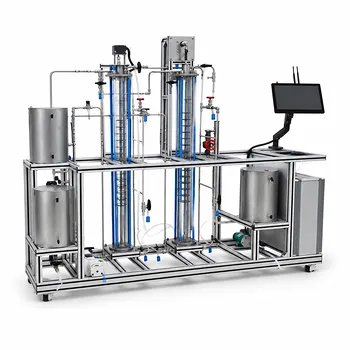
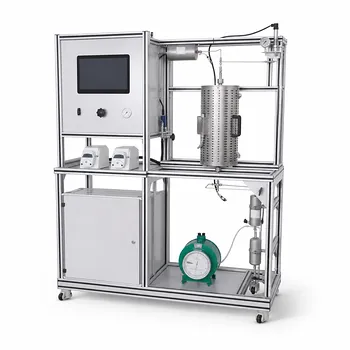
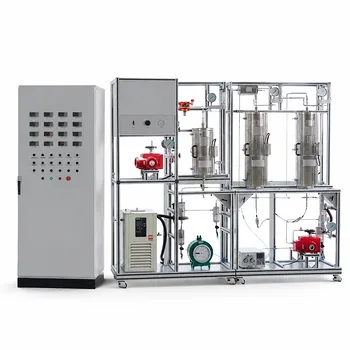
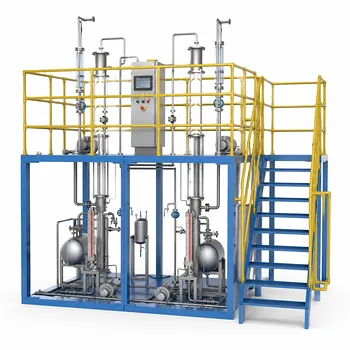
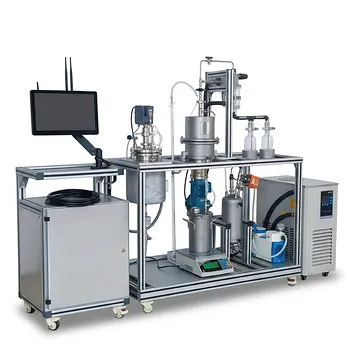
The selection of an entrainer for azeotropic distillation is not merely about finding a chemical that works on paper; it is about operational feasibility, safety, and visual clarity. In a pilot plant setting, the most critical criterion is that the entrainer forms a heterogeneous, low-boiling azeotrope with one of the feed components, allowing for clean phase separation in a decanter and easy visual observation by students and researchers.
While thermodynamic compatibility (forming a new azeotrope with a boiling point difference of at least 10°C) is the baseline requirement, the practical success of a pilot-plant run hinges on the entrainer’s ability to form two immiscible liquid phases and its minimal energy penalty. Prioritize safety, low latent heat, and a sharp phase split visible in the glassware.
Deconstructing the Core Selection Criteria
Chemical engineers must move beyond textbook thermodynamics to evaluate how a substance performs in the transient, glass-dominated environment of a pilot plant. The primary requirements distill down to volatility shifts, heterogeneity, energy economics, and safety.
The Thermodynamic Mandate: The 10°C Shift
The entrainer must fundamentally alter the vapor-liquid equilibrium (VLE) to break the original azeotrope. It achieves this by forming a new minimum-boiling azeotrope with one of the key components.
This new azeotrope must have a boiling point significantly lower than the original mixture. The standard threshold in a pilot plant simulation is a difference of at least 10°C (or 10 K). Without this sufficient temperature gap, separation in a column with limited theoretical stages becomes impractical.
The Visual Key: Heterogeneous Azeotrope Formation
This is the decisive factor in a pilot plant. The new azeotrope must be heterogeneous—meaning it separates into two immiscible liquid phases upon condensation.
Pilot plant columns are specifically designed with decanters and glass viewports to exploit this property. When a heterogeneous azeotrope condenses, the entrainer-rich phase and the water/organic-rich phase split sharply. This allows students to visually monitor the phase boundary and perform straightforward gravity separation, recycling the entrainer back to the column.
The Energy Balance: Latent Heat and Dosage
A significant hidden cost is the energy required to vaporize the entrainer. A suitable entrainer must possess a low latent heat of vaporization. This minimizes the reboiler duty, making the separation economically tenable and safer to operate.
Equally important is the required dosage. The quantity of entrainer circulating in the system should be minimal. A higher dosage means greater energy to heat and vaporize it, along with larger holdup volumes that can mask the dynamic responses critical for pilot-plant study.
The Non-Negotiable: Safety and Material Stability
In a research or educational lab, safety eclipses all other metrics. The entrainer must be non-toxic and non-corrosive to protect the users. Pilot plants often contain stainless steel internals, gaskets, and glass components; a corrosive agent risks catastrophic equipment failure.
The substance must also be thermally stable at the operating reboiler temperature to prevent degradation, and inexpensive to account for initial charges and makeup streams during a campaign.
Beyond the Basics: A Deeper Look at Separation Dynamics
While the primary reference defines the "what," understanding the "why" involves integrating knowledge of column configuration and dynamic feasibility.
Connecting Entrainers to Column Configuration
The choice of entrainer dictates which column setup will work. Researchers often use Residue Curve Maps (RCM) to analyze this. If the target pure product is a saddle point (a common scenario when breaking a minimum-boiling azeotrope), simple batch distillation fails entirely. This situation specifically requires a Batch Reactive Extractive Distillation (BRED) column to introduce the entrainer effectively.
For non-reactive systems, the entrainer selection simply shifts the saddle nodes by creating a new distillation boundary. You must verify that the new residue curve allows the desired pure component to be reached from the feed composition, either as a stable node (for a stripper) or an unstable node (for a rectifier).
Azeotrope Types: Homogeneous vs. Heterogeneous
- Homogeneous Entrainers: Form a single liquid phase. While they can work, they require complex secondary distillation columns for recovery. In a pilot plant focused on visualizing fundamentals, they miss the opportunity to demonstrate liquid-liquid extraction dynamics.
- Heterogeneous Entrainers: Form two liquid phases. These are preferred because they enable a closed-loop system. The entrainer is decanted and directly refluxed, creating a sustainable cycle that is ideal for demonstrating steady-state extraction and distillation principles in a single glass column.
The Batch Distillation Context
Most pilot plants operate in batch mode for flexibility. The entrainer must function effectively under these transient conditions. The initial charge composition constantly shifts, changing the relative volatility demands on the entrainer. A robust entrainer maintains the required 10°C+ boiling point gap throughout the entire batch run, from initial heel to final cut, preventing the azeotrope from "breaking" prematurely.
Understanding the Trade-offs
Selecting the perfect entrainer is an exercise in constraint optimization. No single molecule excels in every category.
- The Solubility Paradox: The most effective heterogeneous entrainers often have extremely low mutual solubility with the other liquid phase (which is good for purity). However, this often correlates with a specific latent heat profile. For example, a high-boiling entrainer might have a lower latent heat relative to its mass but require a larger dosage in the vapor phase, negating the energy savings.
- The Safety vs. Performance Trap: Halogenated hydrocarbons historically served as excellent entrainers due to high density and favorable azeotrope formation. However, they are now almost universally disqualified due to toxicity and environmental concerns, despite their unmatched thermodynamic performance data. The pilot plant must sacrifice some separation sharpness to operate with safer, greener solvents.
- Material Compatibility: A non-corrosive entrainer is a must near glass, but some chemically benign solvents can still attack polymer seals or gaskets. Swelling of a PTFE gasket in a decanter loop, while not "corrosion," causes leaks. Pilot plants require chemical compatibility testing not just for metal, but for all wetted materials in the loop.
Making the Right Choice for Your Pilot Plant Goal
Base your final entrainer selection on the primary objective of your pilot plant campaign.
- If your primary focus is demonstrating the separation mechanism visually: Prioritize a heterogeneous entrainer with a sharp, quick-settling phase boundary. Performance trumps minor energy inefficiency here.
- If your primary focus is optimizing for industrial scale-up economics: Screen for the entrainer with the lowest combined energy footprint (latent heat × circulation rate), even if it requires a slightly more complex recovery column downstream.
- If your primary focus is student safety and operational simplicity: Select the non-toxic option with the widest boiling point margin, trading off maximum purity for a robust, forgiving process that won't react to minor temperature fluctuations.
The data from your glass pilot plant is only as valid as the entrainer is practical. A substance that looks perfect in a thermodynamic model but creates invisible operational bottlenecks teaches nothing—so the final and most rigorous criterion is always a successful experimental shake-down.
Summary Table:
| Criterion | Key Requirement | Pilot Plant Significance |
|---|---|---|
| Thermodynamics | ≥ 10°C boiling point shift | Breaks the original azeotrope efficiently |
| Heterogeneity | Forms 2 immiscible phases | Enables gravity decanting & visual monitoring |
| Energy Economy | Low latent heat & low dosage | Minimizes reboiler duty & system holdup |
| Safety & Stability | Non-toxic, non-corrosive | Protects operators, glass, and seals |
Optimize Your Chemical Engineering Lab with LABPARK
Are you looking to enhance your research or teaching capabilities in azeotropic distillation and other unit operations?
LABPARK provides state-of-the-art Educational and Vocational Unit Operations Pilot Plants in chemical engineering, bioprocess & biotech, and environmental & water treatment. Designed specifically for universities, research institutes, and enterprises, our pilot plants feature high-visibility glass components, precise process control, and robust safety standards to make complex separations easy to demonstrate and study.
Ready to upgrade your laboratory setup? Contact LABPARK today to discuss your custom pilot plant needs and request a quote!
Related Products
- Multi-Functional Special Distillation Educational Pilot Plant
- Continuous Batch Extractive Distillation Educational Pilot Plant
- Green Anhydrous Ethanol Purification Extractive Distillation Unit Operations Training Pilot Plant
- Ethyl Acetate Synthesis Unit Operations Pilot Plant for Practical Training
- Continuous Sieve-Plate Distillation Pilot Plant for Unit Operations Laboratory Education
People Also Ask
- Why does simple distillation yield higher efficiency than flash distillation? Key thermodynamic differences.
- How does double temperature difference control improve distillation pilot plants? Stabilize purity.
- How to Integrate Spectroscopy in Distillation Pilot Plants for Advanced Process Control
- How to Verify Distillation Boundary Lines & Composition Regions with Pilot Plants
- Why is the acentric factor important in pilot plants? Fluid property prediction.