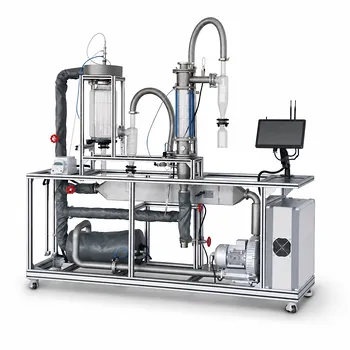
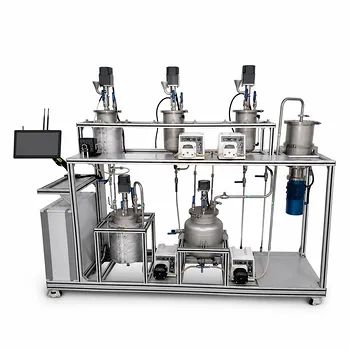
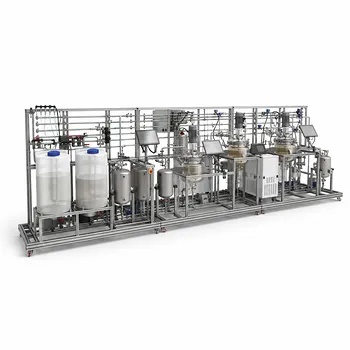
Bridging the gap between theory and practice. Bioprocess pilot plants force students to confront the harsh realities of isolating vanishingly small, heat-labile biomolecules from highly dilute solutions — challenges no textbook can fully capture. They teach how to concentrate product without denaturation, navigate fouling-prone membranes, and fine-tune pressure, flow, and pH to meet exacting purity standards. In short, these plants transform abstract knowledge into the muscle memory needed for industrial biopharmaceutical recovery.
Working with highly diluted biomolecules introduces a multi-dimensional puzzle: low concentrations demand gentle yet efficient concentration methods, tiny sizes require high-resolution separations, and product sensitivity forbids aggressive processing. Pilot plants resolve this puzzle by letting students engage with real equipment, where they can manipulate trans-membrane pressure, flow rates, and mobile phase conditions, directly observing how each choice affects yield, purity, and bioactivity.
The Unique Hardships of Dilute Biomolecule Streams
Submicron Particles That Defy Easy Capture
Biological targets like proteins, viruses, and plasmids often measure 0.01–10 µm. They slip through conventional filtration media, forcing students to explore advanced membrane filtration and microfiltration. Handling these systems reveals the real-world difficulties of pore size selection and fouling management.
The Concentration Conundrum
Starting solutions are extremely dilute. Simply evaporating solvent is energy-intensive and risks heat damage. Students learn that a gentle first step—like ultrafiltration—must concentrate the product without altering its native structure. This demands careful control of trans-membrane pressure and cross-flow velocity to avoid shear stress and gel-layer formation.
Protecting Heat-Sensitive Integrity
Many biomolecules denature at even mild temperature excursions. The challenge extends beyond the main unit operation: feedstock pre-treatment, sterilization cycles, and solvent recovery must all respect thermal limits. Pilot plant training forces students to balance thermal sterilization of media with product cooling, a nuance often overlooked in simulations.
Chasing Pharmaceutical-Grade Purity
Strict purity standards require multi-step purification trains. A single misstep—wrong buffer pH, gradient slope, or column temperature—causes loss of resolution or activity. Students must learn to orchestrate chromatography columns, membrane cassettes, and extraction vessels seamlessly, mirroring the integrated nature of industrial downstream processing.
How Pilot Plants Transform These Hurdles into Hands-On Mastery
Advanced Membrane Separation: Beyond Textbook Theory
Pilot units let students alter trans-membrane pressure, flow rates, and pH in real time. They witness how slight adjustments mitigate concentration polarization, improve flux, and maintain protein solubility. Direct observation cements the link between operational variables and separation performance, impossible to replicate in a lecture.
Chromatography Under Realistic Constraints
Chromatography columns in pilot plants are not perfect small-scale models. Students encounter peak broadening, baseline drift, and column overloading—phenomena that teach them to optimize gradient time, mobile phase ionic strength, and temperature. They learn that resolution depends as much on column packing consistency as on buffer selection.
Bridging Clarification and Purification with Expanded Bed Adsorption (EBA)
Processing highly diluted, unclarified broths traditionally requires separate clarification steps, wasting time and product. EBA pilot units demonstrate how a fluidized bed can adsorb target proteins directly from crude, cell-laden feed. Students grasp the economic and process efficiency gains of combining clarification, concentration, and initial purification in one unit.
Integrated, Closed-Loop Process Training
Pilot plants that chain a bioreactor, extraction vessel, evaporator, and chromatographic column mirror real manufacturing trains. Students manage the flow of dilute product from vessel to vessel, learning the pinch points of solvent recovery, sterile transfer, and process scheduling—key to cost-efficient downstream processing.
Understanding the Trade-offs and Avoiding Common Pitfalls
Yield vs. Purity: The Eternal Balancing Act
Aggressive purification yields ultra-pure product but discards significant mass. Students must decide, for example, to widen a chromatographic cut to boost recovery at the expense of a small impurity peak. Pilot plant experimentation teaches that the optimum is product- and market-specific, not a one-size-fits-all rule.
Cost Escalation with Extra Steps
Downstream processing can consume 40–90% of total production cost. Adding a polishing step might improve purity by 0.5% but double the purification bill. Students learn to critically evaluate when a marginal purity increase justifies the added complexity, solvents, and time—a crucial mindset for industrial bioprocess engineers.
Denaturation from Over-Processing
Over-concentration, excessive shear from pumping, or prolonged exposure to acidic buffers can unfold proteins. Pilot plants reveal these hidden dangers. Students discover that gentler, longer processing often beats aggressive shortcuts, but this must be balanced with production throughput.
Fragility of Sterile Boundaries
Unlike chemical reactors, a single contaminating microbe can destroy a cell culture. Training includes the discipline of maintaining sterile feed lines, heat-sterilizing media, and using sterile compressed air. Any lapse teaches a hard lesson in bioprocess integrity.
Making the Right Training Focus for Your Goals
- If your primary focus is mastering industrial-scale purification of dilute biologics: Prioritize pilot plants with integrated membrane systems and chromatographic columns. Spend time optimizing trans-membrane pressure and pH, not just running predefined protocols.
- If your primary focus is minimizing product degradation during concentration: Seek hands-on training with ultrafiltration and diafiltration units. Learn to detect early signs of protein aggregation and adjust cross-flow rates accordingly.
- If your primary focus is cost-efficient process design: Experiment with EBA units or hybrid extraction methods that combine clarification and capture. Model how skipping a centrifugation step reduces capital and operating expenses.
- If your primary focus is real-time process control: Choose pilot plants equipped with online sensors and data logging. Use the data to correlate pressure, flow, and pH with purity metrics, preparing you for automated GMP environments.
Pilot plants that immerse you in these messy, real-world variables transform theoretical knowledge into the confident decision-making that biopharmaceutical manufacturing demands.
Summary Table:
| Dilute Stream Challenge | Pilot Plant Solution | Key Student Learning |
|---|---|---|
| Submicron Particle Capture | Advanced membrane filtration | Pore size selection & fouling management |
| Concentration without Heat | Gentle ultrafiltration systems | Managing trans-membrane pressure & shear |
| Thermal Sensitivity | Integrated thermal control | Balancing media sterilization with product cooling |
| Strict Purity Standards | Multi-step chromatography & EBA | Optimizing purification steps vs. yield loss |
Prepare the next generation of bioprocess engineers for the realities of industrial biotechnology. LABPARK provides state-of-the-art Educational and Vocational Unit Operations Pilot Plants in chemical engineering, bioprocess & biotech, and environmental & water treatment. Designed specifically for universities, research institutes, and enterprises, our pilot plants bridge the gap between theory and hands-on operational mastery.
Ready to elevate your training curriculum? Contact LABPARK today to find the perfect pilot plant solution for your lab.
Related Products
- Bio-fermentation Ethanol Production Practical Training Unit Operations Pilot Plant
- Natural Product Extraction Unit Operations Training Pilot Plant
- Multimodal Absorption and Desorption Pilot Plant for Unit Operations Training
- Dual-Mode Rectification Pilot Plant for Practical Training Unit Operations
- Multi-Functional Membrane Separation Educational Pilot Plant for Unit Operations Lab
People Also Ask
- Why Use PTFE & Hastelloy in Chemical Pilot Plants? Prevent Corrosion & Ensure Safety
- Why Compare Predicted and Experimental Excess Enthalpy? Key to Accurate Pilot Plant Scale-up
- Why is the chemical plant startup schedule crucial? De-risk scale-up with pilot plants.
- When to transition from PID to adaptive control in pilot plants? Key process indicators.
- Why must batch and fed-batch fermentation pilot plants be designed to accommodate changing rheological conditions?