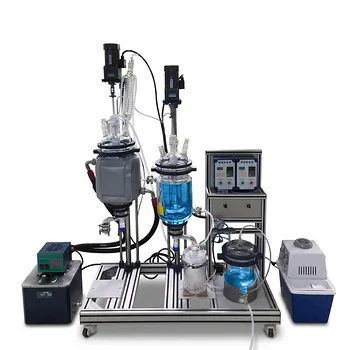
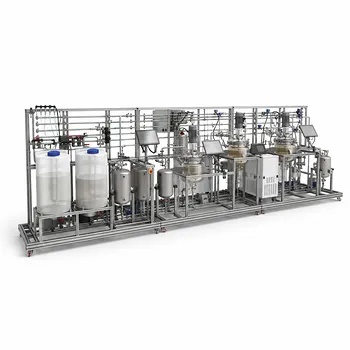
Aggregation and agglomeration can quietly derail a crystallization process that worked flawlessly in the lab. During scale-up, these phenomena introduce bimodal crystal size distributions, batch-to-batch variability, and the formation of immobile slurries that can foul internal reactor equipment and disrupt mixing. Pilot plants provide the controlled environment needed to study these scale-dependent effects—allowing engineers to optimize fluid shear, minimize the driving force for particle sticking, and define a robust operating window before full-scale manufacturing.
The central challenge is that fluid dynamics and mixing patterns change non-linearly with vessel size. What appears as minor particle clustering in a beaker can become a catastrophic loss of slurry mobility and product consistency in a production crystallizer. Pilot plants bridge this gap by making the invisible scale-dependent physics visible, enabling a data-driven strategy to balance shear, supersaturation, and suspension.
The Hidden Risks of Scaling Crystallization: Aggregation and Agglomeration
These particle adhesion phenomena are not just a nuisance—they are direct indicators that your process is not under control. Understanding their root causes is the first step to preventing them.
The Defining Problem: When Crystals Stick Together
Aggregation refers to crystals that adhere through weak physical forces, while agglomeration involves stronger fusion or intergrowth. Both lead to a wider, often bimodal, particle size distribution because large clumps coexist with untreated fine particles.
These irregular clumps create downstream filtration nightmares and can trap impurities, compromising final product purity and bioavailability. In a flowing slurry, they also increase effective viscosity, sometimes causing the entire crystal bed to jam.
From Laboratory Anomaly to Plant‑Scale Disaster
At the benchtop, a small amount of sticking might go unnoticed because manual stirring and small volumes mask poor mixing. In a pilot or production vessel, however, the same phenomenon can escalate rapidly, producing a slurry that is impossible to pump or stir.
The result is not just a failed batch but potentially severe equipment damage, such as broken impeller shafts due to the increased torque required to move a solidified mass. Batch-to-batch reproducibility vanishes because the aggregation event itself is a stochastic process sensitive to thermal history and shear history.
Why Scale Changes Everything: Mixing and Fluid Shear
Both aggregation and agglomeration are highly sensitive to fluid shear and mixing dynamics, which do not scale linearly. A gentle, uniform shear in a small vessel can become extreme near the impeller and almost stagnant near the wall in a large tank.
These gradients create local regions of high supersaturation—the very driving force that causes freshly nucleated particles to stick together. Furthermore, as scale increases, the balance between particle collision frequency (promoting sticking) and fluid-induced breakage (tearing clumps apart) shifts dramatically, often tipping toward uncontrolled agglomeration.
How Pilot Plants De‑risk Scale‑Up
Pilot plants are not just bigger labs. They are experimental platforms that replicate the physical realities of industrial mixing, heat transfer, and residence time distribution. This allows engineers to separate process fundamentals from scale artifacts.
Investigating the Fluid Dynamic Fingerprint
In a unit operations pilot plant, engineers can systematically vary agitation speed, impeller design, and reactor geometry to map exactly how shear fields influence agglomeration. By using multiple impeller types (e.g., pitched‑blade vs. retreat‑curve) they can identify which configuration produces the most homogeneous turbulence without creating dead zones.
Real‑time monitoring of solute concentration via process analytical technology (PAT) reveals how fast supersaturation is being relieved. This fingerprints the relationship between mixing intensity, desupersaturation rate, and the onset of particle clustering.
Optimizing the Supersaturation and Shear Balance
Agglomeration is driven by supersaturation, which rises sharply when mixing fails to distribute temperature or concentration. Pilot plants allow precise control of cooling rates and feed addition profiles, so engineers can maintain a consistent, low supersaturation window where growth dominates over nucleation and sticking.
At the same time, the agitation speed is tuned to provide just enough shear to break up loosely formed aggregates without causing catastrophic attrition of fragile crystals (secondary nucleation). This delicate balance is impossible to find via simulation alone—it requires physical experimentation at a representative scale.
Validating Scale‑Up Criteria with Real Data
Scale‑up often begins with a chosen mixing criterion, but each involves trade‑offs:
- Constant energy dissipation rate (P/V) is a common starting point, calculated as (N_{plant} = N_{lab} \times s^{2/3}) (where s is the impeller diameter ratio). It maintains similar turbulence levels but may fail to keep larger‑diameter vessels fully suspended.
- Constant solids suspension speed (Njs) follows (N_{js,plant} = N_{js,lab} \times s^{0.85}) and guarantees particles don’t settle, yet can create excessive shear near the impeller or leave chemical inhomogeneity.
- Constant tip speed scales linearly ((N_{plant} = N_{lab} \times s)) and usually leads to dangerously low agitation, allowing solids to settle and form massive, immobile aggregates.
A pilot plant enables you to test your chosen criterion against reality. You can observe directly whether particles remain suspended, whether local hot spots of supersaturation appear, and how the crystal size distribution evolves—all before committing to a production‑scale design.
Understanding the Trade‑offs
No single mixing strategy or scale‑up rule solves everything. A purely anti‑agglomeration approach can create new problems that pilot plants are uniquely suited to surface.
The Double‑Edged Sword of High Shear
Using intense mixing to keep particles apart and break aggregates can backfire. Excessive agitation increases contact nucleation, where microscopic attrition between particles, impeller, and wall generates a shower of fine crystals. These fines then act as additional sites for agglomeration, potentially worsening the very problem you tried to solve.
In pilot plants, you can monitor crystal morphology under a microscope during a run. If originally robust particles start showing fractured surfaces or if fragile acicular (needle‑like) crystals break, you have direct evidence that your mixing is too harsh, even if the slurry remains mobile.
The Sedimentation Trap
Conversely, a conservative scale‑up that prioritizes gentle conditions risks partial settling. Solids that accumulate at the bottom of the vessel experience high local supersaturation as the temperature changes, fusing them into a hard, immobile cake. The pilot plant reveals this failure mode early, showing that simply maintaining a “low shear” environment is not enough—you must satisfy the minimum suspension speed (Njs) while still managing shear.
Making the Right Choice for Your Scale‑Up Goal
Your pilot plant campaign should be tailored to the specific risks you face. Use it as a decision engine, not just a demonstration run.
After defining your product’s critical quality attributes and your process constraints, focus your pilot‑plant work on the following:
- If your primary focus is preventing agglomerate formation: Map the supersaturation profile across varying cooling rates and mixing speeds using PAT. Identify the highest cooling rate that still avoids a bimodal size distribution, and use that as an upper design limit.
- If your primary focus is ensuring a robust, scalable mixing strategy: Test at least two scale‑up criteria (e.g., constant P/V and constant Njs) in the pilot plant. Compare the resulting crystal size distribution, filterability, and microscopic appearance to select the one that best balances homogeneity with particle integrity.
- If your primary focus is avoiding downstream processing problems: Run the pilot plant in a mode that mimics the full manufacturing cycle, including slurry transfer lines and isolation. Observe if aggregates form in stagnant legs or during temperature ramps, and adjust the equipment design or operating procedure accordingly.
- If your primary focus is teaching or de‑risking a novel compound: Use the pilot plant to deliberately induce agglomeration (e.g., by reducing agitation to failure). Defining the failure boundary is just as valuable as finding the operating point, because it establishes the safe envelope you must never cross.
Approach pilot‑plant scale‑up as an exploration of physical limits, not a confirmation of a single recipe. By doing so, you turn aggregation and agglomeration from unpredictable threats into well‑mapped, avoidable conditions.
Summary Table:
| Scale-Up Challenge | Process Impact | Pilot Plant Solution |
|---|---|---|
| Aggregation & Agglomeration | Bimodal crystal size, impurity trapping, and filter clogging | Optimize supersaturation via controlled cooling and feed rates |
| Non-Linear Fluid Shear | Stagnant zones vs. high-shear zones leading to local sticking | Test impeller designs and speed to balance particle suspension and shear |
| Solids Sedimentation | Hard cake formation at the bottom of the crystallizer | Validate Minimum Suspension Speed (Njs) without causing attrition |
Master Your Process Scale-Up with LABPARK
Bridging the gap between laboratory benchtop and industrial production requires physical testing under realistic fluid dynamics. LABPARK provides state-of-the-art Educational and Vocational Unit Operations Pilot Plants in chemical engineering, bioprocess & biotech, and environmental & water treatment for universities, research institutes, and enterprises.
Our customizable pilot systems help you study shear effects, optimize mixing configurations, and prevent costly crystallization failures before moving to full-scale manufacturing.
Contact LABPARK today to find the right pilot plant solution for your facility!
Related Products
- Multi Functional Membrane Crystallization Educational Unit Operations Pilot Plant
- Potassium Salt Thermal Dissolution and Crystallization Separation Educational Unit Operations Pilot Plant
- Multi-Functional Special Distillation Educational Pilot Plant
- Ethyl Acetate Synthesis Unit Operations Pilot Plant for Practical Training
- Multi-Modal Distillation Unit Operations Training Pilot Plant
People Also Ask
- Control Crystallization Pilot Plant Secondary Nucleation: 4 Key Adjustments
- Why is precise temperature control critical in crystallization pilot plants? Key to Scale-Up Success
- What key factors should be considered when configuring a crystallization unit operations pilot plant?
- What are the benefits of integrating online PAT tools like ATR-FTIR into crystallization unit operations pilot plants?
- How to use crystallization pilot plant agitation speed to identify diffusion vs reaction growth?