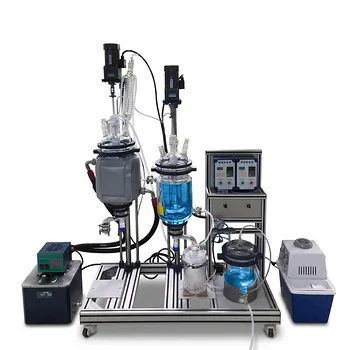
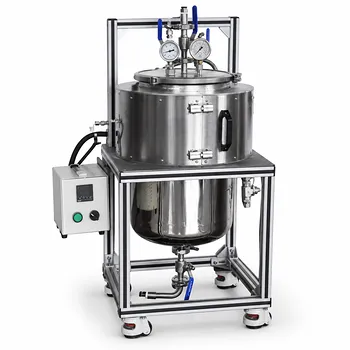
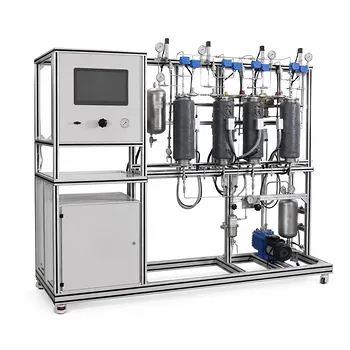
The central challenge of wall temperature management in a batch cooling crystallization pilot plant is this: a smaller heat transfer area-to-volume ratio forces the use of a colder jacket, creating a vessel wall that is significantly cooler than the bulk liquid. This localized “cold wall” generates extreme supersaturation at the surface, well before the bulk solution reaches seeding conditions, which triggers uncontrolled nucleation, degrades crystal quality, and introduces a difficult trade-off between cooling speed and process stability.
Pilot plant cooling crystallization requires reconciling the enhanced heat transfer driving force needed at small scale with the risk of violating the metastable zone width directly at the vessel wall. The operational art lies in designing cooling profiles and jacket temperature limits that prevent wall-induced nucleation without extending batch time to the point where spontaneous nucleation occurs in the bulk.
Why Wall Temperature Becomes a Critical Challenge in Pilot-Scale Crystallization
The Geometry of Heat Transfer at Small Scale
When a cooling crystallization process scales down to a pilot plant, the ratio of heat transfer surface area to vessel volume decreases. To remove heat at the same rate (i.e., maintain the same cooling curve), the temperature difference between the jacket and the bulk solution must increase. This is a straightforward consequence of the heat transfer equation: Q = U·A·ΔT. A smaller A demands a larger ΔT to deliver the same Q.
The Cold Wall Effect and Metastable Zone Violation
A large jacket-to-bulk temperature differential means the vessel wall becomes much colder than the solution body. Before seeding, this cold wall locally drives solute concentration to a deeply supercooled state. If the local supersaturation exceeds the metastable limit, primary nucleation erupts directly on the wall. This nucleation is uncontrolled, unpredictable, and nearly impossible to suppress once the solution is in contact with that surface.
The Consequences of Unmanaged Wall-Induced Nucleation
Premature Primary Nucleation
When the wall temperature drops too low, crystals form before the intended seeding point. These nuclei are typically tiny, abundant, and originate from a thin film at the wall rather than from a well-mixed bulk. Because they are not introduced under controlled supercooling with precise seed crystals, the resulting crystal population is highly heterogeneous.
Degraded Crystal Size Distribution and Purity
Uncontrolled nucleation yields needle-like or dendritic crystals with poor filterability and low purity. The product’s size distribution widens, and downstream processing becomes erratic. This is especially problematic in pilot plants intended to mimic production-scale quality, but instead generate data that is impossible to translate to larger vessels.
Understanding the Trade-offs: Cooling Rate vs. Nucleation Control
The Trap of an Aggressive Jacket ΔT
Pushing the jacket temperature far below the solution temperature dramatically shortens batch time but all but guarantees wall-induced spontaneous nucleation. The supercooling at the wall can easily exceed the threshold (e.g., ΔT ≥ 8°C for some hydrates) where uncontrolled nucleation becomes inevitable, even if the bulk measurement stays within the metastable zone.
The Peril of an Overly Conservative Cooling Profile
Cautiously limiting the jacket-solution ΔT to avoid cold-wall nucleation preserves the metastable state at the wall, but greatly extends the cooling time. A prolonged cooling period can cause the bulk solution itself to nucleate spontaneously because even a small supercooling maintained for an extended duration can push the system past the metastable limit by statistical fluctuation or by acting on any active impurity. Slow cooling may also lead to uncontrolled nucleation if the point of seeding is missed.
The Design Sweet Spot
Pilot plant trials exist precisely to find the maximum allowable jacket ΔT that does not trigger localized nucleation while still achieving a cooling rate that keeps the overall batch time within a nucleation-safe window. This sweet spot is unique to each solute–solvent system, vessel geometry, and agitation regime.
Practical Strategies to Manage Wall Temperature in Pilot Plants
Designing Safe Cooling Profiles
Pilot plant operations design segmented cooling profiles where the jacket temperature is automatically adjusted to maintain a nearly constant small driving force. For example, a linear cooling ramp for the bulk might be paired with a jacket that progressively cools, never exceeding a pre-defined ΔT_max. These profiles are validated by observing whether crystals appear on the wall before seeding.
Implementing Seeding at the Correct Thermal Condition
Crystallization is deliberately induced by introducing seed crystals exactly when the solution enters the metastable zone. By ensuring the bulk is uniformly at a safe supercooling (e.g., ΔT < 4°C for a specific hydrate) and the wall temperature is not excessively low, the growth proceeds on the seeds without eruptive nucleation.
High-Precision Temperature Control and Uniform Mixing
Pilot plants require temperature control loops with high accuracy and fast response to maintain the jacket at the designed setpoint without overshoot. Additionally, robust agitation and optimized circulation flow rates reduce the temperature boundary layer at the wall, lowering the effective local supercooling and preventing stagnant cold spots that favor spontaneous nucleation.
Using Advanced Monitoring
Close observation of turbidity, FBRM (Focused Beam Reflectance Measurement), or visual inspection helps detect the first signs of wall nucleation. This data feeds back into refining the cooling profile for subsequent batches, turning the pilot plant into a true scale-up learning tool rather than a source of irreproducible results.
Making the Right Choice for Your Pilot Plant Crystallization
Effective wall temperature management is not a one-size-fits-all prescription; it must be aligned with your primary development goal. Here is how to prioritize the trade-offs:
- If your primary focus is maximizing crystal purity and size uniformity: Adopt a conservative jacket
ΔTlimit and a longer cooling profile. Accept a longer batch time in exchange for suppressing wall nucleation and operating entirely within the metastable zone. - If your primary focus is minimizing batch time while maintaining acceptable quality: Use a segmented cooling profile that pushes the jacket
ΔTup to the experimentally determined maximum safe limit, and tightly couple it with aggressive but even agitation to scrub the wall boundary layer. - If your primary focus is generating scale-up data for a production reactor: Characterize the exact heat transfer coefficients and
ΔT_maxthat correlate with zero wall nucleation. Document the pairing of cooling rate and agitation rate that yields the target supercooling profile; this becomes the basis for maintaining geometrical similarity and thermal equivalence at full scale.
The pilot plant’s true value is revealed when wall temperature is managed as a primary variable—not just a consequence of scale. By deliberately mapping the trade-off between heat transfer driving force and metastable zone limits, you transform a small-scale challenge into a repeatable, scalable crystallization design.
Summary Table:
| Key Challenge | Cause / Mechanism | Operational Impact | Mitigation Strategy |
|---|---|---|---|
| Cold Wall Effect | Small heat transfer area-to-volume ratio requires high jacket-bulk Delta T. | Localized supersaturation & primary nucleation on vessel walls. | Segmented cooling profiles with defined Delta T_max. |
| Uncontrolled Nucleation | Wall temperature drops below metastable zone limit before seeding. | Heterogeneous crystal population, poor filterability & purity. | High-precision temperature control & optimized agitation/mixing. |
Optimize Your Crystallization Process with LABPARK
Managing complex thermal dynamics in pilot-scale crystallization requires precision-engineered equipment. LABPARK provides state-of-the-art Educational and Vocational Unit Operations Pilot Plants in chemical engineering, bioprocess & biotech, and environmental & water treatment. Designed specifically for universities, research institutes, and enterprises, our pilot plants deliver the precise temperature control and uniform mixing needed to prevent wall-induced nucleation and scale up your processes with confidence.
Ready to enhance your lab's research capabilities and ensure repeatable crystallization results? Contact our expert team today to find the perfect pilot plant solution for your needs.
Related Products
- Multi Functional Membrane Crystallization Educational Unit Operations Pilot Plant
- Potassium Salt Thermal Dissolution and Crystallization Separation Educational Unit Operations Pilot Plant
- Continuous Batch Extractive Distillation Educational Pilot Plant
- Multi-Functional Special Distillation Educational Pilot Plant
- Hot Filtration Educational Unit Operations Pilot Plant Laboratory System
People Also Ask
- Why is precise temperature control critical in crystallization pilot plants? Key to Scale-Up Success
- Control Crystallization Pilot Plant Secondary Nucleation: 4 Key Adjustments
- What key factors should be considered when configuring a crystallization unit operations pilot plant?
- What are the benefits of integrating online PAT tools like ATR-FTIR into crystallization unit operations pilot plants?
- How to use crystallization pilot plant agitation speed to identify diffusion vs reaction growth?