Particle size inconsistency is the root cause of bypassing in wet-lay structured sorbent fabrication. When sorbent particles of varying diameters are entrained in a fibrous slurry, they settle at different speeds. This differential settling creates non-uniform particle distribution, leaving weak spots and open channels in the microfibrous network. In unit operations laboratory training, such bypassing undermines experiments by distorting gas flow patterns, leading to premature breakthrough and preventing students from accurately measuring equilibrium and kinetic data.
Bypassing in these sorbents isn’t just a manufacturing flaw—it’s a direct threat to educational integrity. A fiber matrix that looks sound can still contain invisible flow channels, causing early gas breakthrough that mimics false performance. For lab courses focusing on reactor design, mass transfer, and kinetics, the ability to recognize and eliminate bypassing becomes a fundamental learning objective in itself.
The Wet-Lay Process and How Inconsistency Creates Hidden Channels
The wet-lay method suspends microfibers and sorbent particles in water, then forms a sheet by draining the liquid. This is the critical moment where size uniformity dictates structural uniformity.
How Inconsistent Particle Sizes Drive Differential Settling
In a mixed-size system, larger particles settle faster under gravity, concentrating at the bottom of the mat. Fine particles remain suspended longer, clustering near the top or in isolated pockets. The resulting composite is stratified, not homogeneous.
The Formation of Preferential Flow Channels
These stratified regions create localized areas of low particle density. When gas flows through the sorbent bed, it naturally seeks the path of least resistance. The loosely packed zones become highways for gas, bypassing the sorbent-rich regions entirely. The primary reference correctly identifies these as channels that directly cause gas bypassing, and this effect is amplified when the sheet is cut into reactor-sized pieces, potentially aligning multiple defects.
Why Bypassing Devastates Unit Operations Laboratory Training
For a lab exercise designed to teach reactor modeling and mass transfer, a bypassing sorbent bed fails in two critical ways—both of which sabotage the student's ability to learn from the data.
Premature Breakthrough Masks True Equilibrium
A well-made sorbent should show a sharp breakthrough curve, indicating uniform gas contact and full utilization of capacity. Bypassing gas flows through with minimal contact, breaking through far earlier than the bed’s true capacity would allow. Students measure a “breakthrough” that reflects structural defects, not thermodynamics. This prevents them from validating adsorption isotherms or understanding equilibrium-limited behavior.
Kinetics Measurements Become Unreliable
Reaction or adsorption kinetics depend on a known, uniform flow distribution to derive rate constants. Bypassing distorts residence time distributions, making the reactor behave like a combination of a packed bed and a parallel bypass stream. Calculated kinetic parameters become artifacts of flow maldistribution, not the intrinsic reaction rates the experiment was designed to teach. Students end up modeling poor data, reinforcing misconceptions instead of building foundational knowledge.
Understanding the Trade-offs: Uniformity, Cost, and Fabrication Practicality
Achieving perfect particle monodispersity is a real-world challenge. Lab instructors and process designers must weigh several competing factors.
- Tight particle size cuts improve dispersion but increase material cost and sieving time.
- Broader size distributions speed up fabrication and mimic industrial-grade materials, yet they introduce bypassing risk.
- Thicker mats can sometimes compensate by adding more tortuosity, but they increase pressure drop and alter mass transfer characteristics—swapping one artifact for another.
- Visual inspection of the final felt is rarely sufficient; bypassing channels are often microscopic.
- Teaching the trade-off itself becomes a valuable lesson: students learn that characterization (e.g., bed permeability testing, tracer studies) is essential before trusting any experimental run.
How to Apply This to Your Laboratory Training
The goal is not to eliminate all variability, but to produce a sorbent bed whose flow behavior is predictable and well-characterized. Use the following guidance to align your fabrication process with your educational objectives.
- If your primary focus is demonstrating ideal reactor behavior: Use tightly sieved particles with a coefficient of variation below 5% and verify cross-sectional uniformity using micro-CT or simple dye tracer tests before the run.
- If your primary focus is industrial-process troubleshooting: Teach students to diagnose bypassing by intentionally creating two beds—one uniform, one with mixed sizes—and have them compare breakthrough curves, pressure drop profiles, and calculated capacity.
- If your primary focus is bridging theory and practice: Require each student group to measure the bed’s Peclet number or residence time distribution and include a bypassing fraction in their reactor model, reinforcing that real systems are rarely ideal.
- If your primary focus is resource-constrained lab scalability: Use layered deposition techniques (e.g., depositing fines first, then larger particles) to engineer a gradient that reduces channel formation even when size uniformity is imperfect.
By confronting bypassing head-on, your unit operations lab transforms from a recipe-following exercise into a genuine investigation of mass transfer fundamentals—and your students leave equipped to design and troubleshoot real adsorption systems.
Summary Table:
| Key Aspect | Mechanism / Impact | Recommended Action |
|---|---|---|
| Root Cause | Inconsistent particle sizes settle at different speeds during wet-lay. | Tighten particle sieving (coefficient of variation < 5%). |
| Structural Defect | Stratification creates localized low-density paths of least resistance. | Verify bed uniformity using tracer tests or micro-CT. |
| Educational Impact | Premature breakthrough and unreliable kinetics distort student models. | Teach students to diagnose bypassing by comparing non-ideal beds. |
Bridge the Gap Between Theory and Practice with LABPARK
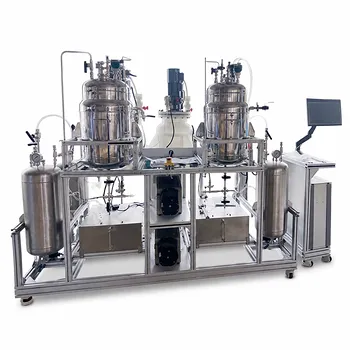
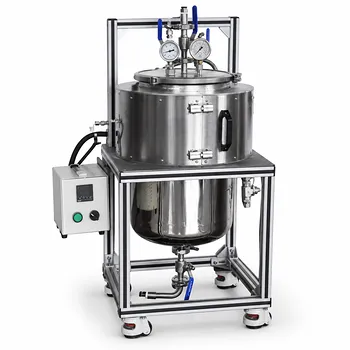
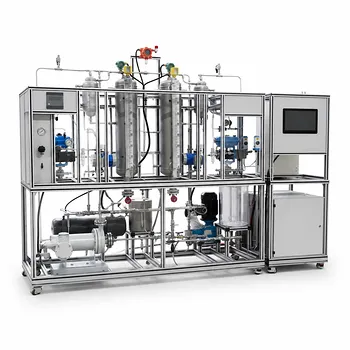
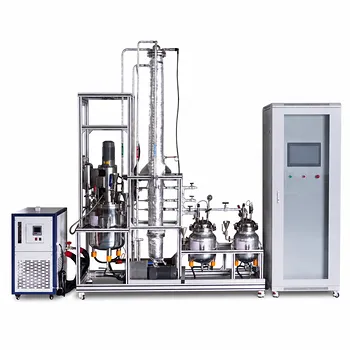
Ensure your students work with reliable, industry-grade equipment. LABPARK provides advanced Educational and Vocational Unit Operations Pilot Plants in chemical engineering, bioprocess & biotech, and environmental & water treatment for universities, research institutes, and enterprises. Our pilot plants help eliminate experimental anomalies and deliver predictable, high-fidelity data.
Contact LABPARK today to find the perfect pilot plant for your lab!
Related Products
- Rising and Falling Film Evaporation Educational Unit Operations Pilot Plant
- Polymerization Granulation and Pellet Processing Educational Unit Operations Pilot Plant
- Constant Pressure Filtration Educational Unit Operations Pilot Plant
- Multi-Functional Drying Educational Unit Operations Pilot Plant
- General Purpose Cosmetics Production Unit Operations Training Pilot Plant
People Also Ask
- How do educational unit operations pilot plants bridge theory and design? Bridge the Engineering Gap
- How do educational unit operations pilot plants address safety and waste management when scaling up?
- How is the heat transfer area calculated for an evaporation unit operations pilot plant during experimental design? Guide
- How to select educational evaporator pilot plants for thermal & scaling solutions? Complete Guide
- What are the structural characteristics & applications of rising-falling film evaporators in unit operations training?