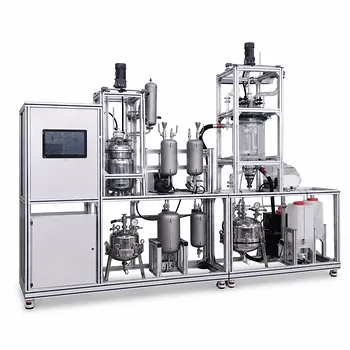
The choice between a centrifugal and a column-type extraction pilot plant for a training laboratory is not simply about performance—it’s about aligning your instructional mission with the capabilities and constraints of the equipment. A centrifugal extractor delivers industry-relevant speed and gentle treatment for sensitive biomolecules, but it demands higher costs, rigorous maintenance, and sacrifices the visual, hands-on learning that columns provide. A column-type pilot plant, by contrast, offers transparent, robust operation ideal for teaching fundamental mass transfer principles, yet it falls short when you need to demonstrate rapid processing or handle difficult-to-separate liquid systems common in modern bioprocessing.
The core trade-off in a training context is between exposing students to advanced, high-speed extraction technology (centrifugal) and providing a durable, low-cost platform where they can visibly observe and internalize classical unit operations (column). The right decision depends on whether your curriculum emphasizes industrial readiness or foundational understanding.
Defining the Training Lab’s Priorities
What a Centrifugal Extractor Brings to the Curriculum
The primary reference and supporting literature confirm that centrifugal extractors excel in processing heat-sensitive bioproducts such as antibiotics or recombinant proteins. They achieve near-instantaneous mass transfer and phase separation through high g-forces, drastically reducing product degradation.
This makes them indispensable for demonstrating modern, high-throughput downstream processing. In an educational setting, they expose trainees to equipment they will encounter in advanced pilot plants and biomanufacturing facilities.
Additionally, these units handle systems with extremely low density differences or strong emulsification tendencies—scenarios where gravity columns would require impractically large vessels or long residence times. The centrifugal force effectively breaks emulsions and drives separation, broadening the experimental scope.
What a Column Extractor Provides for Pedagogy
Column-type extractors—whether packed, rotating disc, or pulsed—are structurally simpler and inherently more visual. Many can be constructed with glass sections, allowing students to directly observe the dispersion, coalescence, and interfacial behavior that underpin all liquid-liquid extraction.
This transparency is a profound teaching advantage. Students can witness the formation of flooding, the effect of flow rate changes, and the actual movement of droplets, building an intuitive understanding that opaquely sealed centrifugal machines cannot offer.
The mechanical simplicity also translates to easier cleaning and lower downtime between experiments. For a shared training facility where multiple user groups run diverse systems, this operational ruggedness is a major asset.
Performance Characteristics and Their Educational Impact
Processing Speed and Product Sensitivity
The primary reference highlights a defining trade-off: centrifugal units provide extremely short residence times. For bioproducts prone to thermal or chemical degradation, this can mean the difference between a successful extraction and a denatured sample.
However, this speed comes with an educational nuance. The process is so fast that students cannot observe the separation dynamics. They only see inputs and outputs, which can turn a rich learning moment into a “black box” experience.
Columns, with their longer residence times, force students to think about steady-state operation and equilibrium stages. While slower, they make the physics tangible, which is crucial for deep conceptual learning.
Handling Solids and Real-World Feeds
A critical vulnerability of centrifugal extractors is their sensitivity to solids or precipitates. In bioprocess training, if the goal is to work with unclarified fermentation broths or cell lysates, clogging can become a frequent and frustrating maintenance issue.
Column-type extractors, especially those with open internal structures, are far more forgiving. They tolerate a certain level of particulate loading and are easier to disassemble and clean when fouling occurs. This robustness is a practical necessity in a teaching laboratory where experimental purity can vary.
This does not mean columns are universally better; it simply means that the cost of immaculate feed preparation must be factored into the centrifugal workflow. For training, this adds a layer of complexity that may detract from the core extraction principles being taught.
Understanding the Trade-offs for a Training Environment
The Visibility-versus-Velocity Conflict
The most poignant trade-off is visual feedback versus processing velocity. Centrifugal extractors prioritize speed and efficiency, making them the tool of choice for industry but leaving students with less direct sensory data. Columns prioritize demonstrability, sacrificing throughput for a crystal-clear view of mass transfer in action.
For a laboratory focused on basic engineering education, the column’s visibility is often the deciding factor. For one geared toward bioprocess R&D, the centrifugal unit’s ability to replicate industrial conditions takes precedence.
Operational Cost and Maintenance Burden
The primary reference notes that centrifugal extractors involve higher manufacturing and operating costs and a complex mechanical structure. In a training facility, this translates to a need for dedicated technical support and more expensive spare parts.
A column’s lower capital and maintenance costs free up budget for consumables, additional experiments, or other pilot plants. This can broaden the laboratory’s overall educational offering rather than concentrating resources on a single, high-maintenance asset.
Footprint and Facility Requirements
Centrifugal extractors typically offer a compact footprint for the throughput they deliver, but they require robust mounting and may generate vibration or noise. Columns often demand significant vertical space and a larger installation area, which can be a constraint in smaller academic labs.
The decision can hinge on whether your facility can accommodate the height of a column versus the structural requirements of a high-speed centrifuge. Supplementary references confirm that mechanically agitated columns offer a compromise with a more moderate footprint and good dispersion, though still larger than a centrifugal machine.
Making the Right Choice for Your Training Goals
The best equipment aligns the inherent trade-offs with the specific learning objectives and operational realities of your laboratory. Consider the following recommendations based on your primary focus.
- If your primary focus is teaching fundamental extraction principles with visual clarity: Choose a column-type pilot plant. Its transparent, forgiving operation allows students to see and understand the physics behind every separation.
- If your primary focus is preparing students for modern biomanufacturing and rapid, gentle processing: Choose a centrifugal extractor. It will expose them to the very equipment used for heat-sensitive, high-value products in the pharmaceutical industry.
- If your primary focus is minimizing cost, complexity, and downtime in a multi-user facility: A column extractor is the clear winner. Its simplicity keeps training running smoothly with less specialized technical support.
- If your primary focus is experimenting with challenging liquid-liquid systems (low density difference, emulsifying): A centrifugal extractor may be essential. Without it, certain relevant bioprocess demonstrations simply become impractical.
Ultimately, the most effective training tool is the one that removes enough abstraction to cement core principles while still being safe to operate and maintain. Your choice is a commitment to a specific educational philosophy, and that clarity of purpose will determine which set of trade-offs you can confidently accept.
Summary Table:
| Feature | Centrifugal Extraction | Column-Type Extraction |
|---|---|---|
| Visibility | Low (Opaque/Sealed) | High (Transparent/Glass) |
| Processing Speed | Very Fast (Short residence) | Slower (Steady-state focus) |
| Solids Handling | Sensitive to clogging | Tolerant & easier to clean |
| Cost & Maintenance | Higher capital & maintenance | Lower cost, simpler operation |
| Best For | Advanced bioprocess R&D | Fundamental mass transfer pedagogy |
Build the Perfect Training Lab with LABPARK
Selecting the right pilot plant is critical to your curriculum's success. LABPARK provides premium Educational and Vocational Unit Operations Pilot Plants in chemical engineering, bioprocess & biotech, and environmental & water treatment. Designed specifically for universities, research institutes, and enterprises, our systems balance industrial realism with educational clarity.
Ready to upgrade your laboratory? Contact our experts today to find the ideal extraction solution for your training needs!
Related Products
- Centrifugal Pump Performance and Orifice Flowmeter Calibration Educational Pilot Plant
- Natural Product Extraction Unit Operations Training Pilot Plant
- Educational Rotary Disc Liquid-Liquid Extraction Pilot Plant
- Continuous Batch Extractive Distillation Educational Pilot Plant
- Comprehensive Liquid-Liquid Extraction Pilot Plant for Engineering Education
People Also Ask
- What features should instructors look for in pump & flowmeter pilot plants? Key Selection Guide
- Why start a centrifugal pump with a closed outlet valve? Protect your pilot plant motors.
- How to update chemometric calibration models in pilot plants? Best practices for process engineers.
- Why is continuous measurement preferred over manual sampling in pilot plants? Get real-time kinetic insights.
- Why is Peng-Robinson preferred over SRK? Enhance thermodynamic modeling in educational pilot plants.