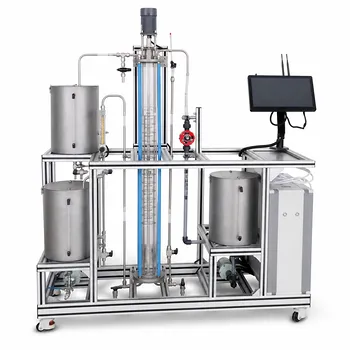
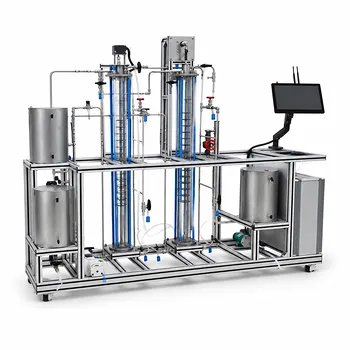
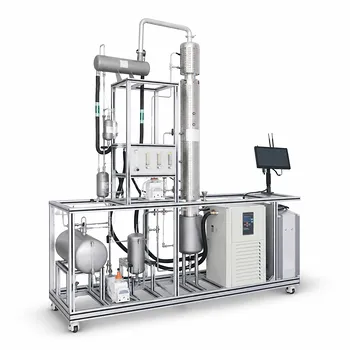
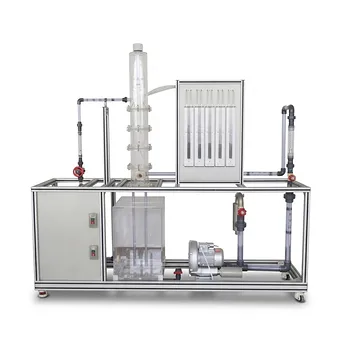
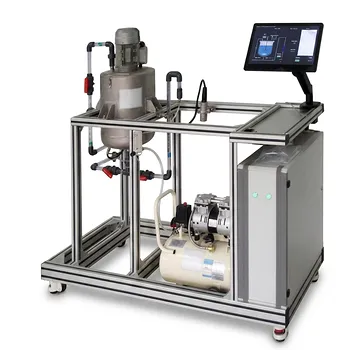
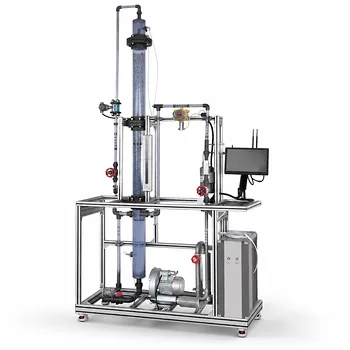
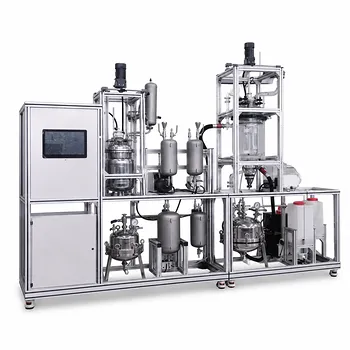
Both columns use mechanical agitation, but they achieve it through fundamentally different internals. The Oldshue-Rushton tower relies on compartmentalized stator rings and high-shear Rushton turbines to tightly control axial mixing, while the Rotating Disc Contactor (RDC) uses a simpler, open architecture with flat rotating discs that deliver gentler, more stable dispersion. This core structural divergence directly shapes their operational sensitivity, throughput, and suitability for teaching versus focused research.
Understanding these differences is crucial for pilot plant design, as the choice between them determines how clearly you can isolate and demonstrate the effects of shear force, droplet size, and backmixing on extraction efficiency.
The Core Design Philosophies: How Each Column Creates Dispersion
The physical internals are the starting point. They define every subsequent operational characteristic.
The Oldshue-Rushton Tower: Compartmentalized Control
The Oldshue-Rushton column is built around vertical stator rings that divide the entire column into a series of distinct mixing compartments. Inside each compartment, a Rushton turbine impeller mounted on a central shaft provides intense, localized shear to disperse the liquid phases. Crucially, each compartment is separated by horizontal baffle plates, which act as physical barriers to deliberately suppress liquid flowing back in the axial direction. This creates a cascading series of well-mixed stages, closely approaching plug flow.
The Rotating Disc Contactor (RDC): Open Simplicity
The RDC’s structure is far simpler. It consists of a column shell with a central rotating shaft on which flat, circular discs are mounted at intervals. There are no stator rings or compartmentalizing baffles. These simple discs rotate to apply shear force, but the column interior remains a largely open, uninterrupted vertical passage. This minimalism is the source of the RDC’s operational flexibility and high throughput.
How Structure Dictates Operational Behavior
The two designs lead to sharply different behaviors in how dispersion is achieved and how sensitive the process is to adjustments.
The Dispersion Mechanism and Shear Intensity
In the Oldshue-Rushton column, the Rushton turbines generate high, concentrated shear in each compartment. This produces a fine droplet size distribution but can be highly aggressive. The RDC’s flat discs, by contrast, create a gentler, more distributed shearing field across the column diameter. The dispersion effect is a direct result of the disc’s rotation, without the intense turbulence of baffled turbine compartments.
Sensitivity to Rotor Speed
This is a critical operational differentiator. The Oldshue-Rushton column is highly sensitive to changes in agitation speed, especially at larger column diameters. Minor speed adjustments can dramatically alter droplet size and, consequently, flooding and separation performance. The RDC, however, is far less sensitive to variations in rotation speed. Its dispersion effectiveness changes gradually, allowing for more stable and forgiving operation. This robustness makes it easier to operate without constant fine-tuning.
Throughput and Stability
The open internal structure of the RDC provides minimal resistance to phase flow, granting it a large throughput capacity and excellent hydraulic stability. The Oldshue-Rushton’s compartment baffles, while effective at suppressing backmixing, inherently restrict flow and can reduce maximum throughput. The RDC’s design ensures that its dispersion effect remains stable even with minor fluctuations in rotor speed, making it inherently reliable for long-duration runs.
Understanding the Trade-offs
Neither column is perfect for all situations. Choosing requires acknowledging their hidden costs.
The Scale-Up Trap of the Oldshue-Rushton
The very feature that makes the Oldshue-Rushton column excellent for research—its aggressive compartmentalization—becomes a liability at scale. As the column diameter increases, the sensitivity to agitation speed intensifies. A speed profile that works well in a small glass pilot unit can lead to severe axial mixing or flooding in a larger column, making scale-up a delicate, non-linear problem. This is a classic pitfall: a design that teaches control at the bench may not translate to industrial predictability.
The Simplicity Trade-off
The RDC’s open design, while robust, offers less aggressive local mixing and does not physically force a compartment-to-compartment cascade. For research that demands studying the absolute suppression of axial backmixing or the effects of intense localized shear, the RDC’s gentler, more integrative behavior may mask certain mechanisms. Its strength in stability and throughput comes at the cost of the razor-sharp compartmentalization found in the Oldshue-Rushton tower.
Making the Right Choice for Your Pilot Plant Goal
Your selection should be dictated entirely by what you intend to teach or study. Each column excels at revealing different fundamental truths.
- If your primary focus is teaching fundamental extraction principles with a stable, robust platform: Choose the Rotating Disc Contactor. Its forgiving nature, simple design, and high throughput let students concentrate on phase behavior and mass transfer without battling column instability.
- If your primary focus is researching the precise effects of axial mixing and intense shear on droplet size distribution: Choose the Oldshue-Rushton tower. Its compartmentalized design and sensitivity to agitator speed provide a powerful lens for isolating and demonstrating these specific fluid dynamic variables.
The right mechanical agitation column is the one that makes the specific trade-off you are studying as visible as possible to the operator.
Summary Table:
| Feature | Oldshue-Rushton Tower | Rotating Disc Contactor (RDC) |
|---|---|---|
| Internals | Stator rings & Rushton turbines | Flat rotating discs (no stators) |
| Shear Intensity | High, localized shear | Gentle, distributed shear |
| Speed Sensitivity | Highly sensitive (risk of axial mixing) | Robust & forgiving of speed changes |
| Throughput | Restricted by baffle plates | High capacity & excellent stability |
| Best For | Researching axial mixing & droplet size | Teaching fundamental extraction principles |
Optimize Your Extraction Lab with LABPARK
Selecting the right extraction column is critical for achieving your academic and research goals. LABPARK provides state-of-the-art Educational and Vocational Unit Operations Pilot Plants in chemical engineering, bioprocess & biotech, and environmental & water treatment for universities, research institutes, and enterprises.
Whether you need to demonstrate stable, high-throughput extraction with a Rotating Disc Contactor (RDC) or conduct advanced research on shear effects in an Oldshue-Rushton tower, we have the engineering expertise to build the perfect pilot unit for you.
Ready to elevate your engineering lab? Contact LABPARK today to discuss your customized pilot plant requirements!
Related Products
- Educational Rotary Disc Liquid-Liquid Extraction Pilot Plant
- Comprehensive Liquid-Liquid Extraction Pilot Plant for Engineering Education
- Continuous Batch Extractive Distillation Educational Pilot Plant
- Multi-Functional Special Distillation Educational Pilot Plant
- Continuous Sieve-Plate Distillation Pilot Plant for Unit Operations Laboratory Education
People Also Ask
- How do density and IFT affect liquid-liquid extraction pilot plants? Optimize Column Performance
- How are ternary phase diagrams and LLE data applied in extraction experiments? Optimize Pilot Plant Scale-up
- In a liquid-liquid extraction pilot plant, how is a ternary-phase diagram utilized to determine solvent feed requirements?
- How Do Selectivity & Distribution Coefficients Influence LLE Pilot Plant Solvent Choice?
- How to Validate BIPs for LLE Pilot Plants? Steps to Align Simulations with Reality