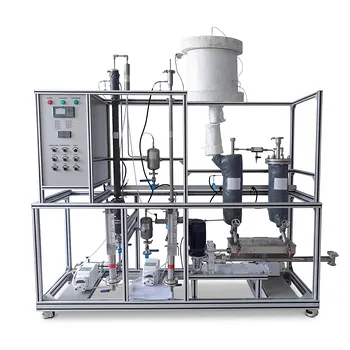
High-temperature fused salt electrolysis is one of the most challenging unit operations to bring from the bench to a pilot plant, pushing materials and thermal control systems to their absolute limits. The primary operational challenges stem from containing highly corrosive melts and reactive products (molten metals, halogen gases) while maintaining stable, energy-efficient operation. The cornerstone thermal management strategy is to aggressively lower the operating temperature through the use of a flux—a secondary salt that depresses the melting point of the primary electrolyte—and to pair this with advanced, corrosion-resistant containment and heat-transfer designs.
Fused salt electrolysis succeeds in pilot plants not by withstanding extreme temperatures, but by intelligently reducing them. The central strategy is to use a flux to lower the melt’s freezing point, then build a thermal management system that controls every watt of heat in an environment where the wrong temperature gradient can cause catastrophic failure.
The Inherent Aggressiveness of the Fused Salt Environment
Fused salt electrolysis creates a perfect storm of thermal and chemical aggression. The core challenge is not just heat, but the combination of intense heat with chemically incompatible products.
Why the Process Itself Destroys Ordinary Equipment
Molten salts at 600–1000°C can dissolve or rapidly corrode conventional metals. At the same time, the electrolysis products—such as molten sodium, lithium, or halide gases like chlorine—will attack almost any unprotected surface. Even ceramic liners can fail if they are not perfectly matched to the salt chemistry.
Thermal Stress and Material Limits
Operating above 300°C drastically reduces the maximum allowable stress of standard steels, forcing pilot plants into expensive, code-compliant designs. Above 500°C, creep becomes a real risk, and thermal cycling can induce fracture. For reliable operation, the reactor pressure boundary often needs to be kept mechanically cool, which drives cold-wall reactor architectures or thick internal insulation.
The Hidden Threat of Salt Hydrolysis
Many halide salts are hygroscopic, and any trace of moisture will trigger endothermic salt hydrolysis at high temperatures. This produces corrosive hydrogen halide gases and metal oxides that precipitate as turbidity, clogging pipes and electrodes. Suppressing hydrolysis demands absolute atmospheric control and dry feed materials—a constant operational discipline.
The Thermal Management Playbook for Pilot Plants
Effective thermal management in fused salt electrolysis is a layered strategy. It begins with chemistry (fluxing) and extends through reactor architecture to heat-exchange integration.
Strategy 1: Lower the Thermodynamic Target with a Flux
The primary reference's most important insight is this: do not operate at the pure salt's melting point. Adding even a small amount of a second salt (e.g., barium chloride to sodium chloride) creates a eutectic mixture with a significantly lower liquidus temperature. This simultaneously reduces energy input, eases thermal stress on the reactor vessel, and broadens the safe operating window before solidification occurs.
Strategy 2: Select Containment for the Real Operating Temperature
By using a flux, you can operate at a temperature where a wider selection of corrosion-resistant alloys or ceramics is viable. High-nickel alloys, graphite, or dense alumina may become practical. The thermal strategy and the materials strategy are inseparable—only by lowering the peak temperature do you earn the right to use a more durable, easier-to-fabricate containment.
Strategy 3: Architect the Reactor for Heat Management
At the elevated but reduced temperatures, the pilot plant must still handle significant heat. Two approaches dominate:
- Cold-wall reactors: The vessel's pressure shell is kept cool (often below 300°C) by an internal insulating lining or an external cooling jacket. The structural steel sees only low stress, while the hot electrolyte is contained by a chemically resistant liner. This compartmentalizes the mechanical and corrosion challenges.
- Integrated high-intensity heat exchange: Borrowing from fuel-processing pilot plants, you can embed microchannel heat exchangers or carefully designed heating cartridges directly into the salt bath or the reactor walls. This provides uniform heat supply to maintain the melt and prevent localized freezing, while also enabling rapid heat removal if an exothermic excursion begins.
Strategy 4: Control the Atmosphere to Control the Side Reactions
Thermal management also means preventing unwanted chemical heat sources. A constant dry argon or nitrogen blanket excludes moisture, suppressing both salt hydrolysis and the formation of corrosive acid gases. This maintains the pH stability of the melt and prevents precipitation, ensuring consistent electrolysis performance and protecting downstream tubing from clogging.
Understanding the Trade-offs
Every strategy that makes the pilot plant safer or more efficient introduces a cost.
Fluxes Lower Temperature but May Compromise Purity
Adding a second salt means the electrolytic product (e.g., sodium metal) may now be contaminated with trace barium. If the goal is ultrapure metal, downstream distillation is required, which adds complexity. For high-purity applications, operators often sacrifice the flux benefit and instead invest in more exotic reactor materials to run at a higher, pure-salt temperature.
Cold-Wall Designs Increase Reactor Cost and Complexity
While cold-wall reactors protect the pressure vessel, the inner liner must withstand the full corrosive attack and thermal gradient. A liner failure can expose the shell to a sudden, catastrophic over-temperature event. These designs also require more intricate sealing and are harder to instrument correctly.
Microchannel Heat Exchangers Demand Clean Salts
The high surface-area-to-volume ratio that makes microchannel heat exchangers excellent for heat transfer also makes them extremely susceptible to blockage by precipitated solids or frozen salt. If hydrolysis occurs or if the salt is not pre-purified, these high-performance thermal devices become a major maintenance liability.
Making the Right Choice for Your Pilot Plant Goal
Your specific research or production objective will dictate where you land in the trade-off space.
- If your primary focus is maximizing energy efficiency and equipment longevity: Rely heavily on a eutectic flux to lower the operating temperature, use a cold-wall design with internal insulation, and recirculate waste heat where possible.
- If your primary focus is producing high-purity materials with no foreign cation contamination: Minimize or eliminate the flux, invest in a dense ceramic liner (such as high-purity alumina), and accept the higher energy input and structural reinforcement required for pure-salt temperatures.
- If your primary focus is achieving flexible, rapid-response thermal control for kinetic studies: Adopt an integrated microchannel or internal bayonet heater/cooler layout, maintain ultra-dry conditions rigorously, and pair this with online temperature monitoring at the electrode surface to study reaction dynamics without thermal lag.
Ultimately, the discipline of running a fused salt electrolysis pilot plant is the art of lowering your effective thermal burden while never losing sight of the chemical aggressiveness that temperature alone cannot eliminate.
Summary Table:
| Challenge | Key Impact | Management Strategy |
|---|---|---|
| High-Temp Corrosion | Destroys standard metals & liners | Use flux to lower melting point; select high-nickel alloys/ceramics |
| Thermal Stress | Creep & structural failure >500°C | Implement cold-wall reactor designs with internal insulation |
| Salt Hydrolysis | Produces corrosive acid gases & clogging | Maintain dry argon/nitrogen blanket atmospheric control |
| Thermal Excursions | Localized freezing or overheating | Embed microchannel heat exchangers or heating cartridges |
Scale Up Safely with LABPARK
Are you looking to master complex chemical processes like high-temperature electrolysis? LABPARK provides advanced Educational and Vocational Unit Operations Pilot Plants in chemical engineering, bioprocess & biotech, and environmental & water treatment. We help universities, research institutes, and enterprises bridge the gap between lab-scale research and industrial reality with safe, high-performance pilot systems.
Contact LABPARK today to find the ideal pilot plant solution for your facility!
Related Products
- Alkaline Membrane Water Electrolysis Educational Pilot Plant Unit Operations Training System
- Electrolyte Distillation Purification and Formulation Educational Pilot Plant
- Water Electrolysis Hydrogen Production and Storage Educational Pilot Plant
- Electrolytic Hydrogen Production Educational Unit Operations Pilot Plant
- Potassium Salt Thermal Dissolution and Crystallization Separation Educational Unit Operations Pilot Plant
People Also Ask
- How do chemical engineering pilot plants demonstrate electrolysis? Bridge Theory & Industrial Scale
- How do alkaline and PEM electrolysis technologies differ in pilot plant operations?
- Why is the selection of electrode materials critical when configuring or operating educational electrolysis pilot plants?
- Bipolar vs Monopolar Electrolysis: Key Configuration Details to Analyze in Pilot Plants
- Which Electrolysis Pilot Plant Parameters Ensure Safety & Efficiency? Key Controls Explained