Fuzzy control handles the non-linear, unpredictable behavior of water treatment processes by mimicking human reasoning in three core stages. When you apply it to variables like pH or dissolved oxygen in a pilot plant, the controller moves through Fuzzification, Rule Evaluation, and Defuzzification—converting crisp sensor data into fuzzy categories, applying operator-inspired rules, and then turning the blended result back into a precise valve or pump signal. It is a direct, model-free method that thrives on the uncertainty and shifting dynamics inherent in environmental treatment processes.
The real power of fuzzy control in a pilot plant isn’t just about avoiding differential equations—it lets you directly embed decades of operator intuition into a repeatable, auditable automation strategy. Fuzzification grades reality, rule evaluation manipulates those grades with linguistic logic, and defuzzification delivers a single, actionable output. Together they form a transparent control loop that works even when the process chemistry never sits still.
How Each Stage Solves the Non-Linearity Problem
Pilot water treatment plants expose you to raw, non-linear behavior: a small acid dose might swing pH violently, or oxygen demand can spike with a spike in organic load. Fuzzy control doesn’t try to model these relationships algebraically; instead, it partitions them into human-understandable chunks at every stage.
Fuzzification: Converting Precision into Possibility
This first stage takes your crisp sensor readings—like a pH error of 0.3 or a change-of-error of 0.05—and turns them into degrees of membership in fuzzy sets. You define membership functions (trapezoidal, triangular, or Gaussian curves) for labels such as “negative large,” “near zero,” or “positive small.”
For non-linear variables, this is where you absorb real-world messiness. A pH error of 0.3 might be 70% “small positive” and 30% “near zero” simultaneously. That overlap reflects how a skilled operator would think: “it’s mostly okay, but I can see it starting to drift.” By refusing to force a single, brittle category, fuzzification smooths out the discontinuities that would break a classical PID controller.
Rule Evaluation: Encoding Operator Intuition as IF-THEN Logic
Once your crisp inputs have been graded, the controller executes an IF-THEN rule base filled with linguistic statements drawn directly from human experience. For dissolved oxygen control in a pilot reactor, a typical rule might be:
“IF oxygen error is negative large AND error-change is positive small, THEN air flow increase is medium.”
In a non-linear process, the value is that you’re not approximating a curve with a equation—you’re capturing conditional patterns that depend on the operating region. When pH correction is highly non-linear near neutrality, you simply add rules that fire more strongly in that zone. The inference engine combines all active rules using operators like MIN for AND or MAX for OR, producing a fuzzy output set that blends multiple recommendations. Because each rule is readable, operators and trainees can inspect, question, and tune the logic without a control theory background.
Defuzzification: Turning Blended Advice into a Single Actuator Command
The last stage transforms the fuzzy output set back into a crisp control signal—a specific stroke percentage for a dosing pump or a valve position. The most common method, the centroid technique, computes the geometric center of the aggregated output membership curves.
Why this matters for pilot plant training: defuzzification demonstrates how the controller balances conflicting rules. If one rule says “dose strongly” and another says “dose just a little,” the center of gravity naturally favors the stronger recommendation while still honoring the weaker one. The result is a smooth, continuous output trajectory even as the process shifts from one non-linear zone to another. No switching logic, no separate sets of tuning gains—just a continuous response surface.
Validating the Approach in Pilot Plant Environments
Beyond the three-stage cycle, successful implementation in environmental pilot plants depends on how you integrate these stages into a living system where processes are not only non-linear but also time-varying and sensor-noisy.
Closing the Loop on Training and Process Insight
Because fuzzy control rules remain linguistic, a pilot plant serves as an ideal learning sandbox. Operators can observe a rule firing too aggressively during a pH overshoot and rewrite it on the spot. That immediacy transforms the plant into a training tool: every adjustment teaches the team how reactor hydraulics, biological kinetics, or chemical buffering interact without requiring a differential equation model. The control strategy itself becomes documentation of best practices.
Handling Common Real-World Disturbances
Water treatment pilot plants face slug loads, temperature swings, and sensor fouling. Fuzzy controllers inherently absorb step disturbances without the integral wind-up often seen in PID controllers, because rule outcomes shift the operating point only as much as the active rules dictate. If a dissolved oxygen probe suddenly reads low due to a clog, the resulting large error triggers strong rules that quickly restore agitation or aeration. Once the sensor is cleaned, the error shrinks and high-gain rules deactivate, avoiding overshoot. This selective aggression mirrors how a cautious but adaptive human operator would react.
Understanding the Trade-offs
No control strategy is a perfect fit for every variable. Fuzzy control brings transparency and robustness, but it also carries costs you must weigh.
- Rule base scalability: A small number of inputs (2–3) and 5–7 linguistic labels per input lead to a manageable rule table. Increase the inputs or labels, and the rule count explodes combinatorially, making it harder to validate the controller’s behavior in all operating corners.
- Membership function design remains part art: There’s no automatic, globally optimal way to shape your membership functions. You’ll rely on operator interviews and step-response data, which means the initial controller quality depends on the expertise you capture—and that expertise can be incomplete or contradictory.
- Real-time tuning in the field: Pilot plants are live, unstable environments. While you can tweak rules on the fly, you risk creating unanticipated interactions between rules if you don’t keep a record of what was changed and why. Without a version-controlled rule base, the same controller might behave differently after every maintenance shift.
- Performance vs. traditional advanced control: For processes that are mildly non-linear or well-characterized, a well-tuned gain-scheduled PID or model predictive controller might deliver slightly tighter setpoint tracking with less design effort. Fuzzy control shines brightest when the process is deeply uncertain and the human heuristic is the best model you have.
Making the Right Choice for Your Pilot Plant Goal
Your implementation priorities determine how aggressively you adopt fuzzy control and how you structure its three stages.
- If your primary focus is operator training and process understanding: Let trainees build the rule base themselves from interviews and watch the responses live. Prioritize simple membership functions and a small input set—error and change-of-error only—so every rule’s behavior is obvious. Use the controller as a discussion tool, not just a tuning task.
- If your primary focus is rapid, robust control of a notoriously non-linear loop (e.g., pH or ORP in an industrial sidestream): Center your effort on creating dense, expert-derived rules specifically around the difficult neutralization zone. Accept a coarser control elsewhere, and supplement the fuzzy output with a deadband limiter if fine idle control isn’t needed.
- If your primary focus is proving a concept for full-scale deployment: Document every rule change and its impact on key performance indicators. The audit trail will demonstrate to stakeholders that fuzzy control is not a black box—it’s a structured, reproducible automation layer built from human knowledge. Pair the controller with a historian to correlate rule firing patterns with effluent quality.
Fuzzy control’s three stages don’t just process numbers; they give you a language for managing messy, non-linear water treatment in real time—and in a pilot plant, that language bridges the gap between textbook theory and the lived reality of the operators who will inherit the full-scale system.
Summary Table:
| Stage | Process Description | Role in Non-Linear Water Treatment |
|---|---|---|
| 1. Fuzzification | Converts crisp sensor readings (e.g., pH) into degrees of membership in fuzzy sets. | Absorbs real-world noise and smooths out process discontinuities. |
| 2. Rule Evaluation | Executes operator-inspired IF-THEN logic to evaluate current conditions. | Captures complex conditional patterns without requiring exact algebraic models. |
| 3. Defuzzification | Converts aggregated fuzzy output back into a precise control signal (e.g., valve position). | Balances conflicting rules to deliver smooth, continuous actuator commands. |
Enhance Your Engineering Curriculum and Research with LABPARK
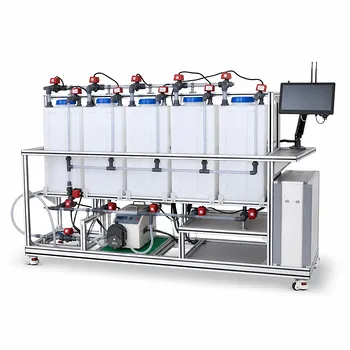
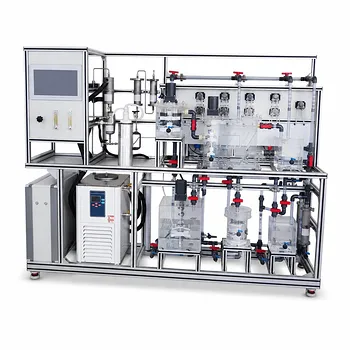
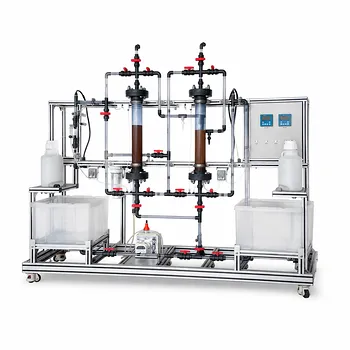
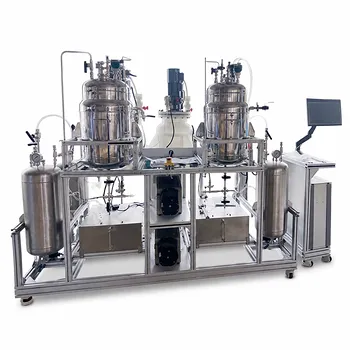
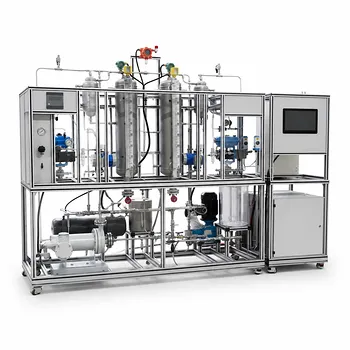
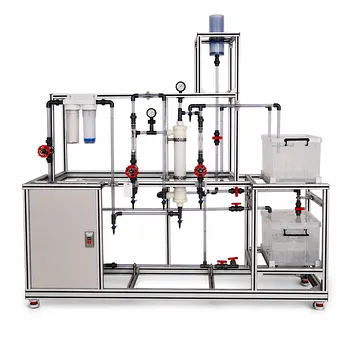
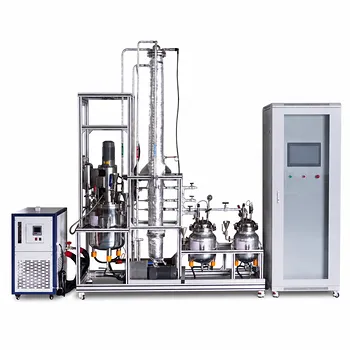
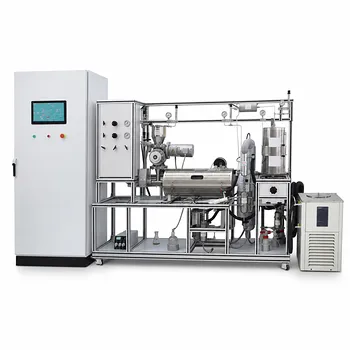
Take your process control training to the next level. LABPARK provides premium Educational and Vocational Unit Operations Pilot Plants in chemical engineering, bioprocess & biotech, and environmental & water treatment. Designed specifically for universities, research institutes, and enterprises, our pilot plants offer hands-on experience with advanced control strategies like fuzzy logic, bridging the gap between theory and industrial reality.
Ready to equip your facility with industry-grade pilot systems? Contact LABPARK today to discuss your project requirements and request a technical proposal!
Related Products
- Electrochemical Water Treatment Educational Unit Operations Pilot Plant
- Thermal Desorption Exhaust Gas and Tail Water Treatment Educational Pilot Plant
- Ion Exchange Water Purification Educational Pilot Plant for Engineering Unit Operations
- Water Electrolysis Hydrogen Production and Storage Educational Pilot Plant
- Alkaline Membrane Water Electrolysis Educational Pilot Plant Unit Operations Training System
People Also Ask
- What design features do educational electrochemical pilot plants utilize to manage gas liberation and water loss?
- How can unit operations pilot plants show lead-acid concentration vs state of charge? Real-time monitoring guide.
- How do educational electrochemical pilot plants scale up electrolysis? Master industrial engineering.
- How to Estimate Sulfate in Water Treatment Pilot Plant Deposits: Gravimetric Guide
- How can foaming be managed during steam generation experiments in water treatment unit operations pilot plants? Tips