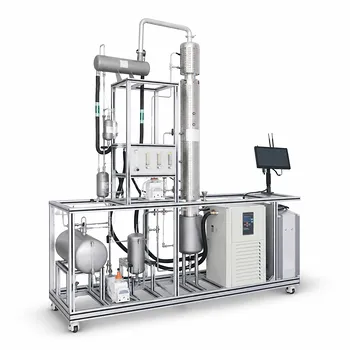
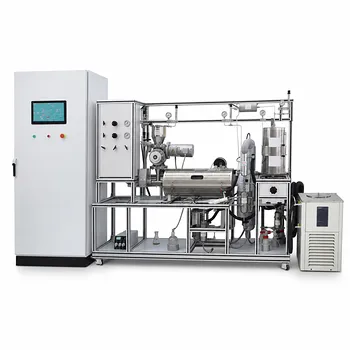
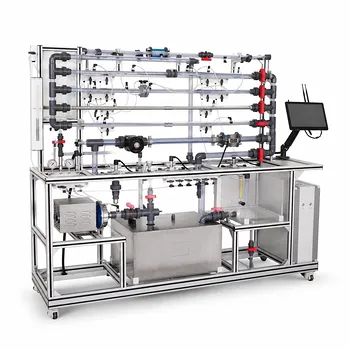
Pervaporation is not a distillation upgrade; it’s a fundamental workaround to the laws of physics. For separating azeotropic mixtures, a pervaporation (PV) pilot plant replaces the volatility logic of distillation with a chemical affinity logic. Instead of relying on heat to separate components by their boiling points, it deploys a selective, non-porous membrane that separates molecules based on their differing speeds of dissolution and diffusion through the membrane material. This single-step, additive-free process eliminates the thermodynamic ceiling that traditional distillation slams into at an azeotrope.
The process advantage is a paradigm shift. Traditional distillation fights azeotropes by chemically manipulating the mixture with entrainers to shift boiling points. Pervaporation ignores the boiling point entirely, using a molecular filter to achieve separation at significantly lower temperatures, thereby saving energy, preserving sensitive compounds, and simplifying the entire process from a complex, multi-step operation to a clean, single-unit one.
Bypassing the Entrainer Trap
The defining limitation of traditional distillation for azeotropic mixtures is the need for an entrainer.
The Intrusive Solution of Distillation
An azeotrope is a stalemate in a distillation column where the liquid and vapor phases possess identical compositions. At this "constant boiling point," the vapor-liquid equilibrium (VLE) flatlines, and further separation by temperature manipulation becomes physically impossible in a single column. To break the stalemate, azeotropic distillation introduces a foreign chemical, an entrainer, like benzene or cyclohexane, to form a new, lower-boiling ternary azeotrope that can be distilled off.
The Clean Cut of Pervaporation
A pervaporation pilot plant fundamentally bypasses the VLE constraint. It does not use boiling point differences as its driving force. Instead, it applies a vacuum on the downstream side of a dense membrane. One component in the liquid feed, due to its higher "chemical affinity" for the membrane material, preferentially dissolves into it, diffuses through it, and evaporates as a pure vapor on the other side. This mechanism breaks the azeotrope without adding any foreign substance, eliminating the costly downstream purification steps required to remove toxic entrainers from the final product.
A Leap in Energy Economics
The energy savings are not just an incremental improvement; they are a direct consequence of redesigning the phase-change mechanism.
Vaporizing a Fraction, Not the Bulk
In distillation, the thermal energy must be sufficient to vaporize a significant portion of the entire liquid mixture, often the majority of it, to create the necessary vapor traffic for separation. A pervaporation pilot plant, however, operates on a "latent heat on demand" principle. Energy is supplied as the latent heat of vaporization only for the select, fast-permeating molecules as they desorb from the membrane. The bulk of the non-permeating liquid remains in the condensed phase and is simply recirculated. This selectivity in phase change translates directly into a practical 30-40% reduction in total energy consumption compared to azeotropic distillation.
Decoupling From Latent Heat Penalties
This operational advantage is anchored in the fact that pervaporation runs at low-pressure differentials and modest temperatures. The entire process occurs far from the vigorous, energy-intensive boil-up required in a reboiler. By sidestepping the bulk latent heat penalty, the pilot plant dramatically reduces both its operational carbon footprint and the required thermal utility infrastructure, making it a cornerstone demonstration in any green chemical engineering curriculum.
The Gentle Touch: Protecting Heat-Sensitive and Reactive Chemistry
The low-temperature personality of a pervaporation unit is a strategic advantage for advanced chemistry.
Preserving Molecular Integrity
Distillation’s high temperatures are destructive to heat-sensitive materials like certain pharmaceuticals, flavors, and fragrances, often causing degradation, unwanted side reactions, or hydrolysis. A pervaporation pilot plant, operating at ambient or moderately elevated temperatures, creates a non-destructive separation environment. This makes it a uniquely safe and powerful tool for training on biopharmaceutical downstream processing, where a liquid-liquid extraction pilot plant is another thermal-preservation tool, but pervaporation uniquely handles azeotropes without introducing an extraction solvent that must later be recovered.
Preventing Unwanted Side Reactions
For reactive mixtures, the addition of a chemical entrainer or a water wash in traditional setups can trigger side reactions like hydrolysis. The membrane in a pervaporation system acts as an inert, physical barrier. It selectively transports one component, such as water for dehydration, without chemically interacting with the target product. This eliminates the risk of introducing reactive contaminants, ensuring the final product's yield and purity are maximized, a process advantage that makes it a superior teaching tool for precision separations.
Understanding the Trade-offs and Operational Realities
A definitive technical assessment must address the inherent limitations that define where pervaporation is, and is not, the right tool.
The Flux-Selectivity Balancing Act
The membrane is not a magic bullet. High selectivity for a target molecule almost always comes at the cost of low permeation flux (throughput). A pilot plant that achieves 99.8% ethanol purity with a PVA membrane will have a defined, often modest, membrane area requirement. Engineering the process is a constant optimization between the desired product purity and the required membrane surface area, which directly dictates capital and footprint costs.
Long-Term Membrane Stability
While a pilot plant avoids entrainers, it introduces a new variable: membrane fouling and aging. Trace impurities in real-world industrial feeds can adsorb onto the membrane surface, reducing performance over time. In a teaching or research setting, this provides a rich learning opportunity, but in a production context, it represents a consumable cost. The membrane is a functional component that will degrade and require eventual replacement, unlike the largely inert mass transfer packing in a distillation column.
The Vacuum-Vapor Permeate Challenge
The permeate exits as a vapor on the low-pressure side. This is a critical process design point. You cannot simply drain a liquid stream; you must use a powerful vacuum system to maintain the driving force and then fully condense the permeate vapor, often at very low temperatures. This downstream condensation step is not optional and represents an additional energy sink that must be factored into a complete lifecycle cost analysis against other technologies like vapor permeation.
Making the Right Choice for Your Pilot Plant Goal
Your selection is not about finding a "better" unit operation, but the correct mechanistic fit for your specific separation and educational objective.
- If your primary focus is replacing azeotropic distillation for dehydration: A pervaporation pilot plant is the definitive modern solution. It accomplishes in one membrane unit what distillation does with complex column sequencing and a toxic entrainer, achieving absolute ethanol with a 30-40% energy reduction.
- If your primary focus is demonstrating a green, non-destructive separation principle: Choose pervaporation. Its low-temperature operation preserves biological activity and chemical structure, avoiding the thermal degradation common in distillation, making it perfect for showcasing separation of a heat-sensitive antibiotic or natural product.
- If your primary focus is teaching hybrid, energy-optimized process design: Integrate a distillation column with a downstream pervaporation unit. This configuration concentrates the feed to the azeotropic point using cheap, bulk separation, and then lets the membrane perform the "final mile" dehydration, demonstrating how to optimally combine unit operations to bypass thermodynamic limits.
Pervaporation succeeds precisely where the physics of boiling points fail, offering a membrane-based shortcut to product purity that a distillation column alone can never reach.
Summary Table:
| Feature | Traditional Distillation | Pervaporation Pilot Plant |
|---|---|---|
| Separation Principle | Vapor-liquid equilibrium (boiling points) | Chemical affinity & membrane diffusion |
| Azeotrope Solution | Requires toxic entrainers (e.g., benzene) | Bypasses VLE limits using a selective membrane |
| Energy Demand | High (vaporizes bulk liquid mixture) | Low (30-40% savings; vaporizes select permeant only) |
| Thermal Sensitivity | High risk of thermal degradation | Gentle, low-temperature separation |
| Secondary Steps | Demands complex downstream entrainer recovery | Direct separation with no additives required |
Elevate Your Chemical Engineering Lab with LABPARK
Are you looking to demonstrate cutting-edge separation technologies in your curriculum or research? LABPARK provides high-quality Educational and Vocational Unit Operations Pilot Plants in chemical engineering, bioprocess & biotech, and environmental & water treatment designed specifically for universities, research institutes, and enterprises.
Our advanced pilot plants help students and researchers master membrane separations, hybrid designs, and energy-efficient process engineering.
Contact LABPARK today to discover how our tailored pilot plant solutions can enhance your institution's hands-on training and research capabilities!
Related Products
- Multi Pump Fluid Transport Process Piping Unit Operations Training Pilot Plant
- Multimodal Absorption and Desorption Pilot Plant for Unit Operations Training
- Rising and Falling Film Evaporation Educational Unit Operations Pilot Plant
- Supercritical High-Gravity Flash Evaporation Educational Unit Operations Pilot Plant
- Natural Product Extraction Unit Operations Training Pilot Plant
People Also Ask
- Why distinguish Newtonian & non-Newtonian fluids in pilot plants? Prevent design errors.
- Why is the chemical plant startup schedule crucial? De-risk scale-up with pilot plants.
- When to transition from PID to adaptive control in pilot plants? Key process indicators.
- How do deviations in estimating latent heat impact pilot plant thermal systems? Avoid hardware mis-sizing.
- How to study gasification in pilot plants? Compare exit gas composition & efficiency