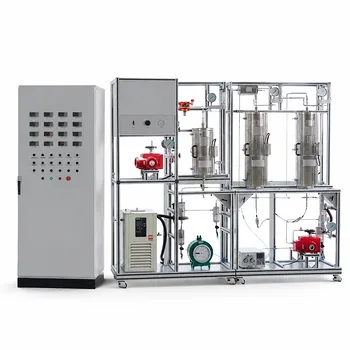
The core physical state of the reaction mixture—and how you manage its heat and viscosity—is the single most critical factor determining your pilot plant’s design and safe operating envelope. Bulk, solution, suspension, and emulsion polymerization are fundamentally distinguished by whether the polymerizing mass is a single phase, a solvent-laden liquid, or a water-dispersed system. Each choice dictates a unique balance of heat transfer capability, required downstream unit operations, and the final product’s morphology.
Selecting a polymerization method for a pilot plant is not just a chemistry problem; it's an engineering decision driven by a trade-off between product purity and operational controllability. The primary reference clearly highlights this tension: methods offering simplicity and purity (bulk) create severe heat and viscosity problems, while methods solving those problems (solution, suspension, emulsion) introduce complex separation steps and reduce product purity.
The Single-Phase Challenge: Bulk vs. Solution Polymerization
The decision between bulk and solution polymerization is a direct choice between operating with the purest possible reactants or trading some purity for easier process control. Your pilot plant's reaction section will look radically different depending on this choice.
The Viscosity and Heat Transfer Problem (The "Gel Effect")
In bulk polymerization, the initial charge is just monomer and initiator. The supplementary reference correctly notes this yields a highly pure product, but the primary reference pinpoints the catastrophic engineering challenge: the gel effect.
As the reaction proceeds, the mixture's viscosity skyrockets beyond what standard agitators can handle. This vicious cycle—where high viscosity hinders heat removal, causing hot spots that accelerate the reaction further—can lead to runaway reactions. A pilot plant for bulk polymerization must therefore be designed around this primary danger, featuring high-torque agitators and specialized, often external, cooling systems.
Solvent as a Control Agent
Solution polymerization solves the viscosity issue by dissolving the monomer in a non-reactive solvent. The solvent acts as a heat sink and a viscosity diluent, enabling smooth, conventional stirred-tank reactor operation with predictable heat transfer.
This operational simplicity, however, is bought with a cost. The supplementary reference makes it clear: your pilot plant’s scope immediately expands from just a reactor to an integrated system. You must now add solvent recovery and purification unit operations—typically distillation columns—to the flow sheet, adding complexity, cost, and a chemical safety dimension absent in bulk processes.
The Water-Dispersed Challenge: Suspension vs. Emulsion Polymerization
When you use water as the continuous phase, you master the heat transfer problem elegantly. Both suspension and emulsion methods offer excellent temperature control, but they lead to entirely different pilot plant workflows for product recovery, as detailed in the supplementary reference.
Suspension Polymerization: Making Solid Beads
In suspension polymerization, the monomer forms tiny droplets suspended in water, stabilized by a dispersant. Each droplet acts like a mini bulk reactor. This process yields discrete, solid polymer beads or powder that can be easily filtered.
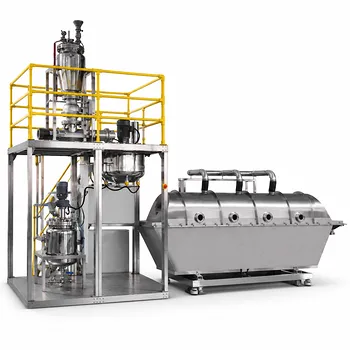
The operational consequence for your pilot plant is the need for standard solid-liquid separation equipment. Based on the references, your downstream train would require centrifuges or pressure filters for primary isolation, followed by washing steps to remove the dispersant, and finally a drying unit, like a fluidized bed dryer. The entire process is a sequence of distinct mechanical operations.
Emulsion Polymerization: Making a Liquid Latex
Emulsion polymerization operates differently. The reaction occurs within micelles in the water phase, producing a stable colloidal dispersion—a liquid latex. The primary reference highlights this method's unique ability to achieve both high reaction rates and exceptionally high molecular weights.
This liquid product fundamentally changes the pilot plant’s downstream design. If the end-use is a liquid coating or adhesive, the work-up is simple filtration and packaging. If a solid product is required, the supplementary reference shows you must install a radically different isolation train: coagulation tanks (to break the emulsion with salt or acid), washing decanters, and dewatering extruders instead of dryers. This is a wet-chemical isolation process, not a mechanical drying one.
Understanding the Trade-offs and Other Critical Factors
Choosing a method requires an honest assessment of what problems your pilot plant is supposed to study. The "best" method doesn't exist; only the best method for your specific research or teaching objective exists.
Product Purity vs. Operational Complexity
- Bulk polymerization gives you the uncontaminated, pure polymer directly from the reactor, but demands the most sophisticated and hazardous reaction control system.
- Solution and water-based methods sacrifice that inherent purity for safe, manageable, and reproducible processing. They shift the engineering challenge from the reactor to the separation equipment.
Product Morphology Drives Equipment
The physical form of your final product dictates your entire post-reactor train.
- A solid bead or powder (suspension) requires filtration and drying.
- A liquid latex (emulsion) requires either simple filtration or a complex coagulation-extrusion line.
- A solvent-laden syrup (solution) requires distillation and devolatilization.
The Critical Role of Reactor Configuration
The supplementary reference adds a vital dimension that goes beyond the method itself: the choice between batch and continuous reactor configurations. Even under identical chemistry, the polymerization method’s outcome is heavily influenced by reactor type.
A continuous stirred-tank reactor (CSTR) or a tubular reactor will yield polymers with different molecular weight distributions and copolymer compositions than a batch reactor due to residence time distribution effects. For a pilot plant dedicated to specialty polymers—where precise product function is paramount—demonstrating and analyzing this distributional control is a key learning objective. Your pilot plant must be instrumented to capture this data.
Making the Right Choice for Your Pilot Plant Goal
The configuration of your unit operations pilot plant should be driven by your primary training or research objective, not merely by copying an industrial process. Here are the recommended pathways based on different goals:
- If your primary focus is safe, hands-on teaching of reaction kinetics and heat transfer: Start with solution polymerization. It allows students to observe exothermic reaction dynamics in a forgiving, controllable liquid system before tackling the instrumentation challenges of bulk or multiphase methods.
- If your primary focus is demonstrating a complete industrial product value chain from monomer to dry powder: Configure your pilot plant for suspension polymerization. The sequence of reaction, filtration, washing, and drying provides the richest, most modular teaching platform for core mechanical unit operations.
- If your primary focus is on specialty coatings, adhesives, or high-molecular-weight polymer physics: Implement an emulsion polymerization line. This uniquely allows study of a high-rate reaction producing an ultra-high molecular weight product in a stable liquid form, with an equally educational liquid-handling downstream.
- If your primary focus is advanced process control and safety systems: The extreme viscosity and non-linear heat generation of bulk polymerization provide the ultimate challenge. Design a heavily instrumented reactor with sophisticated temperature control logic to study the gel effect and runaway reaction prevention.
The ideal pilot plant decision begins by defining the engineering problem you want the students or researchers to solve, then letting that problem dictate the polymerization method and the resulting unit operations.
Summary Table:
| Polymerization Method | Heat & Viscosity Control | Downstream Unit Operations | Final Product Form |
|---|---|---|---|
| Bulk | Poor (High risk of gel effect) | Specialized cooling, high-torque agitation | Pure solid polymer / melt |
| Solution | Good (Solvent dilutes reaction) | Solvent recovery & distillation columns | Solvent-laden syrup |
| Suspension | Excellent (Water continuous phase) | Filtration, washing, fluidized bed drying | Solid beads or powder |
| Emulsion | Excellent (Water continuous phase) | Coagulation tanks, washing, dewatering | Liquid latex or coagulated solid |
Optimize Your Chemical Engineering Lab with LABPARK
Are you looking to set up a state-of-the-art polymerization or reaction engineering lab? LABPARK provides premium Educational and Vocational Unit Operations Pilot Plants in chemical engineering, bioprocess & biotech, and environmental & water treatment tailored for universities, research institutes, and enterprises.
Whether you need to demonstrate complex separation processes or study advanced reaction kinetics, our modular pilot plants offer the safety, control, and reliability your students and researchers deserve.
Contact LABPARK today to consult with our technical team and find the ideal pilot plant configuration for your institution!
Related Products
- Polymerization Granulation and Pellet Processing Educational Unit Operations Pilot Plant
- Ethyl Acetate Synthesis Unit Operations Pilot Plant for Practical Training
- Methanol Synthesis and Catalyst Performance Evaluation Educational Unit Operations Pilot Plant
- Bio-fermentation Ethanol Production Practical Training Unit Operations Pilot Plant
- Multi Functional Membrane Crystallization Educational Unit Operations Pilot Plant
People Also Ask
- How do educational unit operations pilot plants bridge theory and design? Bridge the Engineering Gap
- How do educational unit operations pilot plants address safety and waste management when scaling up?
- Why Compare Predicted and Experimental Excess Enthalpy? Key to Accurate Pilot Plant Scale-up
- When to transition from PID to adaptive control in pilot plants? Key process indicators.
- Why is the chemical plant startup schedule crucial? De-risk scale-up with pilot plants.