Determining a process’s true measurement capabilities, developing robust understanding, and validating control strategies are the foundational objectives when moving from bench to pilot scale. The transition is a deliberate risk-reduction exercise. It focuses not on simply replicating the bench result, but on uncovering how the process behaves under conditions that mimic manufacturing dynamics—testing sensor accuracy, heat and mass transfer limits, and the viability of automation before committing to full-scale capital.
The core purpose of a unit operations pilot plant is to bridge the gap between laboratory chemistry and commercial manufacturing. It is a systematic de-risking tool: you characterize real-time measurement performance, map the knowledge space around critical scale-dependent parameters, build necessary calibration models, and pressure-test your control philosophy in a forgiving environment before scaling up.
Characterizing Measurement System Performance in Real Time
The first objective is to move beyond ideal benchtop analytics and understand how your process sensors actually perform under dynamic, pilot-scale conditions. Bench studies often use offline, high-resolution instruments that are impractical for in-line use.
Defining Sensor Sensitivity, Accuracy, and Repeatability
At pilot scale, you install process analyzers (pH, temperature, spectroscopy, etc.) directly into the stream. The goal is to determine their sensitivity to the analyte of interest, their accuracy against a reference method, and their repeatability over extended runs.
The real-time signal will be noisier and subject to fouling, drifting, and matrix effects that don’t appear on the bench. This is the phase where you quantify that drift and decide whether the sensor can reliably guide a control loop.
Optimizing Sensor Location and Conditioning
Measurement performance is heavily influenced by physical placement. A probe in a dead zone or behind a spray ball will give unrepresentative data. Pilot work lets you experiment with insertion depths, flow cells, and automated cleaning strategies to maximize data quality without interrupting the run.
Achieving representative, high-integrity data is a prerequisite for every subsequent objective.
Building Robust Process Understanding (Knowledge & Control Space)
A pilot plant is a physical simulator for manufacturing dynamics. The second core objective is to map the knowledge space—the multidimensional combination of parameters that define safe and productive operation—and from it define the control space where the process will be routinely run.
Mastering the Scale-Dependent Physics: Heat and Mass Transfer
Bench-scale reactions are often unconstrained by transport phenomena. Scaling up changes everything. Maintaining the volumetric oxygen transfer coefficient ($k_La$) in bioprocesses and managing heat removal become the most critical parameters.
As vessel volume increases, the surface-area-to-volume ratio plummets, reducing natural cooling. The pilot plant objective is to confirm that your agitation, aeration, and heat transfer system (cooling jackets, internal coils, or external heat exchangers) can maintain uniform temperature and dissolved oxygen without creating damaging shear zones.
Understanding Mixing, Fluid Dynamics, and Raw Material Sensitivity
The sequence of raw material charges and the mixing quality can dramatically alter reaction rates, selectivity, and local hot spots. The pilot objective is to study these flow-dependent effects to define safe operating limits for feeding rates, agitation speeds, and temperature ramps.
This phase explicitly answers: “Does this chemistry behave the same when it’s in a 200-liter vessel instead of a 2-liter flask?”
Developing Chemometric Calibration Models
Many advanced process analyzers (e.g., Raman or NIR spectroscopy) do not directly report a concentration; they produce a spectrum. The third objective is to build and validate a chemometric model that translates this spectral data into a real-time process value.
Building a Model Under Process-Relevant Variation
A calibration model built on clean bench samples will fail at scale. The pilot plant allows you to intentionally vary temperature, mixing, batch heterogeneity, and impurity profiles while collecting reference samples.
This generates a training set that captures the true covariance of the manufacturing environment, making the model robust against future production variations.
Validating Model Transferability
The pilot phase tests whether the model can predict accurate values across multiple batches and operators. This is a measurement objective that directly reduces the risk of a “black box” sensor failing in production.
Evaluating and Validating Proposed Process Control Strategies
A process is only as good as its ability to stay within control space. The fourth objective is to subject your proposed control philosophy to realistic disturbances.
Testing Open-Loop and Closed-Loop Control
You run the unit operations to see if a proportional-integral-derivative (PID) loop for temperature control handles an exotherm, or if model-predictive control for nutrient feeding stabilizes the bioprocess. The pilot plant lets you safely inject faults—like a delayed raw material addition or a power failure—to see if the control strategy can recover without a batch loss.
Defining Alarm Thresholds and Safe Operating Limits
From this testing, you establish hard limits for parameters like maximum gas evolution rate or jacket temperature differential. These become the operational safety interlocks for the full-scale facility.
Understanding the Trade-offs and Common Pitfalls
A pilot plant is not a perfect miniature factory. Failing to recognize its limitations can lead to false confidence.
The “Scale-Down” vs. “Scale-Up” Mismatch
A pilot unit often has different material construction, higher surface-area-to-volume ratios, or atypical flow paths. These can suppress a safety problem or hide a fouling issue that will explode at full scale. The objective is to understand these geometric and metallurgical differences and account for them, not ignore them.
Economic Validation vs. Run-length Deception
A pilot batch can prove chemical economics, but short runs may hide catalyst deactivation or by-product accumulation. The trade-off is between the cost of long pilot runs and the risk of scale-up failure; the objective is to design experiments that push the system to expose these slow-burn problems.
Making the Right Choice for Your Goal
Your objectives at pilot scale must be tailored to the specific risks of your process. Apply your resources where uncertainty is highest.
- If your primary focus is a new chemical synthesis with high exothermy: Prioritize thermal stability, heat transfer capacity, and safety relief sizing. The pilot must define the safe operating envelope before anything else.
- If your primary focus is a complex biological process: Prioritize maintaining $k_La$, shear sensitivity, and chemometric model development for real-time nutrient monitoring to lock in product quality attributes.
- If your primary focus is validating a novel continuous processing platform: Prioritize sensor repeatability over long durations and the robustness of your automated control logic against flow disturbances, rather than just endpoint yield.
The transition from bench to pilot is the moment your science becomes an engineering foundation. By systematically tackling measurement performance, transport-limited physics, model fidelity, and control integrity, you convert laboratory promise into a manufacturable reality.
Summary Table:
| Key Objective | Primary Focus Area | Critical Action & Deliverable |
|---|---|---|
| Measurement Performance | Process sensors (pH, Temp, Raman) | Characterize sensor sensitivity, repeatability, and optimal placement. |
| Process Understanding | Heat & mass transfer ($k_La$), mixing | Map scale-dependent physics and define the safe operating envelope. |
| Chemometric Calibration | Spectral data translation | Build robust models to convert real-time spectra into process values. |
| Control Validation | PID loops & automated safety | Pressure-test control strategies and establish alarm thresholds. |
Bridge the Gap from Lab to Industrial Scale with LABPARK
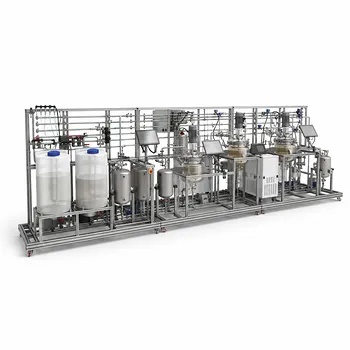
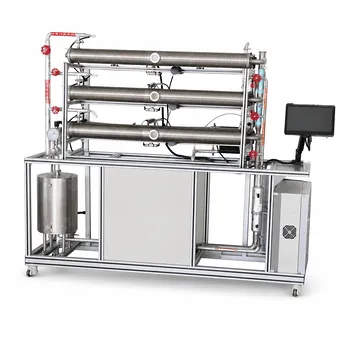
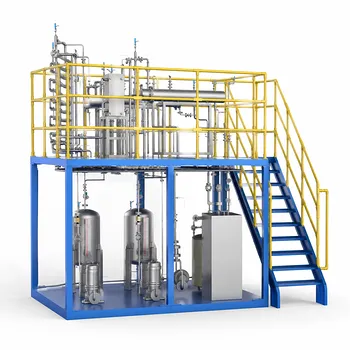
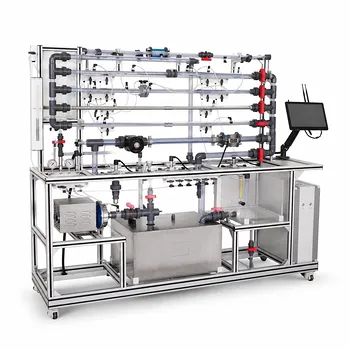
Transitioning your process from benchtop studies to pilot scale requires robust, reliable, and highly controllable equipment. LABPARK designs and manufactures premium Educational and Vocational Unit Operations Pilot Plants specializing in:
- Chemical Engineering
- Bioprocess & Biotech
- Environmental & Water Treatment
Tailored specifically for universities, research institutes, and enterprises, our pilot plants help you accurately characterize measurement systems, master heat/mass transfer dynamics, and validate process control strategies in a safe, controlled environment.
Ready to de-risk your scale-up process and empower your team? Contact our experts today to find the ideal pilot plant solution for your facility!
Related Products
- General Purpose Cosmetics Production Unit Operations Training Pilot Plant
- Multi Pump Fluid Transport Process Piping Unit Operations Training Pilot Plant
- Multi-Functional Drying Educational Unit Operations Pilot Plant
- Fixed-Bed Chemical Reaction and Gas Dust Tar Removal Unit Operations Pilot Plant
- 100L Continuous Loop Hydrogenation Educational Unit Operations Pilot Plant
People Also Ask
- Why is the chemical plant startup schedule crucial? De-risk scale-up with pilot plants.
- How do deviations in estimating latent heat impact pilot plant thermal systems? Avoid hardware mis-sizing.
- When to transition from PID to adaptive control in pilot plants? Key process indicators.
- Why Compare Predicted and Experimental Excess Enthalpy? Key to Accurate Pilot Plant Scale-up
- Why Use PTFE & Hastelloy in Chemical Pilot Plants? Prevent Corrosion & Ensure Safety