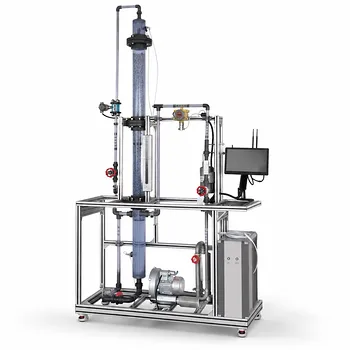
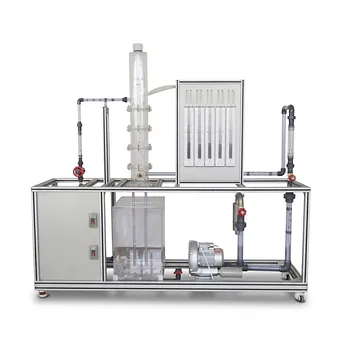
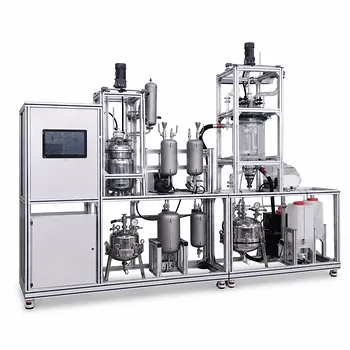
For pilot plant columns, mechanical design transcends basic pressure vessel code—it is fundamentally a structural engineering problem where wind and seismic stability often dictate wall thickness, while cost estimation demands a strict decomposition of the shell and high-precision internals.
A pilot plant column is not just a smaller industrial tower; it is a high-aspect-ratio mechanical structure. The low internal volumes and high surface-area-to-volume ratios mean that ambient mechanical loads (wind) and thermal conservation (heat loss) frequently overshadow internal pressure as the primary design driver. Furthermore, the true capital cost is often masked by the exotic materials and tightly spaced internals required for research-grade flexibility.
The Mechanical Reality: The Column as a Structural Mast
The primary reference establishes that columns are pressure vessels, but the immediate nuance is that their height-to-diameter ratio creates a dominant structural constraint. Unlike squat reactors, a tall, slender distillation column behaves like a cantilever beam.
Why Wall Thickness is Governed by Wind, Not Pressure
In a pilot setting with modest pressurization, the internal pressure calculation might yield a very thin theoretical wall. However, a column standing several meters tall must withstand wind loads and potentially seismic events.
- The "Sail" Effect: Even a small diameter column acts as a sail. The bending moment at the base from wind force often produces a much higher stress than the hoop stress from internal pressure.
- Column Dynamics: Thin walls calculated solely on pressure can lead to unacceptable vibrations and oscillations. The mechanical design must specify a robust Minimum Design Metal Temperature (MDMT) based on condenser conditions if cryogenics are involved, ensuring the structure doesn't become brittle under wind-induced deflection.
The Thermal Ping-Pong: Hot Reboiler, Cold Condenser
The thermal envelope is defined by the extremes. The reboiler sets the maximum design temperature and pressure, requiring a safety margin. But for pilot plants studying low-temperature separation, the overhead condenser dictates the minimum design temperature.
- Thermal Gradients: A critical, often overlooked mechanical consideration is the stress caused by the gradient between a 150°C reboiler sump and a -20°C chilled-water condenser on the same structure.
- Heat Loss as a Mechanical Failure Mode: If insulation is insufficient on the connection to a steam distillation source, steam condenses prematurely. This doesn't just ruin thermal efficiency; it creates liquid slugs that lead to water hammer and catastrophic mechanical failure. Steam lines must be short and lagged.
The Cost Labyrinth: Disaggregating Shell from Internals
A critical strategic error in pilot plant budgeting is treating the column as a single line item. The primary reference insists on a separation of the column shell cost from the internals cost, and the supplementary data reveals why internals can dominate the budget.
The Exponential Trap of Tray Spacing
The relationship between spacing and cost is non-linear. The tray spacing factor ($F_s$) is a cost multiplier, but its impact is often inverted in a pilot plant compared to industry.
- The Shorter Column Paradox: To fit inside a standard laboratory ceiling height, pilot columns often use tighter tray spacing. Reducing spacing from 24 inches to 12 inches doubles the $F_s$ cost factor precisely because you must pack more physical trays into the same shell height.
- The Access Constraint: Unlike industrial columns, pilot plants require hand-holes between tightly spaced trays. Mechanically installing these access points on closely packed trays escalates the fabrication cost far beyond a simple material multiplier.
Material Selection: The Corrosion Premium
The mechanical design is inseparable from chemistry. A standard carbon steel shell ($F_m = 0$) is cheap, but the moment you introduce acidic components requiring Monel cladding ($F_m = 8.5$), the mechanical attachment of internals changes.
- Thermal Expansion Mismatch: Exotic alloys expand at different rates than standard flanges. If not designed mechanically for this delta, the trays will warp or crack under thermal cycling, destroying separation efficiency.
- Tray Type Mechanics: Bubble cap trays ($F_t = 1.6$) are not just expensive; they are mechanically heavy and require a thicker support ring within the column. The dead weight of the internals must be calculated back into the shell thickness, creating a compounding cost spiral.
Understanding the Trade-offs
The Thermal Efficiency vs. Mechanical Complexity Trap
To gain accurate thermodynamic data, you must insulate heavily and eliminate heat bridges. However, insulating over pressure relief valves and level bridles—demanded for thermal consistency—creates a mechanically un-inspectable system. If you prioritize thermal perfection, you risk missing corrosion under insulation (CUI) or mechanical blockages in relief paths.
The Vacuum-Vessel Dilemma
Operating at deep vacuum (near 0.05 bar) flips the mechanical design logic. The vessel is no longer resisting expansion; it is resisting external collapse. Here, stiffening rings become the dominant mechanical feature, not wind bracing. A column designed for atmospheric boiling might immediately buckle if the process is switched to vacuum without this mechanical reinforcement.
Making the Right Choice for Your Pilot Plant Goal
The mechanical and thermal specifications must align with whether you are building a versatile research platform or a fixed-process pilot.
-
If your primary focus is a Dedicated Process Validation: Specify the shell strictly for the working pressure/temperature of that process. Accept the tight tray spacing penalty to match the exact industrial height equivalent (HETP) of the target plant, sacrificing flexibility for direct scalability.
-
If your primary focus is an Educational or Multi-Product Research Platform: Mechanically stiffen the shell for full vacuum and positive pressure (e.g., full range of -1 to +3 barg). Select a wider tray spacing (lower $F_s$) to allow students to visually observe hydrodynamics and to swap between sieve, valve, or structured packing internals for different experiments.
A column that is mechanically rigid enough to survive mistreatment, and tall enough to let you study poor separation just as often as perfect separation, is ultimately a more valuable instrument than one optimized solely for a single thermal efficiency point.
Summary Table:
| Design Element | Mechanical/Thermal Impact | Cost & Structural Implication |
|---|---|---|
| Wind & Seismic Loads | Dominates wall thickness over internal pressure due to high aspect ratio | Increases base metal costs for tall, slender columns |
| Thermal Gradients | Severe temperature deltas cause stress, expansion issues, and condensation | Requires high-quality insulation, short steam lines, and expansion joints |
| Tray Spacing | Tighter spacing fits low laboratory ceilings but increases tray density | Incurs a non-linear cost multiplier ($F_s$) and fabrication complexity |
| Material Selection | Exotic alloys match chemical resistance but warp under thermal cycles | Significantly increases material ($F_m$) and structural reinforcement costs |
Scale Up Your Process with LABPARK Pilot Plants
Designing efficient distillation and extraction columns requires balancing complex mechanical, thermal, and budgetary constraints. LABPARK offers specialized Educational and Vocational Unit Operations Pilot Plants in chemical engineering, bioprocess & biotech, and environmental & water treatment.
We help universities, research institutes, and enterprises build flexible, reliable, and academically rigorous pilot systems that withstand real-world operational challenges.
Ready to optimize your pilot plant design? Contact LABPARK today to discuss your project requirements with our engineering team!
Related Products
- Continuous Batch Extractive Distillation Educational Pilot Plant
- Educational Rotary Disc Liquid-Liquid Extraction Pilot Plant
- Multi-Functional Special Distillation Educational Pilot Plant
- Continuous Sieve-Plate Distillation Pilot Plant for Unit Operations Laboratory Education
- Multi-Modal Distillation Unit Operations Training Pilot Plant
People Also Ask
- How is an extractive distillation pilot plant configured? Setup & Entrainer Roles
- Wilson vs. UNIQUAC: How to Choose the Right Thermodynamic Model for Your Pilot Plant
- Why use non-ideal VLE calculations in distillation pilot plants? Ensure accurate scale-up & purity
- How to Configure a Distillation Pilot Plant? Key Steps for Multi-Mode Setup
- How does the feed thermal state influence distillation pilot plant design and utility consumption?