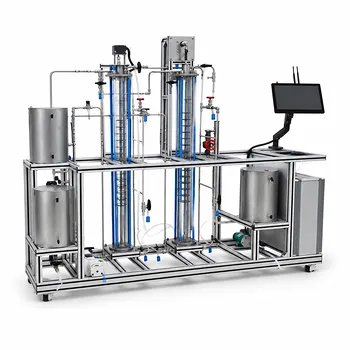
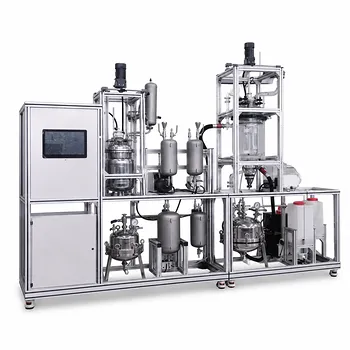
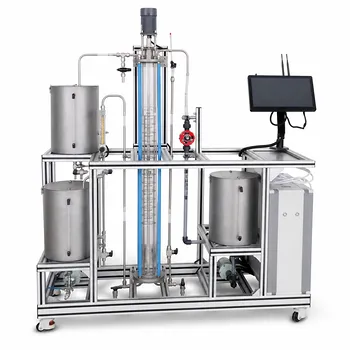
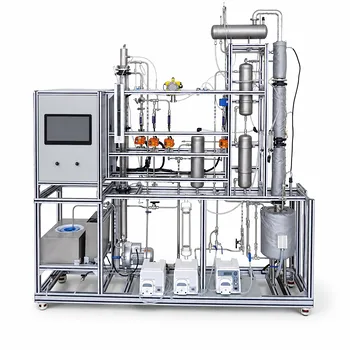
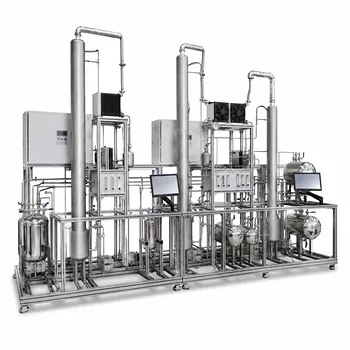
Safety, Product Protection, and Educational Value are the three pillars of any solvent extraction and evaporation pilot plant designed for recovering heat-sensitive natural pigments like capsanthin. The core design must center on a solid-liquid extraction vessel that supports solvent reflux to simulate batch processes, an integrated vacuum evaporation unit to concentrate the extract without destroying the pigment thermally, and comprehensive safety systems to manage flammable vapors and pressure hazards. When the unit is destined for educational training, these technical elements must be packaged in a way that makes process principles visible, controllable, and fail-safe for learners.
For an educational pilot plant targeting capsanthin recovery from chili, the design must seamlessly blend two uncompromising priorities: protecting a thermally sensitive natural pigment from degradation, and creating an inherently safe environment for trainees working with volatile solvents like ethyl acetate. The result is a system built around controlled reflux extraction, vacuum-driven low-temperature evaporation, and explosion-proof operational safeguards—all while maintaining the transparency needed for effective teaching.
Designing for Thermal Sensitivity and Extract Quality
Capsanthin, the vibrant red carotenoid in chili, degrades rapidly under high heat. Any pilot plant must therefore prioritize low-temperature processing from the moment the solvent contacts the ground spice until the final concentrate is collected.
The Solid–Liquid Extraction Vessel Must Support Solvent Reflux
The extraction step relies on intimate contact between the chili feedstock and an organic solvent, typically ethyl acetate or a petroleum ether blend. The vessel needs a jacketed heating system and an overhead condenser that returns vaporized solvent to the bed—batch reflux extraction in miniature. This configuration ensures sustained solvent–feedstock contact at the boiling point of the solvent, but critically, that temperature remains low enough to avoid damaging capsanthin if the solvent is carefully selected. The design must allow students to observe the solvent cycle, take samples, and adjust reflux ratio, turning a fundamental unit operation into a tangible learning experience.
Vacuum Evaporation Mimics a Rotavap at Pilot Scale
Once the extract is separated, concentrating it demands evaporation. A standard atmospheric distillation would quickly ruin capsanthin. Consequently, the pilot plant must include a vacuum evaporation unit that lowers the system pressure, reducing the solvent’s boiling point to well below its atmospheric equivalent. This is functionally a pilot-scale rotary evaporator: a heated vessel under vacuum connected to a condenser and a chilled receiving flask. The design should incorporate a vacuum control valve and a pressure gauge so trainees can manipulate and record the relationship between pressure, boiling point, and evaporation rate, cementing the theoretical concept of vacuum distillation in a practical, memorable way.
Managing Solvent Hazards in an Educational Setting
Ethyl acetate, petroleum ether, and similar solvents are highly volatile and flammable. When the goal is education, the pilot plant cannot hide its risks; it must neutralize them while making safe operation a core part of the training.
Explosion-Proof Components and Venting Are Non-Negotiable
All electrical components—pumps, heaters, solenoid valves, and sensors—must carry proper explosion-proof certifications suitable for the solvent vapor environment. The plant must also include a dedicated venting system that directs fumes away from the operator and toward a safe exhaust or recovery system, and never allow vapor accumulation inside the unit or the laboratory. These features do not simply comply with regulations; they provide visible teaching points for hazard analysis and process safety management.
Precision Temperature Control Prevents Runaway Reactions
A runaway heating scenario could elevate solvent vapors to dangerous pressures or expose the pigment to destructive temperatures. The design therefore requires multi-point temperature sensors and an interlocked heating control that cuts power if a preset limit is exceeded. For educational settings, the control interface should display temperature profiles in real time, giving trainees immediate feedback on how their operational decisions affect thermal safety and product quality.
Integrating Solvent Recovery and Process Control for Holistic Learning
A pilot plant that merely extracts and concentrates misses a crucial training opportunity: solvent recovery. The supplementary reference highlights that distillation and solvent recovery unit operations must manage vapor buildup, excessive pressure, and efficient condensation.
Closed-Loop Configuration Prevents Vapor Release
A closed-loop design connects the evaporation unit’s condenser to a solvent recovery receiver, minimizing atmospheric emissions and fire risk. Trainees learn to monitor condensation efficiency using sight glasses and temperature differentials across the condenser. When the system is under vacuum, they can also observe how vacuum level influences condensation—concepts that are difficult to grasp without hands-on experience.
Teaching Thermal Balance and Reflux Rate Monitoring
The pilot plant should be instrumented to show the balance between heating power, reflux formation, and distillate collection rate. By manipulating heating mantle settings and vacuum levels, students see direct cause-and-effect relationships. This design turns recovery into a core operating principle rather than an afterthought, reinforcing the industrial reality that solvent recycling is both an economic and an environmental necessity.
Understanding the Trade-offs and Limitations
Designing for education introduces inherent compromises that you must acknowledge to avoid setting unrealistic expectations.
- Throughput vs. visibility: A smaller, glass-rich system offers excellent visual access but can severely limit the amount of material that can be processed in a single lab session. Conversely, a larger stainless-steel plant increases throughput but obscures internal flows and mixing, reducing its didactic value.
- Complexity vs. student autonomy: Every added safety interlock and automatic sequence reduces the risk of student error but simultaneously diminishes the manual decision-making that builds deep operator intuition. A design that over-automates the process may produce perfect extracts but poorly prepared graduates.
- Solvent compatibility: While ethyl acetate is preferred for capsanthin, educational programs often wish to run alternative experiments with different solvents. Materials of construction—gaskets, seals, hoses—must be carefully selected to withstand a range of chemical exposures without degrading or contaminating the product.
- Cost of explosion-proof certification: Certified electrical enclosures, intrinsically safe barriers, and specialized ventilation significantly raise the capital cost. Educational institutions must balance this expense against the irreducible safety requirement, sometimes limiting the plant’s scale or feature set.
Making the Right Choice for Your Educational Goals
Your decision criteria will vary based on the primary learning outcomes you intend to achieve. Use the following goal-oriented recommendations to guide your design specification.
- If your primary focus is process safety education: Select a plant with full explosion-proof certification, a fully closed-loop solvent recovery system, and comprehensive interlocks that force students to follow a startup and shutdown sequence. Make the safety features themselves the curriculum.
- If your primary focus is maximizing capsanthin yield and quality: Prioritize a design with precise vacuum control and a jacketed extraction vessel capable of stable reflux. Invest in extended instrumentation that allows students to map temperature, pressure, and time against final extract purity and concentration.
- If your primary focus is teaching scale-up principles: Choose a modular plant that uses industrial-type materials (stainless steel, sanitary fittings) but retains glass sections at critical points. Emphasize the similarity to a laboratory rotary evaporator while challenging students to calculate heat transfer area, condenser load, and solvent losses at the pilot scale.
- If your primary focus is operational flexibility across multiple feedstocks: Opt for a design with easily interchangeable extraction baskets, variable speed agitation, and vacuum-rated vessels tolerant of a broad solvent polarity range, even if this adds to the complexity and maintenance load.
A well-designed educational pilot plant for capsanthin recovery transforms a simple extraction into a multidisciplinary lesson—safeguarding the pigment, the student, and the environment all at once.
Summary Table:
| Design Pillar | Main Objective | Key Engineering Features |
|---|---|---|
| Product Protection | Prevent thermal degradation of pigments (e.g., capsanthin) | Vacuum-driven low-temperature evaporation, jacketed solvent reflux |
| Operator Safety | Manage volatile & flammable solvents safely | Explosion-proof components, closed-loop recovery, automatic shutoffs |
| Educational Value | Facilitate student learning and data collection | Visible flow paths, manual overrides, multi-point temperature sensors |
Empower Your Engineers with LABPARK Pilot Plants
Bridge the gap between textbook theory and industrial reality. LABPARK provides state-of-the-art Educational and Vocational Unit Operations Pilot Plants in chemical engineering, bioprocess & biotech, and environmental & water treatment. Specially designed for universities, research institutes, and enterprises, our plants offer:
- Uncompromising Safety: Explosion-proof (Ex) components and automatic safety interlocks.
- High Process Visibility: Transparent glass-rich configurations designed for real-time monitoring.
- Curriculum-Aligned Design: Easily adjustable controls for hands-on training and research.
Ready to elevate your training and research facilities? Contact LABPARK today to customize your pilot plant!
Related Products
- Natural Product Extraction Unit Operations Training Pilot Plant
- Comprehensive Liquid-Liquid Extraction Pilot Plant for Engineering Education
- Rising and Falling Film Evaporation Educational Unit Operations Pilot Plant
- Gallium and Indium Selective Extraction Educational Pilot Plant
- Educational Rotary Disc Liquid-Liquid Extraction Pilot Plant
People Also Ask
- How to Demo Solubility Sensitivity in SFE Pilot Plants? Practical Thermodynamics
- How do pilot plants differentiate physical vs chemical extraction? Enhance Chemical Engineering Training
- How are HTU and NTU applied to determine extraction column height? Guide to Pilot Plant Scaling
- How do fluid transport principles apply to pilot plant configuration? Optimize your unit operations.
- What are the limitations of acentric factor models? Avoid pilot plant errors with polar fluids.