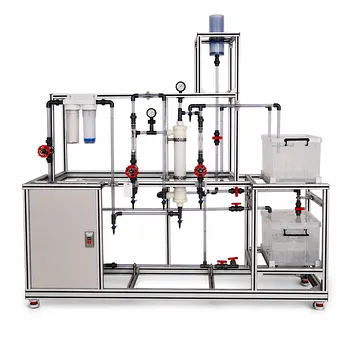
The key chemical reactions and parameters to monitor in a lime-soda softening pilot plant are the precipitation of calcium as calcium carbonate and magnesium as magnesium hydroxide, with strict control of lime and soda ash dosing, temperature, alkalinity targets, retention time, coagulant aid, and filtration efficiency. At its surface, your question is about which dials to watch on the pilot unit. But the deeper need is to understand how those dials connect—so you can demonstrate reliable softening, train operators, and generate data that scales to full municipal design.
The heart of the pilot plant demonstration is verifying that calculated stoichiometric dosages actually achieve the target finished-water hardness under your specific water chemistry and operating conditions. Success is measured not just by hardness removal, but by stable operation: minimal carryover of fine precipitates, controlled alkalinity residuals, and the ability to hit cold- or hot-process hardness goals consistently.
The Core Chemical Reactions Driving Softening
The lime-soda process works by converting soluble hardness ions into insoluble particles that can be settled and filtered out. Every monitoring decision flows from understanding these two parallel precipitation pathways.
Calcium Removal: Forming Calcium Carbonate
When hydrated lime (calcium hydroxide) is added to water containing calcium bicarbonate—the main component of temporary hardness—the reaction strips a molecule of carbon dioxide and forces calcium to precipitate as calcium carbonate (CaCO₃). The same lime also neutralizes free carbon dioxide, which would otherwise keep the carbonate dissolved. In a pilot plant, you monitor the completion of this reaction by tracking the drop in calcium hardness and the simultaneous change in alkalinity.
Magnesium Removal: Precipitating Magnesium Hydroxide
Magnesium hardness demands a higher pH. Lime provides the necessary hydroxide ions to convert soluble magnesium salts into magnesium hydroxide (Mg(OH)₂), a flocculent, gelatinous precipitate. This reaction is slower and more pH-dependent than calcium precipitation. That is why pilot plants must vigilantly monitor causticity (2P – M alkalinity) as a proxy for the free hydroxide availability that drives magnesium removal to completion.
Permanent Hardness Removal with Soda Ash
Non-carbonate (permanent) hardness—typically calcium and magnesium sulfates or chlorides—cannot be removed by lime alone. Soda ash (sodium carbonate) supplies the carbonate ion to precipitate this fraction as additional calcium carbonate. The pilot plant’s soda ash dosing is the lever that handles the hardness fraction not accompanied by bicarbonate alkalinity.
Critical Process Parameters to Monitor
Pilot plant instrumentation and grab-sample schedules are built around five control points. Letting any one of them drift will result in data that cannot be trusted for design scale-up.
Chemical Dosing Ratios: Getting Stoichiometry Right
Chemical addition is not guesswork. When the raw water’s total hardness (TH) exceeds its M-alkalinity—the typical municipal case—dosages are calculated from three raw-water numbers:
- Lime required (as Ca(OH)₂) = (M‑alkalinity + magnesium hardness, both as CaCO₃) × 0.74
- Soda ash required (as Na₂CO₃) = (Total Hardness – M‑alkalinity, both as CaCO₃) × 1.06
These formulas are the pilot plant’s starting recipe. The pilot’s job is to validate them under dynamic flow conditions and to tweak for the specific raw water quality swings you encounter.
Free Alkalinity (2P – M) for Magnesium Control
The pilot operator’s most powerful single number is the differential alkalinity (2P – M). It indicates the amount of free hydroxide alkalinity available. For effective magnesium removal and precipitate flocculation, this value should ideally be maintained between 12 and 18 ppm as CaCO₃. A low differential means magnesium stays in solution; a high differential wastes chemicals and can lead to carryover of unreacted floc. To sustain this target, operators often add a small dose of ferric sulfate or another coagulant, which consumes a bit of alkalinity and tightens the floc structure.
Temperature: The Cold vs. Hot Divide
Temperature dramatically changes your bottom-line hardness number. Cold lime-soda softening (ambient temperatures) will typically reduce calcium hardness to about 35 mg/L as CaCO₃, while leaving roughly 90% of the magnesium in solution. Raising the process temperature—hot lime-soda softening—lowers the solubility of both precipitates, driving total hardness down to around 20 mg/L as CaCO₃. Monitoring temperature continuously and correlating it with effluent hardness is non-negotiable; without this record, a pilot run cannot demonstrate whether the chemistry or the thermodynamics limited your performance.
Retention Time and Settling Basin Performance
Lime and soda ash produce a heavy but fine precipitate, especially the magnesium hydroxide floc. Retention time in the settling basin must be sufficient (typically several hours) to allow solids to separate by gravity. Monitor the sludge blanket depth and the turbidity of the settled water overflow. If these indicators climb, the pilot is telling you that your coagulant dose, mixing energy, or retention time needs adjustment. Often, a coagulant aid like an iron or aluminum salt is added to create a denser, faster-settling floc.
Post-Settling Filtration and Phosphate Polishing
Filtration is not an add-on; it is the final barrier that catches the fine carbonate particles that escape the settler. Filter effluent turbidity and particle counts are the direct measure of suspension removal efficiency. For pilots that must demonstrate extremely low hardness (approaching 2 mg/L as CaCO₃), a small post-softening dose of phosphate (5–8 mg/L residual after filtration) is introduced to sequester any remaining calcium. Monitoring the phosphate residual proves that this polishing step is active and not overdosed, which would risk post-precipitation in distribution lines.
Understanding the Trade-offs
Pilot plants are truth-telling machines—they reveal the hidden costs of each softening goal.
Cold Process Simplicity vs. Residual Hardness
Running the pilot cold simplifies the equipment and eliminates energy costs, but it leaves a measurable hardness floor. You cannot beat the solubility limit of calcium carbonate at ambient temperatures. If your finished-water goal is simply to reduce scaling tendency and not to reach sub-30 mg/L hardness, the cold process is sufficient and the pilot should be set up to prove stability at that floor.
Stoichiometric Overdosing: Sludge and Chemistry Upsets
Adding more lime and soda ash than the formulas prescribe does not linearly improve hardness removal. It creates excess sludge, can push the 2P–M value out of its optimal window, and may even reverse magnesium removal by forming soluble complexes. The pilot plant must demonstrate the narrow operating band between “enough chemical” and “wasteful overdosing.”
Silica Interference
When raw water contains silica, it can inhibit magnesium precipitation. Pilot plants often test the addition of a small amount of magnesia (MgO) to bind silica and prevent it from fouling the process. Monitoring silica in the effluent validates that this side reaction is under control and that magnesium removal is not being silently sabotaged.
Making the Right Choice for Your Pilot Demonstration
Your pilot plant’s monitoring plan must match the specific design objectives of the full-scale facility. Align your emphasis accordingly.
- If your primary focus is demonstrating reliable municipal softening with minimal operational complexity: Anchor your monitoring on calculated lime and soda ash dosages, verify the (2P–M) alkalinity stays between 12–18 ppm, and track settled water turbidity and post-filter hardness. This proves the baseline cold process works.
- If your primary focus is achieving the lowest possible finished hardness (sub-20 mg/L): You must run the pilot in heated mode, continuously record temperature, and incorporate phosphate post-treatment. Monitor not only hardness but also the phosphate residual to confirm the polishing step is active and controlled.
- If your primary focus is operator training and process dynamics: Emphasize grab-sample schedules that capture diurnal raw-water quality changes, link jar-test coagulant doses directly to the 2P–M reading, and log sludge blanket depth under varying flow rates to teach cause-and-effect.
The difference between a pilot plant that generates useful design data and one that merely recirculates water is whether you monitor chemical demands, alkalinity differentials, and thermal effects as tightly coupled system—not as isolated instrument readings.
Summary Table:
| Parameter | Target Value / Formula | Process Significance |
|---|---|---|
| Lime Dosage | $(M\text{-Alkalinity} + Mg^{2+}\text{ Hardness}) \times 0.74$ | Precipitates calcium carbonate and neutralizes $CO_2$ |
| Soda Ash Dosage | $(TH - M\text{-Alkalinity}) \times 1.06$ | Precipitates non-carbonate (permanent) calcium hardness |
| Free Alkalinity ($2P-M$) | $12\text{ to }18\text{ ppm as }CaCO_3$ | Key indicator for successful magnesium hydroxide precipitation |
| Operating Temperature | Ambient (Cold) vs. Heated (Hot) | Hot process reduces total hardness floor down to $\sim20\text{ mg/L}$ |
| Phosphate Polishing | $5\text{ to }8\text{ mg/L residual}$ | Sequesters trace calcium post-filtration to prevent scaling |
Scale Up Your Water Treatment Research and Training with LABPARK
Transitioning from bench-scale chemistry to reliable pilot operation requires robust, industrial-grade demonstration systems. LABPARK designs and delivers premium Educational and Vocational Unit Operations Pilot Plants in chemical engineering, bioprocess & biotech, and environmental & water treatment.
Whether you are a university equipping an engineering lab, a research institute validating water treatment kinetics, or an enterprise scaling up municipal processes, our pilot plants provide the precise control and instrumentation needed to verify key process parameters.
Contact LABPARK today to discuss your project requirements and request a customized quote.
Related Products
- Multi-Functional Special Distillation Educational Pilot Plant
- Electrochemical Water Treatment Educational Unit Operations Pilot Plant
- Continuous Batch Extractive Distillation Educational Pilot Plant
- Liquid-Liquid Mass Transfer Coefficient Determination Educational Pilot Plant
- Comprehensive Liquid-Liquid Extraction Pilot Plant for Engineering Education
People Also Ask
- Why does simple distillation yield higher efficiency than flash distillation? Key thermodynamic differences.
- How to Estimate Distillation Pilot Plant Tray Efficiency? O'Connell's Correlation Guide
- How does double temperature difference control improve distillation pilot plants? Stabilize purity.
- How Batch vs Continuous Configuration Affects Distillation Pilot Plant Versatility & Footprint
- How to Verify Distillation Boundary Lines & Composition Regions with Pilot Plants