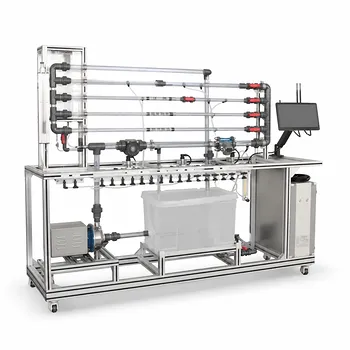
PVDF has become a standard in pilot-scale operations because it uniquely combines broad-spectrum chemical inertness with a functional temperature range that few other polymers can match.
At its core, polyvinylidene fluoride (PVDF) provides researchers and engineers with a membrane that resists degradation from aggressive chemicals and maintains physical integrity across a thermal window stretching from -50°C to 140°C. This inherent stability allows a single pilot plant skid to switch from sterilizing a low-temperature pharmaceutical stream with ozone to filtering a hot, acidic industrial effluent without requiring a complete membrane swap.
The fundamental challenge in any pilot plant is balancing experimental flexibility with reliable, repeatable results. PVDF solves this by providing a nearly universal chemical platform capable of withstanding harsh cleaning and diverse feed streams, but its natural hydrophobicity demands a strategic surface modification plan to prevent catastrophic fouling.
The Thermal and Chemical Core of PVDF
The unique performance of PVDF stems directly from its molecular structure. The strong carbon-fluorine bonds create a polymer backbone that is fundamentally non-reactive and thermally stable, a property that defines its entire operational envelope.
Defining the Thermal Operating Window
The glass transition temperature (Tg) of PVDF sits at -40°C, far below any normal pilot plant operating environment. This means the membrane remains in a consistent, mechanically stable state rather than becoming brittle or deforming under thermal stress. In practical terms, this allows confident operation from sub-freezing conditions up to a sustained 140°C.
When comparing this to standard engineering polymers, the difference is critical. Unplasticized PVC, for instance, begins to soften above 60°C. Polypropylene can operate to 120°C, but its chemical resistance profile is narrower. PVDF occupies a crucial middle ground between simple polymers and exotic, high-cost materials like PTFE, providing high-temperature capability without sacrificing ease of fabrication.
A Shield Against Chemical Attack
Pilot plants are, by definition, experimental environments where membrane contact with unknown or aggressive chemicals is a constant risk. PVDF’s resistance to acids, oxidizers, and solvents directly translates to experimental freedom and reduced system downtime.
The material is inert to most inorganic and organic acids, allowing for filtration of highly acidic process streams and aggressive clean-in-place (CIP) cycles with nitric or hydrochloric acid. Its stability in oxidizing environments, particularly resistance to ozone, makes it the preferred choice for advanced water sterilization and disinfection pilot studies.
Equally important is its insolubility in a wide range of organic solvents. PVDF membranes can process feeds containing aromatic hydrocarbons, alcohols, and halogenated solvents without swelling or dissolving, a catastrophic failure mode for many other polymeric membranes like unplasticized PVC. For structural components like piping and fittings, PVDF offers similar chemical resistance to PTFE but is significantly easier to weld and fabricate on-site.
The Deep Need: Operational Resilience in a Pilot Plant
The surface-level advantages of temperature and chemical resistance translate into a single, powerful operational outcome: process continuity and data integrity. In a pilot plant, a failed membrane isn't just a replacement cost; it's the loss of an entire experimental run.
Eliminating Experimental Variables
Membrane degradation introduces silent variables into an experiment. As a membrane swells or corrodes, its pore structure changes, leading to unexplained drops in rejection or permeate flux. PVDF’s inherent stability eliminates this degradation pathway, ensuring that a change in process performance is a true response to the test conditions, not an artifact of material failure.
This stability extends across a wide pH range, meaning a single PVDF membrane module can be used for an acid-catalyzed synthesis trial one week and an alkaline wastewater treatment experiment the next. This multi-use capability simplifies inventory for research labs and vocational training facilities.
Simplifying Clean-in-Place Protocols
Fouling is inevitable, but cleaning a membrane should not be destructive. PVDF’s chemical tolerance allows for aggressive, multi-step CIP protocols that would destroy less robust materials. A typical sequence might involve an acid wash to remove mineral scale, followed by an oxidizer treatment to oxidize organic foulants, and then a chlorinated solvent flush. PVDF withstands this sequencing without structural fatigue, restoring performance to near-baseline levels.
The Critical Trade-off: Managing the Hydrophobic Achilles' Heel
This is the point where the technical narrative must confront the practical reality. The very chemistry that makes PVDF so stable—its strong carbon-fluorine bonds—also creates a low-energy, hydrophobic surface that actively repels water.
The Fouling Problem in Aqueous Systems
In any bioprocess or environmental pilot plant processing an aqueous feed stream, an untreated PVDF membrane will rapidly foul. Organic matter and proteins readily adsorb to the water-repelling surface, forming a gel layer that collapses permeate flux and invalidates separation data. Without addressing this, all the chemical and thermal advantages are rendered useless in a water-treatment context.
The solution lies in predictable surface modification. This is not a defect to be avoided, but a design parameter to be managed. The most common and effective methods include:
- Blending with hydrophilic polymers like polyvinylpyrrolidone (PVP) or polyethylene glycol (PEG) during membrane casting.
- Post-treatment grafting, such as plasma treatment to introduce acrylic acid or polyacrylamide chains, permanently increasing surface energy.
- Alkaline or oxidizing pre-treatment to create surface hydroxyl and carboxyl groups.
The Performance vs. Stability Balance
These modifications create a low-protein-binding, hydrophilic surface that sustains a stable permeate flux. For a pilot plant operator, this means extended experimental runs without fouling-induced shutdowns. However, a subtle trade-off remains: the most aggressive surface modifications can, over extreme timeframes, slightly alter the molecular weight cut-off or create weak points. A truly objective assessment acknowledges that a modified PVDF membrane is a carefully tuned composite, not a monolithic material, and its longevity must be verified for multi-year installations.
Beyond Simple Sterilization: PVDF's Role in Advanced Processes
While water treatment is the primary application, PVDF’s role in pilot plants is expanding into reactive separations, a domain traditionally reserved for ceramic membranes.
The Rise of Catalytic PVDF Membranes
An emerging application involves embedding catalytic complexes directly into the PVDF matrix. For example, Ti(IV) trialkanolamine complexes can be incorporated to create a membrane that performs chemoselective oxidations, such as converting secondary amines to nitrones, directly at the filtration surface.
The performance data here is compelling. These polymeric catalytic membranes achieve high reaction yields and stereoselectivity comparable to homogeneous catalysts, but with a critical operational advantage: low catalyst concentration (as low as 1%) and high reusability. The membrane becomes the reactor and the separation unit simultaneously.
The Recylability Anomaly
One of the most interesting documented phenomena is the increase in catalytic activity after the first use. This is counterintuitive. Rather than degrading, the initial reaction appears to modify the polymer surface, making the embedded metal catalyst either more accessible or enhancing its Lewis acidity. For a pilot plant operator, this means consistent yields of approximately 90% can be maintained for at least five consecutive runs.
The protocol for this stability is specific. The membrane must be carefully removed after each batch, washed with a suitable solvent like chloroform to desorb any retained reagents, and then returned to the reactor. This step is critical for maintaining the elevated catalytic efficiency and prevents the accumulation of adsorbed species that could mask the active sites.
Making the Right Choice for Your Pilot Plant
Your material selection is not a theoretical exercise; it's a direct decision that determines your plant’s experimental bandwidth and maintenance burden. PVDF is frequently the right choice, but it’s not the universal one.
- If your primary focus is a multi-purpose research platform: Choose PVDF. Its ability to handle aggressive CIP chemicals, tolerate a wide temperature range, and resist organic solvents makes it the most flexible material for an environment where the next experiment is always an unknown.
- If your primary focus is high-temperature, non-aqueous reactive separations: Evaluate ceramic membranes. While more expensive and harder to seal, they offer thermal stability up to 250°C and can withstand aggressive neutral organic solvents like DMSO without any risk of swelling.
- If your primary focus is long-duration aqueous bioprocessing: Select surface-modified PVDF. The untreated polymer’s hydrophobic nature is a fatal flaw here. You must prioritize a membrane with a proven hydrophilic grafting or blending treatment to ensure stable flux and low protein binding across your experimental campaign.
The goal is not to find a perfect material without limitations, but to deploy one whose failure modes you fully understand and can control. PVDF’s clear and manageable Achilles' heel makes its powerful stability a reliable foundation for scaling your process from lab to reality.
Summary Table:
| Property | PVDF Capability | Pilot Plant Benefit |
|---|---|---|
| Thermal Range | Stable from -50°C to 140°C | Withstands sterilization and high-temp feeds |
| Chemical Resistance | Inert to acids, ozone, and solvents | Allows aggressive CIP cycles and diverse feed testing |
| Surface Properties | Hydrophobic (requires modification) | Modified membranes prevent organic fouling in aqueous runs |
Optimize Your Process Scale-Up with LABPARK
Selecting the right membrane material is critical to ensuring experimental repeatability and system longevity. LABPARK provides Educational and Vocational Unit Operations Pilot Plants in chemical engineering, bioprocess & biotech, and environmental & water treatment for universities, research institutes, and enterprises.
Whether you need high-temperature stability or advanced chemical resistance, we can help you configure the ideal pilot system. Contact our technical experts today to discuss your project requirements!
Related Products
- Photocatalytic Membrane Separation and Degradation Unit Operations Pilot Plant
- Ultrafiltration Membrane Separation Educational Pilot Plant
- Multi-Functional Membrane Separation Educational Pilot Plant for Unit Operations Lab
- Hollow Fiber Ultrafiltration Membrane Separation Educational Pilot Plant
- Multi Functional Membrane Crystallization Educational Unit Operations Pilot Plant
People Also Ask
- What are the key differences in membrane configurations? Choose the Right Unit Operations Pilot Plant
- How Do Pervaporation, Vapor, and Gas Permeation Differ in Pilot Plants? Key Comparison
- What are the structural & performance trade-offs of flat-sheet, spiral-wound, & hollow-fiber membrane modules?
- Pervaporation vs. Vapor Permeation: Handling Suspended Solids in Membrane Pilot Plants
- How do PEI, PVDF, and PSU membranes compare in pilot plants? Find the best fit.