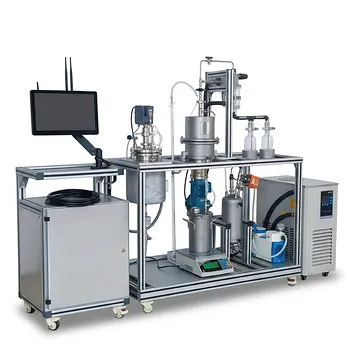
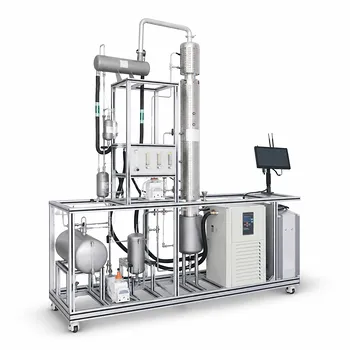
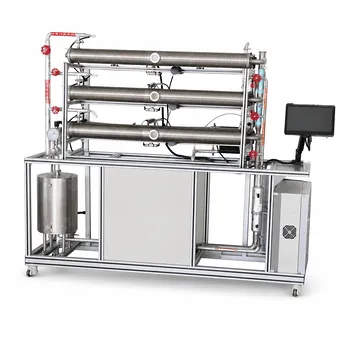
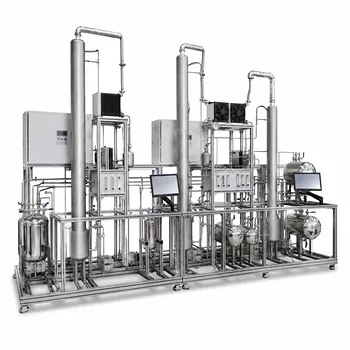
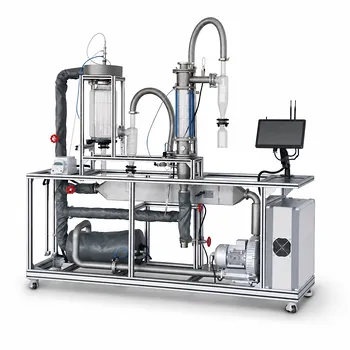
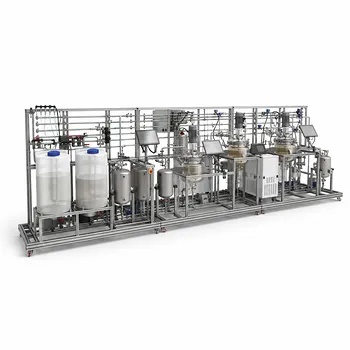
The paramount advantage of a batch pervaporation pilot plant is its unmatched experimental flexibility. Unlike a continuous system, a batch configuration allows a single feed charge to be recirculated over the membrane module multiple times until the target separation is achieved, making it the ideal platform for academic study. This design enables researchers and students to treat vastly different feed streams and compositions with the same equipment, turning the plant into a universal teaching tool for advanced membrane separation principles.
While it consumes more energy and demands more membrane area per unit of product than a continuous system, the batch pervaporation pilot plant prioritizes versatility and pedagogical clarity. Its core value is providing a hands-on, configurable platform to demonstrate the mechanics of sorption, diffusion, and desorption, free from the thermodynamic constraints of distillation.
The Pedagogical Power of Process Configuration
The batch design is not a scaled-down industrial solution; it’s a deliberate educational choice. Its operational simplicity provides a clear window into the fundamental transport phenomena without the complexity of steady-state optimization.
Universality Across Feed Streams
A single batch plant is a universal system. Researchers can dehydrate ethanol in the morning and remove volatile organic compounds (VOCs) from wastewater in the afternoon.
- No Dedicated Infrastructure: The primary loop, consisting of a feed tank, pump, preheater, and single membrane module, is material-agnostic.
- Rapid Turnover: By simply draining and cleaning the storage tank, the plant is immediately ready for a completely different separation challenge. This utility is unmatched in packed distillation columns.
Concentration Control via Recirculation
Batch operation turns time into a direct proxy for product purity. The concept of "passes" is intuitive and powerful for learners.
- Defining the Filtration Cycle: The feed circulates back to the storage tank, passing over the membrane repeatedly. The target component is steadily depleted from the tank until a desired endpoint, often measured in parts per million (ppm), is reached.
- Adjustable Product Quality: Capacity and final product quality are not fixed design parameters. They are easily adjusted by simply changing the number of recirculation passes, offering a direct demonstration of the mass balance in action.
Studying Transport Mechanisms in Practice
The transparent, staged nature of a batch plant makes it an ideal testbed for validating theoretical models. The laboratory setup becomes a physical representation of complex equations.
Observing the Solution-Diffusion Model
For dense membranes like those used in dehydration, the solution-diffusion mechanism governs performance. The batch plant makes its three discrete steps observable.
- Preferential Sorption: The selective interaction of the membrane polymer with a target molecule (e.g., water in ethanol) begins at the feed-membrane interface.
- Diffusion via Fick's Law: The sorbed molecule diffuses through the polymer matrix under a concentration gradient, a step directly affected by the feed temperature maintained by the pilot plant’s preheater.
- Downstream Desorption: The permeate vaporizes under vacuum into the downstream chamber and is recovered in a cold trap, often using liquid nitrogen, proving the phase-change concept without adding external heat.
Contrasting with Molecular Sieving
The same batch rig can be used to test porous membranes, demonstrating a fundamentally different separation logic.
- Size Exclusion: Separation depends on pore size distribution and the kinetic diameter of permeating molecules.
- Capillary Flow: Molecules preferentially sorb on the upstream surface but travel through capillary pores by viscous flow, evaporating only at the pore outlet. A single pilot plant lets students contrast this mechanism directly with the solution-diffusion model.
Demonstrating Hybrid and Intensified Processes
The true research value of a batch pervaporation unit emerges when it’s integrated with other equipment.
Equilibrum Shift in Esterification Reactions
Coupling a reactor to the pervaporation unit directly illustrates Le Chatelier's principle in a practical, chemical engineering context.
- Byproduct Removal: During an esterification reaction, water is a byproduct. The pervaporation unit continuously extracts this water through the membrane.
- Driving Total Conversion: This continuous removal permanently shifts the reaction equilibrium toward the product side. The result is near-total conversion of reactants and a dramatic increase in yield, eliminating complex downstream purification.
- Practical Integration: This setup teaches students the tangible benefits of process intensification—combining reaction and separation into a single, efficient unit operation.
An Energy-Efficient Alternative to Azeotropic Distillation
The process is a premier teaching tool for green chemistry because it sidesteps thermodynamic bottlenecks. A direct comparison of energy needs is a powerful lesson.
- Bypassing the Azeotrope: Pervaporation does not rely on vapor-liquid equilibrium. It’s a kinetically controlled process driven by differences in permeation rates, not relative volatility.
- No Additive Requirement: Unlike azeotropic distillation, which requires adding an entrainer to break the azeotrope, pervaporation achieves separation in a single, clean step using a selective membrane.
- Quantifiable Energy Savings: For ethanol dehydration, achieving 99.8% purity with a hydrophilic PVA membrane consumes 30% to 40% less energy than azeotropic distillation. The gentle, ambient or moderate-temperature operation also makes it ideal for heat-sensitive materials.
Understanding the Critical Trade-off: The Temperature Cascade
A batch process exposes a fundamental operational challenge. Students and researchers must learn to manage the system’s internal heat dynamics, which is a key learning objective.
- The Sensible Heat Problem: The heat required to vaporize the permeate is drawn directly from the sensible heat of the liquid feed itself. This causes a significant feed temperature drop across the module.
- The Flux-Temperature Relationship: Transmembrane flux decreases exponentially with temperature. The temperature drop, if unchecked, cripples separation efficiency in a single pass.
- The Staging Solution: To maintain an acceptable flux, pilot plants often split the total membrane area into multiple stages. Intermediate inter-stage heaters are placed between these modules to reheat the liquid feed. This design allows for a direct study of how to optimize the balance between capital investment in membrane area and the cost of thermal energy input.
Making the Right Choice for Your Laboratory Goal
Selecting a batch pervaporation pilot plant configuration depends entirely on your primary educational or research objective.
- If your primary focus is teaching fundamental principles: Maximize the use of a simple, single-stage batch system. Its clarity in demonstrating sorption, diffusion, and desorption, without the complexity of inter-stage heating, is unmatched for building baseline knowledge.
- If your primary focus is process optimization research: Choose a multi-stage configuration with intermediate heating. This setup is essential for studying heat and mass transfer coupling and for collecting accurate data on flux decay and energy consumption.
- If your primary focus is demonstrating process intensification: Ensure the plant has standardized ports for coupling with a chemical reactor. This transforms the rig from a simple separator into an integrated reaction-separation platform, teaching equilibrium-shift principles in a truly hands-on manner.
The batch pervaporation pilot plant remains a uniquely potent platform for education and research, precisely because its design trade-offs prioritize experimental clarity and direct observation of the separation mechanism over sheer production efficiency.
Summary Table:
| Advantage | Operational/Design Feature | Key Academic & Research Value |
|---|---|---|
| High Flexibility | Material-agnostic loop, rapid cleaning & turnover | Universal platform for diverse feed streams |
| Concentration Control | Adjustable product quality via recirculation passes | Demonstrates mass balance and Fick's Law in real time |
| Process Intensification | Direct coupling with chemical reactors | Illustrates equilibrium shift (e.g., esterification) |
| Azeotropic Bypass | Kinetically controlled separation (no thermodynamic limits) | Green chemistry teaching tool with 30-40% energy savings |
| Thermal Management | Multi-stage configuration with inter-stage heaters | Provides practical study of heat and mass transfer coupling |
Elevate Your Engineering Lab with LABPARK Pilot Plants
Are you looking to enhance hands-on learning and research efficiency in your institution? LABPARK provides premium Educational and Vocational Unit Operations Pilot Plants across chemical engineering, bioprocess & biotech, and environmental & water treatment. Designed specifically for universities, research institutes, and enterprises, our modular systems—including batch pervaporation units—help students and researchers visualize complex thermodynamic and mass transfer processes with ease.
Contact LABPARK today to find the perfect pilot plant configuration for your laboratory!
Related Products
- Multi Pump Fluid Transport Process Piping Unit Operations Training Pilot Plant
- Supercritical High-Gravity Flash Evaporation Educational Unit Operations Pilot Plant
- Rising and Falling Film Evaporation Educational Unit Operations Pilot Plant
- Natural Product Extraction Unit Operations Training Pilot Plant
- Multimodal Absorption and Desorption Pilot Plant for Unit Operations Training
People Also Ask
- Why distinguish Newtonian & non-Newtonian fluids in pilot plants? Prevent design errors.
- Why is the chemical plant startup schedule crucial? De-risk scale-up with pilot plants.
- When to transition from PID to adaptive control in pilot plants? Key process indicators.
- How do deviations in estimating latent heat impact pilot plant thermal systems? Avoid hardware mis-sizing.
- How to study gasification in pilot plants? Compare exit gas composition & efficiency