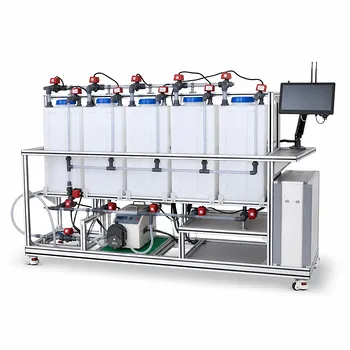
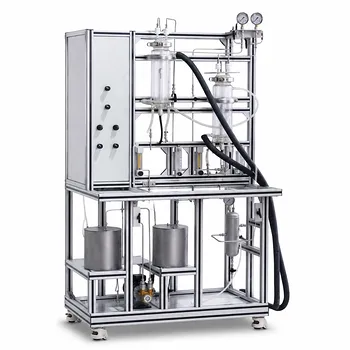
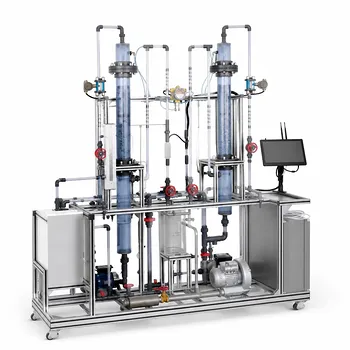
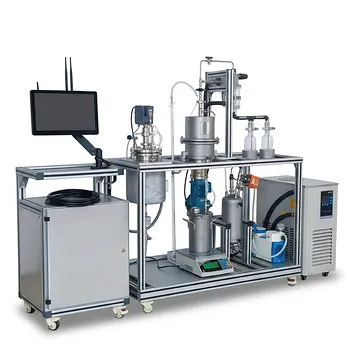
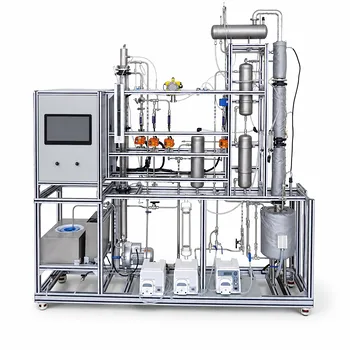
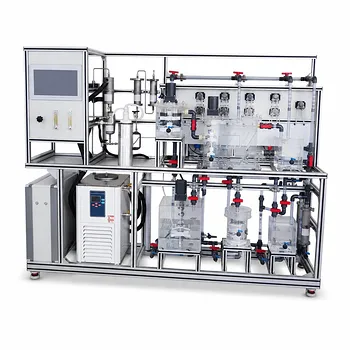
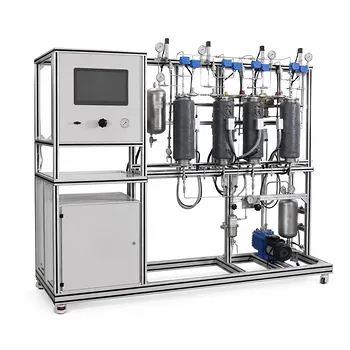
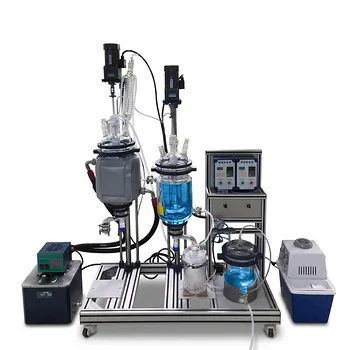
Pervaporation pilot plants offer a uniquely high-selectivity, low-energy pathway for water desalination and VOC recovery. Unlike reverse osmosis or multistage flash distillation, they achieve excellent salt rejection with significantly reduced thermal and electrical consumption. The process revolves around selective membrane materials—hydrophobic ones like PDMS for VOC removal, and hydrophilic matrices such as PVA, silica, graphene oxide, or zeolites for desalination. The primary engineering compromise is that this remarkable selectivity is currently paired with modest permeation rates, making membrane material innovation the central focus of pilot-scale research.
Pervaporation pilot plants unlock high-purity separations without chemical additives and at mild temperatures, but real-world deployment hinges on overcoming inherently low flux through advanced hybrid and thin-film composite membranes.
The Strategic Advantages of Pervaporation at Pilot Scale
Unrivaled Selectivity for Desalination and VOC Separation
Pervaporation’s fundamental strength is its ability to separate challenging mixtures in a single, membrane-driven step. For desalination, it achieves near-total salt rejection—often outperforming conventional pressure-driven methods. For VOC recovery from aqueous streams, the process exploits the preferential transport of organic molecules through a carefully chosen membrane, enabling concentration down to ppm levels without introducing a chemical entrainer.
Break Azeotropes Without Any Additives
Traditional distillation frequently hits an azeotropic barrier that demands a foreign entrainer and downstream purification. A pervaporation pilot plant sidesteps this complexity entirely. The selective membrane pulls one component across the vapour side based on solubility and diffusivity, breaking the azeotrope without altering the feed chemistry—a dramatically cleaner, safer route for research and industrial settings.
Operation at Ambient or Moderate Temperatures
Because only the permeating component vaporizes under a vacuum downstream, the process avoids boiling the entire bulk liquid. This confers two deep benefits: energy input is intrinsically lower than in distillation, and heat-sensitive compounds or biological materials are never exposed to destructive thermal shock. It is a non-destructive separation that preserves both stream integrity and equipment safety.
Inherent Process Flexibility in Pilot Configurations
A typical batch pervaporation pilot plant circulates the feed from a storage tank across a single-stage membrane module, back to the tank, until the target concentration is reached. This loop arrangement gives researchers extreme operational flexibility. The same plant can handle varied feed compositions, and the final product quality is tuned simply by adjusting the number of recirculation passes—an invaluable feature for educational labs and multi-product feasibility studies.
Critical Material Considerations for Membrane Selection
Membrane Materials for VOC Recovery
For removing volatile organics from dilute aqueous streams, hydrophobic elastomeric membranes such as polydimethylsiloxane (PDMS) are the workhorse. Their high free volume and affinity for organic molecules drive selective sorption and diffusion, leaving the water phase behind. However, the membrane must also resist swelling and chemical attack from the VOC itself, so trade-offs between selectivity and stability are constantly tested at pilot scale.
Membrane Materials for Water Desalination
Desalination demands hydrophilic, dense membranes that block ions while allowing water to pass as vapour. Polyvinyl alcohol (PVA) is a widespread baseline material, often crosslinked with glutaraldehyde to boost thermo-mechanical integrity and prevent dissolution. Other mature material classes include silica/silicates, graphene oxide (GO) laminates, and zeolite thin films, each offering a different balance of permeability, stability, and fabrication cost.
Optimising Flux with Hybrid and Composite Designs
The Achilles' heel of pure polymeric or ceramic layers is low permeation rate. Pilot-scale research overwhelmingly targets inorganic-organic hybrid membranes and thin-film composite (TFC) architectures that layer an ultra-selective coating on a highly permeable support. Such designs aim to decouple the selectivity function from the mechanical support, pushing flux upward while maintaining the near-perfect rejection demanded by desalination and VOC capture.
Stability, Compatibility, and Cost at Pilot Scale
Beyond chemical performance, any membrane must survive repeated thermal cycling, exposure to aggressive solvents, and the physical stress of continuous operation. Inorganic membranes (ceramics, zeolites) provide exceptional chemical and thermal resilience but are inherently fragile and expensive. Polymeric options are cheaper and more easily formed into modules, but they may require crosslinking or blending to prevent degradation. A pilot plant is precisely the environment where these opposing factors—material lifetime, selectivity, and cost—are brutally interrogated before scale-up.
Understanding the Trade-offs
Low Permeation Rates vs. High Selectivity
The core tension in any pervaporation application is that the same dense, selective layer that blocks salts or retains VOCs inevitably restricts mass transport. Pilot studies consistently reveal that despite outstanding rejection figures, water or organic vapour flux can fall short of industrial targets, demanding larger membrane areas or multi-module arrays that impact capital cost.
Batch Operation and Redilution Penalties
The flexible batch recirculation that makes a pilot plant so attractive also introduces a hidden energy penalty. With each pass, the permeate is removed and the retentate becomes progressively depleted, but the bulk feed is constantly re-diluted by the returning circulated stream. This means that more membrane area and longer run times are needed to hit ultra-low target concentrations compared to a multi-stage continuous process—a trade-off between flexibility and energetic efficiency.
Membrane Fouling and Long-Term Durability
Real aqueous streams contain foulants that can irreversibly block membrane surfaces. Even chemically stable materials can suffer a slow decline in flux due to scale formation, biofilm growth, or contaminant adsorption. Pilot testing is crucial to gather life-cycle data on cleaning protocols, membrane regeneration, and how many operational hours a given material can truly endure before performance falls below economic viability.
Making the Right Choice for Your Pilot Plant Goals
- If your primary focus is achieving the highest salt rejection or VOC purity without chemical additives: Prioritise material screening on membranes with proven dense selective layers—PVA (crosslinked) for desalination or PDMS for VOCs—and accept longer batch cycle times.
- If your primary focus is accelerating permeation rates and energy efficiency: Direct resources toward hybrid or thin-film composite membrane modules that boost water or organic flux, but plan for rigorous stability testing under your real feed conditions.
- If your primary focus is versatile, multi-stream research across different feeds: Adopt the classic batch recirculation configuration with easily swappable membrane modules, which gives you maximum experimental freedom while keeping floor space and capital costs low.
- If your primary focus is generating scale-up data for industrial transition: Record granular data on temperature, vacuum pressure, feed flow rates, and effective membrane area across hundreds of cycles to build the reliable process model that bridges the gap between bench and plant.
A well-designed pervaporation pilot plant does not simply separate streams—it separates the practical from the impractical, letting you rigorously test the membrane-property trade-offs that define the eventual industrial success of both water desalination and VOC recovery projects.
Summary Table:
| Application | Common Membrane Materials | Key Advantages | Main Trade-offs |
|---|---|---|---|
| Water Desalination | Hydrophilic matrices (PVA, Silica, Graphene Oxide, Zeolites) | Near-total salt rejection; ambient/moderate temperature operation | Lower permeation flux; susceptibility to scaling and fouling |
| VOC Recovery | Hydrophobic elastomers (PDMS) | Breaks azeotropes without chemical additives; high selectivity | Membrane swelling risks; needs high membrane surface area |
Optimize Your Separation Processes with LABPARK
Are you looking to enhance separation efficiency, test advanced membranes, or scale up your chemical processes? LABPARK provides premium Educational and Vocational Unit Operations Pilot Plants in chemical engineering, bioprocess & biotech, and environmental & water treatment. Built for universities, research institutes, and enterprises, our pilot systems deliver the flexibility, reliability, and precise control needed to validate your research and accelerate scale-up.
Contact us today to discover how LABPARK can customize the perfect pilot plant solution for your lab!
Related Products
- Electrochemical Water Treatment Educational Unit Operations Pilot Plant
- Multi-Functional Special Distillation Educational Pilot Plant
- Continuous Batch Extractive Distillation Educational Pilot Plant
- Electrolytic Hydrogen Production Educational Unit Operations Pilot Plant
- Ion Exchange Water Purification Educational Pilot Plant for Engineering Unit Operations
People Also Ask
- What design features do educational electrochemical pilot plants utilize to manage gas liberation and water loss?
- How can unit operations pilot plants show lead-acid concentration vs state of charge? Real-time monitoring guide.
- How do educational electrochemical pilot plants scale up electrolysis? Master industrial engineering.
- How to Estimate Sulfate in Water Treatment Pilot Plant Deposits: Gravimetric Guide
- How can foaming be managed during steam generation experiments in water treatment unit operations pilot plants? Tips