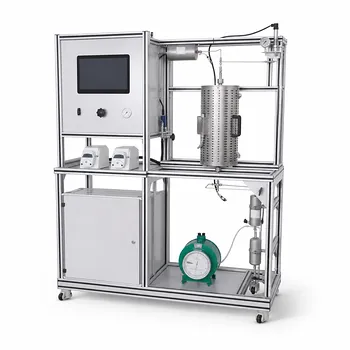
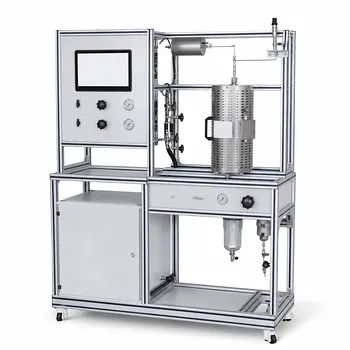
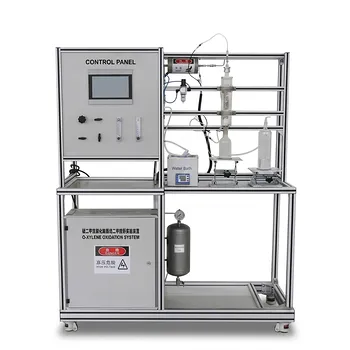
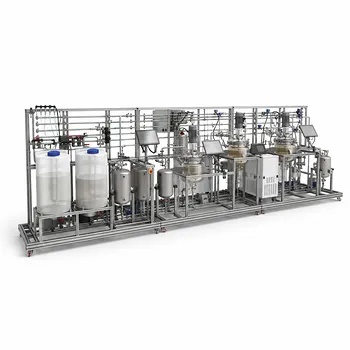
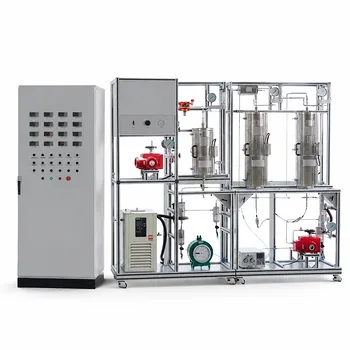
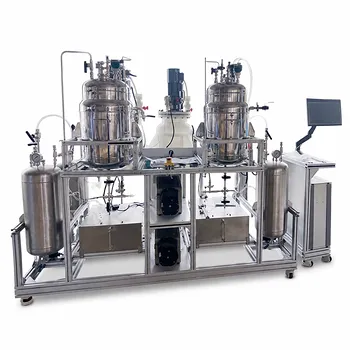
The core value of a pilot plant is not to prove your simulation right, but to show you where it's dangerously wrong. While simulation software like ASPEN PLUS provides a fast, idealized thermodynamic and mass-balance landscape for comparing acetylene and ethylene routes to vinyl chloride monomer (VCM), it fundamentally cannot account for the messy realities of physical equipment. Pilot plants complement these digital models by introducing empirical, real-world constraints—specifically, physical rate limitations, catalyst instability, and essential safety dynamics—that turn a theoretical chemistry model into a viable, scalable industrial process.
Simulation software models a perfect world where reactions go to completion instantly and valves never leak. A pilot plant models reality. For VCM production, this combination is critical because the acetylene and ethylene routes have entirely different physical bottlenecks: one is dominated by explosive thermal management, and the other by complex separation logistics.
The Fundamental Gap Between Simulation and Reality
Process simulators operate by solving mathematical equations in an environment without friction, corrosion, or human error. Their predictions are only as good as the assumptions entered into them. A pilot plant’s primary complement is to stress-test these assumptions against actual fluid dynamics and material science.
Simulators Ignore Reaction Kinetics and Heat Transfer Rates
Software defaults often assume ideal plug-flow or perfectly mixed continuous stirred-tank behavior with instantaneous thermal equilibrium. A physical acetylene hydrochlorination reactor exposes the critical flaw in this assumption. The reaction over the mercuric chloride (HgCl₂) catalyst is highly exothermic. In a real-world tubular reactor, if heat removal is insufficient, localized hot spots form. This doesn’t just lower yield—it can volatilize the toxic catalyst, creating an immediate safety hazard and deactivating the bed. A simulation may show a stable 150°C profile, while a pilot plant reveals a runaway 200°C spike in the middle of the tube, a discrepancy simulation alone cannot predict.
The Critical Role of Catalyst Deactivation Data
Simulation models typically treat catalyst activity as a constant or a simple decay function. In a pilot plant producing VCM from acetylene, students and researchers observe that mercury-based catalyst deactivation is non-linear and influenced by trace impurities in the feed. The physical unit operation provides the actual lifespan and deactivation curve, data which is essential for refining the simulation's thermodynamic model for any scale-up feasibility study.
Contrasting the Acetylene and Ethylene Route Bottlenecks
The two feedstocks present entirely distinct physical challenges that simulations mask under idealized unit operation blocks. Physical pilot plants are vital for revealing the true operational cost and complexity hidden in the process flow diagrams.
The Acetylene Route: Managing Thermal Runaway and Environmental Risk
A simulator calculates the theoretical conversion of acetylene and HCl into vinyl chloride cleanly. The physical pilot plant, however, forces operators to manage the "front-end" reaction severity. Because the reaction happens in a single step, precise space velocity and temperature control are tested hands-on. The supplementary need for robust scrubbing systems to handle the toxic HgCl₂ catalyst is a physical plant layout challenge that a software interface does not convey. This teaches a stark reality: the process is mechanically simple but operationally hazardous.
The Ethylene Route: Balancing Coupled Reactors and High-Pressure Separation
The simulation for the ethylene route appears elegant, balancing an exothermic chlorination reactor with an endothermic cracking furnace. However, a pilot plant reveals the thermodynamic and mechanical lock between these two units. Physical operation requires tuning a discharge pump to 30 atm to hold flow rates stable against fluctuating high temperatures. While a computer easily solves the phase equilibrium, the pilot plant demonstrates the real-world logistics of achieving this separation. It highlights that minimizing energy use in the cracking furnace requires physical recycling loops that are prone to fouling and pressure drops—nuances easily lost in idealized recycling calculators.
Validating Downstream Separation Models
Simulation excels at predicting vapor-liquid equilibrium (VLE) using thermodynamic packages, but it assumes perfect tray efficiencies and no entrainment. Pilot-scale distillation and extraction columns bridge this gap by proving or disproving these idealities.
Confronting Theoretical Predictions with Physical Splits
When comparing the two feedstock routes, the ethylene route demands complex, high-pressure distillation to isolate VCM. The acetylene route requires separating VCM from unreacted HCl and acetylene, often involving low-temperature processing at -16°C. A physical flash distillation or fractionation unit allows comparison of actual liquid/vapor ratios against simulation predictions. If the pilot column requires a higher reflux ratio to achieve 99.5% purity than the model predicts, it indicates a tray efficiency problem. This raw performance data is vital for recalibrating the simulation for accurate scale-up.
Real-Time Observation of Operational Discrepancies
Multicomponent Multistage Separation (MMSP) programs can model complex columns with multiple side draws, but they cannot predict how a slight pressure surge from the upstream reactor collapses the column’s temperature profile. In a pilot plant setting, students manipulate flow rates and immediately see a knock-on effect on the separation purity. This dynamic, integrated response teaches process control logic in a way that a static convergence on a digital solver never can.
Understanding the Trade-offs and Limitations
While essential, a physical pilot plant is not a flawless truth-teller. Its value as a complement is maximized when its own limitations are understood.
The Problem of Scale-Down vs. Scale-Up
Pilot plants suffer from disproportionate heat loss due to a high surface-area-to-volume ratio. A small educational column might need excessive insulation compared to an industrial adiabatic unit. This can lead students to overestimate heating requirements, a distortion that must be mathematically reconciled with the simulation rather than taken as a literal design specification.
The High Cost of Safety in Education
The acetylene route, with its mercury catalyst, demands rigorous containment and exhaust scrubbing protocols. The physical cost and safety logistics of running this route in a pilot plant are vastly higher than simulating it. The complement here is educational: the simulation saves material cost, while the rare physical run provides a non-negotiable lesson in industrial hygiene and reaction quenching that cannot be learned on a screen.
Making the Right Choice for Your Goal
The integration of pilot plants with simulation depends entirely on the depth of understanding required. The relationship is ultimately about reconciling the predicted mass and energy balances with tangible, observable performance.
- If your primary focus is comparing thermodynamic efficiency: Lean heavily on the simulator first to map the theoretical energy consumption of the ethylene cracking furnace versus the acetylene reactor preheating. Use the pilot plant only to validate the single most critical heat exchanger.
- If your primary focus is process safety and operability: The acetylene pilot plant is non-negotiable. Physical experience with managing the HgCl₂ reactor's hot spot behavior and related safety interlocks provides a visceral education that complements the simulator’s abstract control logic.
- If your primary focus is separation physics: Use the pilot distillation columns to generate tray efficiency and pressure-drop data for the ethylene route’s complex purification train, then feed these empirical coefficients back into your simulation to transform a generic model into a predictive digital twin.
The synergy lies in a feedback loop: the simulation identifies the thermodynamic target, the pilot plant reveals the physical impediments, and the resulting empirical data refines the simulation into a tool that can be trusted for serious commercial design.
Summary Table:
| Parameter | Simulation Software (Idealized) | Physical Pilot Plant (Reality) |
|---|---|---|
| Thermal Management | Assumes instant equilibrium & stable profiles | Reveals hot spots and thermal runaway risks |
| Catalyst Activity | Models deactivation as a constant function | Captures non-linear decay and impurity impacts |
| Separation Physics | Predicts perfect tray efficiencies | Validates actual reflux ratios & column stability |
| Process Safety | Idealized control loops without physical risk | Tests containment, hygiene, and emergency shutdown |
Ready to bridge the gap between process simulation and physical reality in your labs?
LABPARK provides high-quality Educational and Vocational Unit Operations Pilot Plants in chemical engineering, bioprocess & biotech, and environmental & water treatment. Tailored for universities, research institutes, and enterprises, our systems empower students and researchers to master hands-on process safety, thermodynamics, and real-world system operations.
Contact LABPARK today to find the ideal pilot plant solution for your institution.
Related Products
- Multi-Functional Special Distillation Educational Pilot Plant
- Ethyl Acetate Synthesis Unit Operations Pilot Plant for Practical Training
- Methanol Synthesis and Catalyst Performance Evaluation Educational Unit Operations Pilot Plant
- Methane Cracking Educational Unit Operations Pilot Plant
- Carbon Dioxide Hydrogen Methanol Synthesis Educational Unit Operations Pilot Plant
People Also Ask
- Why does simple distillation yield higher efficiency than flash distillation? Key thermodynamic differences.
- How to Verify Distillation Boundary Lines & Composition Regions with Pilot Plants
- How to Integrate Spectroscopy in Distillation Pilot Plants for Advanced Process Control
- Why is the acentric factor important in pilot plants? Fluid property prediction.
- How to Estimate Distillation Pilot Plant Tray Efficiency? O'Connell's Correlation Guide