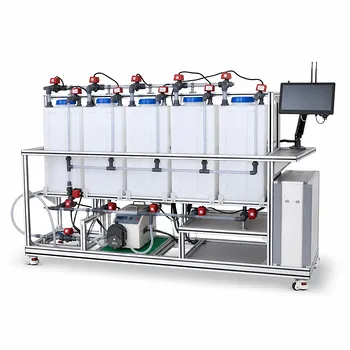
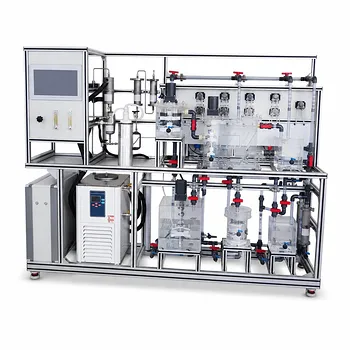
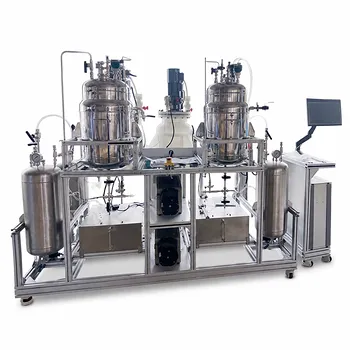
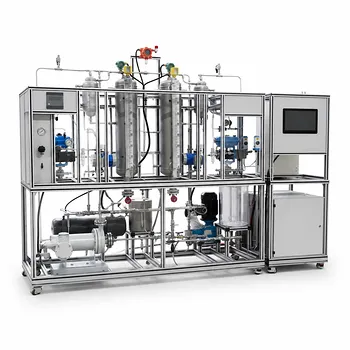
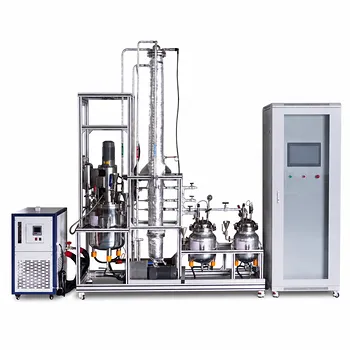
Pilot plants unlock the invisible chemistry of water softening by transforming textbook reactions into tangible, hands-on engineering. They are configured as a multi-stage process train that precisely doses calcium hydroxide (slaked lime), mixes it with raw water, provides controlled time for flocculation, and then separates the precipitated hardness solids—all while capturing live data on pH, turbidity, and hydraulic parameters. This modular approach lets students connect chemical equilibrium directly to physical unit operations.
The most effective teaching configurations go beyond simple softening; they integrate real-time monitoring and jar-test scaling to demonstrate the critical interplay between chemical solubility, settling dynamics, and sludge management—preparing students to design and troubleshoot reliable industrial-scale systems.
The Modular Process Train: Essential Pilot Plant Units
A pilot plant designed to teach lime softening must replicate the sequence found in full-scale plants, but with the flexibility to vary conditions and measure results.
Precise Chemical Dosing: The First Point of Control
The process begins with a chemical dosing pump that introduces a calcium hydroxide slurry or solution into the raw water stream. Precise control here is paramount, because the dose must match the bicarbonate hardness (calcium and magnesium bicarbonates) to drive precipitation to completion without wasting chemicals or raising the pH unnecessarily.
Rapid Mixing and Flocculation: Driving Particle Collisions
After dosing, the water enters a rapid-mix chamber to disperse the lime uniformly. This is immediately followed by a flocculation vessel, where gentle agitation encourages the newly formed calcium carbonate (CaCO₃) and magnesium hydroxide (Mg(OH)₂) precipitates to collide and grow into settleable flocs. Students can vary mixing speeds and retention times to see their effect on floc size and downstream clarity.
Sedimentation and Sludge Management: Teaching Solid-Liquid Separation
The last core unit is a sedimentation tank (clarifier). Here, the precipitated solids separate by gravity, forming a sludge blanket at the bottom while clear, softened water overflows from the top. The pilot plant allows students to measure sludge accumulation rates, observe the impact of hydraulic loading, and practice sludge wasting—a critical operational skill often overlooked in purely bench-scale work.
From Classroom Theory to Process Control Instruments
The true power of a pilot plant comes from the sensors and analytical access points it provides. These turn abstract chemistry into measurable engineering variables.
Measuring pH and M-Alkalinity to Unlock Carbonate Chemistry
Lime softening is fundamentally a pH-driven reaction. In-line pH sensors and sample ports for M-alkalinity titration let students track the conversion of soluble bicarbonates to insoluble carbonates. They learn that dissolved CO₂ and carbonate speciation govern how much lime is required, and that the final pH can stabilize around the equilibrium point of solid CaCO₃—often near 9.9 in pure water, but lower in real buffered systems.
Turbidity Monitoring and Ksp Calculations
By placing a turbidity meter on the clarifier effluent, students can quantify removal efficiency and correlate it with the theoretical solubility product (Ksp) of calcium carbonate. They see that perfect removal is impossible—residual hardness ions remain—and that operational factors like overflow rate and floc carry-over directly affect practical performance, not just chemical limits.
Scaling Up Jar Tests to Industrial Logic
A well-designed pilot plant bridges the gap between a bench-top jar test and a full-scale treatment works.
Hydraulic Retention Time and Settling Velocities
Unlike a static jar, the pilot plant runs continuously. Students set flow rates to investigate hydraulic retention time (HRT) in the flocculator and clarifier, then measure corresponding settling velocities. This teaches them to size equipment for a given flow—a direct application of Stoke’s law in a real flow environment.
Sludge Accumulation and Handling
Over a multi-hour run, the pilot plant reveals how sludge blanket height increases with time and influent hardness. Students can develop sludge wasting schedules and test the effect of sludge recirculation on floc density. This hands-on experience with a messy by-product makes the economic and operational realities of lime softening concrete.
Beyond Softening: Integrating Anti-Scaling Chemistry
An advanced educational configuration adds a second dosing point downstream of the clarifier.
Preventing Post-Precipitation Scale with Sodium Hexametaphosphate
Even after softening, the water may be supersaturated with residual calcium carbonate and can form post-precipitation scale in pipes or cooling systems. By injecting a small dose of sodium hexametaphosphate (a sequestering agent) after sedimentation, students learn how to chemically stabilize the softened water. This transforms the pilot plant into a complete scale prevention demonstration, linking the chemistry of solubility to industrial asset protection.
Understanding the Trade-offs and Pitfalls
Teaching with a pilot plant is powerful, but instructors must navigate its limitations to avoid creating misconceptions.
The pH Balancing Act
Over-dosing lime in pursuit of lower hardness can spike the pH above 10.5, leading to excessive sludge production, slower settling due to light magnesium hydroxide flocs, and a more corrosive or unstable water. Students must learn to target the optimal pH window for both CaCO₃ and Mg(OH)₂ precipitation while keeping the treated water manageable.
Sludge Volume and Realism
Pilot plants handle small volumes, so the quantity of sludge generated is modest. This can hide the real-world challenge of sludge thickening, dewatering, and disposal. However, it remains a valuable lesson in mass balance and the concept that softening creates a solid waste stream that cannot be ignored.
Over-Simplification Risks
A simplified pilot plant may not capture the complex hydrodynamics of a full-scale conical clarifier or sludge blanket reactor. If not framed carefully, students might underestimate the impact of short-circuiting and temperature effects. The best teaching configurations explicitly discuss these gaps, reinforcing that the pilot is a scaled, not identical, model.
Making the Right Choice for Your Teaching Goal
When designing a pilot plant exercise for lime softening, align the configuration with your primary educational objective.
- If your primary focus is chemical equilibrium and stoichiometry: Prioritize precision dosing pumps and extensive sampling ports for pH, M-alkalinity, and residual hardness measurements. Let students calculate the exact mass balance between lime added and precipitates formed.
- If your primary focus is process scaling and unit sizing: Emphasize variable-speed mixers and a clarifier with multiple overflow ports to measure settling velocity as a function of flow rate and HRT.
- If your primary focus is water chemistry analysis: Incorporate the full alkalinity/pH titration suite, CO₂ calculation, and turbidity monitoring to link the solubility product (Ksp) to observed residual hardness.
- If your primary focus is downstream equipment protection: Add the sodium hexametaphosphate dosing stage and instruct students to perform post-softening stability tests, showing how chemical sequestration prevents scale on heat exchangers or membranes.
The best pilot plant is not the most complex one, but the one that makes the invisible interplay between chemistry, hydraulics, and practical operation visible to every learner.
Summary Table:
| Pilot Plant Unit | Key Function | Educational Objective |
|---|---|---|
| Chemical Dosing | Precise calcium hydroxide injection | Teach stoichiometry and mass balance calculations |
| Flocculation Vessel | Controlled mixing for particle collision | Observe floc growth and hydraulic retention time (HRT) |
| Clarifier (Sedimentation) | Gravity separation of precipitates | Practice sludge wasting schedules and study settling velocities |
| Analytical Sensors | Real-time pH and turbidity monitoring | Analyze carbonate chemistry and solubility product (Ksp) |
Bring Industrial Water Treatment to Life with LABPARK
Looking to equip your laboratory with robust, hands-on teaching systems? LABPARK offers specialized Educational and Vocational Unit Operations Pilot Plants in chemical engineering, bioprocess & biotech, and environmental & water treatment.
Tailored for universities, research institutes, and enterprises, our custom-configured pilot plants enable students and researchers to master real-world process dynamics—from precipitation-based water softening to advanced scale prevention.
Contact LABPARK today to request a quote or customize your pilot plant setup.
Related Products
- Electrochemical Water Treatment Educational Unit Operations Pilot Plant
- Thermal Desorption Exhaust Gas and Tail Water Treatment Educational Pilot Plant
- Ion Exchange Water Purification Educational Pilot Plant for Engineering Unit Operations
- Water Electrolysis Hydrogen Production and Storage Educational Pilot Plant
- Alkaline Membrane Water Electrolysis Educational Pilot Plant Unit Operations Training System
People Also Ask
- What design features do educational electrochemical pilot plants utilize to manage gas liberation and water loss?
- How can unit operations pilot plants show lead-acid concentration vs state of charge? Real-time monitoring guide.
- How do educational electrochemical pilot plants scale up electrolysis? Master industrial engineering.
- How to Estimate Sulfate in Water Treatment Pilot Plant Deposits: Gravimetric Guide
- How can foaming be managed during steam generation experiments in water treatment unit operations pilot plants? Tips