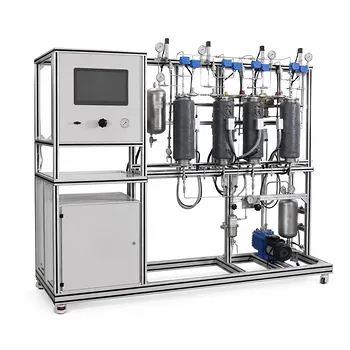
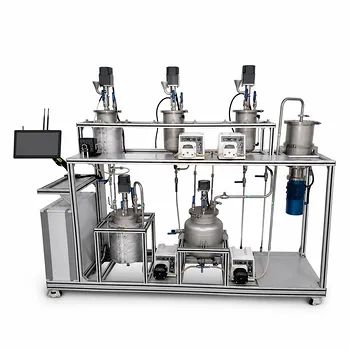
Pilot plants are the critical proving ground where the principles of green chemistry meet the harsh realities of industrial production. Environmental and bioprocess unit operations pilot plants are utilized to test and optimize biological wastewater treatment, enzymatic degradation of persistent polymers, and eco-friendly chemical synthesis under continuous operation. They enable researchers to study mass balances, biocatalyst stability, and filtration efficiency at a scale that bridges the gap between lab discovery and practical environmental solutions.
The true value of environmental and bioprocess pilot plants lies in their ability to de-risk the scale-up of sustainable technologies. By providing the data needed for lifecycle analysis and industrial design, they turn theoretical green chemistry into tangible, economically viable processes that genuinely reduce waste and degrade pollutants.
The Scale-Up Bridge: From Lab Beaker to Industrial Reality
The most immediate way these pilot plants address green chemistry challenges is by enabling continuous, scalable testing of biological and chemical processes. A shake flask can prove a concept, but only a pilot plant can prove its viability for a factory.
Testing Biological and Enzymatic Degradation Pathways
Enzymatic and microbial degradation of plastics and waste streams often stall at larger volumes due to mass transfer limitations or biocatalyst deactivation. Environmental pilot plants overcome this by mimicking real-world shear, mixing, and residence times.
Running these processes on a pilot scale allows direct measurement of degradation kinetics under continuous loading, providing the hard data needed to design full-scale bioreactors. This is essential for confirming that a novel enzyme actually breaks down polymers at an industrially relevant rate.
Optimizing Fermentation for Bio-based Chemicals
Producing green chemicals from renewable feedstocks—such as converting organic waste into biofuels or bio-based acids—requires moving beyond flask-level screening. Bioprocess pilot plants provide precision control over dissolved oxygen, pH, temperature, and nutrient feeding, parameters that dictate yield and productivity.
This controlled environment lets researchers optimize fermentation for maximum carbon efficiency, directly minimizing the carbon footprint of chemical manufacturing. Without this intermediate scale, countless promising green syntheses would never leave the academic lab.
Advancing Green Remediation Technologies
For waste degradation in water, pilot plants test reactive materials like nano-iron particles that degrade chlorinated solvents. Simulating continuous flow and realistic hydraulic conditions reveals true contaminant removal rates and identifies issues like particle agglomeration or loss of reactivity that are invisible in batch tests.
Such testing is non-negotiable for determining the technical and economic feasibility of in-situ green remediation before expensive field implementation begins.
Embedding Waste Minimization at the Process Level
True green chemistry seeks to prevent waste at its source, not just treat it afterward. Pilot plants allow engineers to experiment with integrated design strategies that drastically reduce pollution generation.
Feed Purification and Catalyst Protection
Many side reactions and waste products stem from impurities in the raw feed. By integrating feed purification units upstream of the reactor, pilot studies can quantify how lowered impurity concentrations extend catalyst lifespan and reduce hazardous byproduct formation.
Protective adsorbent beds placed before sensitive catalyst stages further minimize solid waste from deactivated materials, a design tweak that can pay for itself many times over at commercial scale.
Solvent Recovery and Recycle Loops
Waste minimization becomes tangible when pilot plants incorporate reactant and solvent recycle loops. Students and researchers can physically demonstrate how unreacted materials are separated and reinjected into the process, seeing firsthand the dramatic drop in overall process mass intensity.
Operating these closed-loop systems at pilot scale teaches the inseparable link between separation efficiency and waste output—a principle easily ignored in a single-use flask experiment.
Downstream Processing for Atomic Economy
Producing a bio-based molecule like glucaric acid means nothing if it cannot be purified without generating a river of waste. Downstream unit operations—membrane filtration, evaporation, crystallization, solvent extraction—are themselves assessed in pilot plants for their energy consumption and waste generation.
Optimizing these steps at scale is how researchers maximize the process's atomic economy, proving that a green chemistry alternative is both environmentally superior and commercially sustainable.
Bridging the Skills Gap Through Hands-On Education
A less obvious but vital role of pilot plants is training the workforce that will deploy these technologies. Textbook theory cannot simulate the complex reality of an integrated chemical process.
Managing Real-World Engineering Constraints
When a process scales, engineers face challenges like heat removal, exotherm management, and raw material feeding consistency that are trivially controlled on a bench top. Pilot plant operation forces this education.
Learning to manage these constraints builds an instinct for inherently safer design and lifecycle thinking. The engineer who has troubleshooted a membrane fouling event or a runaway stirred tank in a pilot hall is far better equipped to design a resilient industrial plant.
Mastering Mass Transfer Operations for Pollution Control
For environmental waste degradation, pilot plants housing ion exchange columns, adsorption columns, and membrane units turn theory into practical skill. Running breakthrough curves and evaluating resin regeneration cycles under varying pressures builds a deep, intuitive understanding of scalability.
This hands-on training reveals the true cost and operational limits of meeting strict discharge regulations, creating engineers who can design treatment trains that are actually functional, not just theoretically clean.
Understanding the Trade-offs and Limitations
No tool is without its constraints, and the pilot plant is no exception. Pilot-scale data is essential, but it is not an exact replica of full-scale dynamics. Fluid flow patterns, heat transfer coefficients, and even microbial community stability can shift when dimensions increase tenfold. A process that performs flawlessly in a 50-liter bioreactor may still face unexpected mass transfer bottlenecks in a 50,000-liter vessel.
Additionally, the very operation of a pilot plant carries an environmental footprint. Energy for heating, cooling, and pumping can be significant per kilogram of product. The goal must be to learn quickly and efficiently, not to use the pilot plant as a mini-production facility indefinitely. The financial cost of pilot-scale runs can also be high, requiring a clear hypothesis and a sharply focused experimental plan to avoid wasteful data collection.
Making the Right Choice for Your Green Chemistry Goal
How you configure and utilize your pilot plant resources should flow directly from the specific challenge you aim to solve.
- If your primary focus is degrading persistent waste like plastics: Prioritize pilot setups that allow continuous enzymatic or microbial degradation testing, with real-time analytics to track breakdown products and prevent the accumulation of inhibitory intermediates.
- If your primary focus is developing bio-based green chemicals: Use an integrated bioprocess pilot plant that links fermentation with downstream purification. This single stream lets you optimize yield, atomic economy, and energy efficiency simultaneously.
- If your primary focus is water remediation with reactive nanotechnologies: Employ environmental pilot units capable of continuous flow with inline monitoring of contaminant degradation. Validate the technology’s robustness under variable hydrological conditions before field deployment.
- If your primary focus is embedding waste minimization at the source: Design your pilot work around closed-loop systems, testing feed purification and solvent recycle strategies to measure the direct reduction in overall process mass intensity.
- If your primary focus is workforce development: Leverage the pilot plant as a holistic teaching tool. Stress the experiential learning of scale-up complexities, safety hazards, and the real-time management of heat and mass transfer that no simulation can replicate.
By matching the right pilot plant configuration to your core challenge, you move beyond incremental improvement and build the foundational knowledge needed for a truly circular, waste-free chemical economy.
Summary Table:
| Focus Area | Key Pilot Plant Application | Primary Benefit |
|---|---|---|
| Waste Degradation | Continuous enzymatic & microbial testing | Overcomes mass transfer limits; measures kinetics |
| Bio-based Chemicals | Precision-controlled fermentation & purification | Maximizes carbon efficiency & yield |
| Water Remediation | Continuous flow testing of reactive materials | Simulates real-world hydraulic conditions |
| Waste Minimization | Integrated feed purification & recycle loops | Minimizes process mass intensity & byproducts |
| Workforce Education | Hands-on operation of integrated systems | Bridges the skill gap in scale-up engineering |
Bring Sustainable Engineering to Life with LABPARK
Are you looking to bridge the gap between lab-scale green chemistry and industrial application? LABPARK provides state-of-the-art Educational and Vocational Unit Operations Pilot Plants in chemical engineering, bioprocess & biotech, and environmental & water treatment. Designed specifically for universities, research institutes, and enterprises, our pilot plants empower students and researchers to master scale-up challenges, optimize waste degradation, and design highly efficient, closed-loop processes.
Ready to elevate your research and training capabilities? Contact LABPARK today to find the perfect pilot plant solution for your institution!
Related Products
- Multimodal Absorption and Desorption Pilot Plant for Unit Operations Training
- Bio-fermentation Ethanol Production Practical Training Unit Operations Pilot Plant
- Multi-Functional Membrane Separation Educational Pilot Plant for Unit Operations Lab
- Dual-Mode Rectification Pilot Plant for Practical Training Unit Operations
- Dual Mode Heat Transfer Pilot Plant for Unit Operations Training
People Also Ask
- How do predictive thermodynamic models integrate into pilot plants? Bridging Theory and Practice
- Which cross-validation strategy should be selected for pilot plant time-series & batch data? Avoid Data Leakage
- How can process control schemes be configured to teach basic and advanced control?
- Why Use Center Points in Process Analyzer Calibration? Key Benefits Explained
- How does polyphosphate hydrolysis affect scale and corrosion in pilot plants? Essential Monitoring Guide