Knowledge Vocational Pharmaceutical Engineering Education How does a fluid bed coating pilot plant teach QbD? Bridge theory and practice in vocational training.
Author avatar

Tech Team · LABPARK

Updated 1 month ago

How does a fluid bed coating pilot plant teach QbD? Bridge theory and practice in vocational training.


A fluid bed coating pilot plant is not just a piece of equipment; it's a physical simulator for risk. In vocational training, it transforms the abstract regulatory concepts of Quality by Design (QbD) into a tangible, cause-and-effect learning experience. For novel drug formulations, like coated multiparticulates, it provides the critical hands-on platform to define, control, and validate a robust manufacturing process from the very first experiment, rather than merely testing the final product.

While QbD is a science- and risk-based framework, its principles can feel theoretical until you see a failing process. A fluid bed pilot plant directly answers the deep need to understand why a process fails. It proves that quality is engineered by controlling thermodynamics and mass transfer, not by hoping for a passing final test.

The Deep Need: Making QbD Tangible

The surface need is understanding how a pilot plant aids QbD training. The deep need is far more critical: grasping that quality must be engineered into a product through process understanding, not inspected into it at the end. A fluid bed coater makes this invisible principle visible.

Why QbD is Counter-Intuitive Without Hands-On Experience

In a purely theoretical setting, it's easy to assume that following a fixed recipe guarantees quality. A pilot plant shatters this myth immediately.

You can set the identical inlet temperature, spray rate, and airflow, but change the starting material’s particle size. A student will observe that the coating quality and drug release profile change drastically. This is the foundational lesson of QbD: a fixed process cannot handle variable inputs.

The pilot plant forces the student to become a problem-solver. They must stop blaming the "bad" raw material and start asking, "How should I change my process to consistently produce a quality product from this material?" This shift in mindset is the core of vocational training.

Using the Pilot Plant as a Process Detective

For a novel formulation like osmotic rupturing multiparticulates, the coating is the functional heart of the drug. A fluid bed pilot plant allows trainees to investigate the physics that build that heart.

Linking Critical Parameters to Critical Quality Attributes

The primary reference highlights the direct link between process parameters and product performance. A pilot plant lets a trainee manipulate these levers and instantly see the result:

  • Drying Airflow and Inlet Temperature: These are the primary drivers of energy transfer. A student will learn that a high airflow with a low temperature can have the same drying effect as a low airflow with a high temperature, but with vastly different impacts on film formation. This teaches the core QbD concept of a multidimensional design space.
  • Spray Rate: This controls the mass transfer of the coating solution. A trainee can push this rate too high, visually observing over-wetting, agglomeration, and the immediate loss of product functionality. They learn that the spray rate's upper boundary is defined by the system's capacity to evaporate the solvent, linking mass and energy balance in a single, memorable failure.

Defining a Robust and Scalable Design Space

Once the critical parameters are known, the training shifts to systematically mapping out the "safe zone" of operation—the design space. This is where the pilot plant’s true value emerges.

By executing a structured Design of Experiments (DoE) on the pilot plant, a student can vary temperature and spray rate simultaneously. They will discover that the failure boundary isn't a single number but a curve. This hands-on data plotting defines a multidimensional region where quality is assured, making the ICH Q8 guideline a lived reality, not a regulatory abstraction.

Furthermore, as a supplementary reference notes, pilot plants are essential for understanding scale. Trainees learn to distinguish between scale-independent properties (like chemical kinetics) and scale-dependent ones (like mixing and heat transfer). Running a coating trial that fails at a higher airflow rate due to unanticipated fluidization dynamics teaches a lesson about defining a truly scale-independent design space that no textbook can convey.

Understanding the Trade-offs in a QbD Approach

A critical part of becoming a trusted technical advisor is acknowledging the complexities. Implementing QbD on a pilot plant is not a frictionless process.

  • The Pitfall of Over-Modeling: There's a danger in treating the pilot plant as a pure data generator. Trainees can become so focused on a statistical model that they ignore visual process cues, like a subtle change in fluidization pattern. The model defines a "proven acceptable range," but a skilled operator knows that a process operating perfectly within that range can still look wrong and require human intervention.
  • Resource Intensity vs. Fundamental Insight: A full DoE campaign is time-consuming and material-intensive. The deep learning trade-off is between running 30 automated experiments to build a response surface model, or running 5 carefully observed, physics-based trials. A balanced vocational program uses the pilot plant to teach both the power of statistics and the irreplaceable value of mechanistic, thermodynamic understanding.
  • The Trap of the Equipment-Specific Design Space: A design space developed on one pilot plant model may not transfer perfectly to another. The lesson is that the design space is not a magic number set but a system-level concept. Trainees must learn to verify, not just assume, transferability, a key risk in novel drug development.

Making the Right Choice for Your Training Goal

The fluid bed pilot plant is a versatile tool. How you wield it in a vocational program should depend on the primary learning objective.

  • If your primary focus is fundamental process engineering principles: Use the pilot plant to reveal the physics first. Have students deliberately cause a process failure by breaking the mass and energy balance before ever introducing a DoE matrix.
  • If your primary focus is regulatory application and ICH Q8 compliance: Use the pilot plant as a DoE platform. The goal is for students to generate data, define a design space using statistical software, and articulate a control strategy that ensures the process remains within that space.
  • If your primary focus is troubleshooting and risk mitigation for novel formulations: Introduce unanticipated raw material variability. Give one group a standard granule and another a granule with a slightly different particle size distribution, and task both groups with producing an identical dissolution profile, forcing them to develop a flexible feedforward control strategy.

A fluid bed coating pilot plant does more than teach; it builds an engineer’s intuition for how a complex product is truly built, one microscopic layer at a time.

Summary Table:

Key Parameter / Concept Role in QbD Training Practical Learning Outcome
Drying Airflow & Temp Energy transfer control Understands multidimensional design space
Spray Rate Mass transfer control Learns boundaries of wetness and agglomeration
Design of Experiments (DoE) Statistical mapping Defines the multidimensional safe operating zone
Scale-up Dynamics Scalability evaluation Identifies scale-dependent vs. independent factors

Elevate Your Vocational Training with LABPARK

Are you looking to bridge the gap between academic theory and industrial practice? LABPARK provides state-of-the-art Educational and Vocational Unit Operations Pilot Plants in chemical engineering, bioprocess & biotech, and environmental & water treatment. Designed specifically for universities, research institutes, and enterprises, our pilot plants empower students and researchers to master Quality by Design (QbD) and process scaling hands-on.

Ready to upgrade your lab's training capabilities? Contact LABPARK today to request a quote or consultation.

Related Products

People Also Ask

Related Products

Fluidized Bed Gas Solid Catalytic Reaction Educational Pilot Plant

Fluidized Bed Gas Solid Catalytic Reaction Educational Pilot Plant

Our educational fluidized bed gas-solid catalytic reaction pilot plant is ideal for chemical engineering labs. Students study fluidization dynamics, catalyst evaluation, and process control hands-on. Features include a customizable reactor, touchscreen HMI, and safety interlocks for safe, curriculum-aligned experiments.

Multi-Reactor Educational Pilot Plant for Reaction Engineering Unit Operations

Multi-Reactor Educational Pilot Plant for Reaction Engineering Unit Operations

Integrated bench-scale educational pilot plant for chemical engineering teaching featuring fixed bed fluidized bed and stirred tank reactors with web-based digital twin controls and safety interlocks for hands-on unit operations and reaction engineering comparative studies in one compact system.

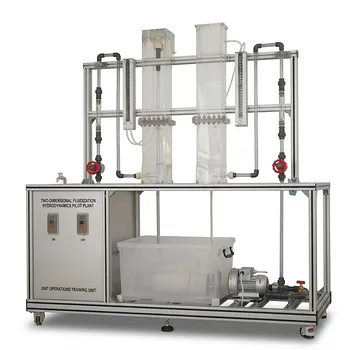
Two-Dimensional Fluidization Hydrodynamics Educational Pilot Plant for Unit Operations Training

Two-Dimensional Fluidization Hydrodynamics Educational Pilot Plant for Unit Operations Training

Explore gas-solid and liquid-solid fluidization hydrodynamics with our transparent 2D educational pilot plant. Ideal for chemical engineering unit operations labs, it demonstrates fixed to fluidized bed regimes, measures pressure drop, and integrates QR-code digital learning for enhanced student training.

Multi-Functional Drying Educational Unit Operations Pilot Plant

Multi-Functional Drying Educational Unit Operations Pilot Plant

Versatile multi-functional drying educational unit operations pilot plant integrating tunnel, fluidized bed, and spray drying. Enables hands-on study of drying curves, psychrometry, and gas-solid separation for chemical engineering curriculum in higher education labs.

Packed Bed Absorption Educational Unit Operations Pilot Plant

Packed Bed Absorption Educational Unit Operations Pilot Plant

Study gas-liquid absorption, pressure drop, flooding, and mass transfer coefficients with this pilot plant. Transparent packed column, industrial touchscreen, real-time sensor data, automated analysis. Investigate two-phase flow, loading points, column efficiency. Comprehensive data logging and assessment software included.

Multi Functional Catalytic Reaction and Reactor Evaluation Educational Unit Operations Pilot Plant

Multi Functional Catalytic Reaction and Reactor Evaluation Educational Unit Operations Pilot Plant

Bench-scale educational pilot plant for catalytic reaction and reactor evaluation, integrating fixed bed, fluidized bed, and stirred tank reactors. Students compare reactor designs, evaluate catalysts, and study reaction kinetics and hydrodynamics. Perfect for unit operations labs in chemical engineering curricula.

Comprehensive Fluid Mechanics Educational Unit Operations Pilot Plant

Comprehensive Fluid Mechanics Educational Unit Operations Pilot Plant

Hands-on fluid mechanics pilot plant for engineering education covering over 13 principles including pipe flow, minor losses, flowmeter calibration, and pump performance with industrial-grade components, smooth and rough piping, venturi and orifice flowmeters, and centrifugal pump testing and analysis.

Fixed Bed Gas Solid Catalytic Reaction Educational Pilot Plant

Fixed Bed Gas Solid Catalytic Reaction Educational Pilot Plant

Fixed-bed gas-solid catalytic reaction unit operations pilot plant for chemical engineering education. Features split-furnace, mass flow controllers, PID control, safety interlocks. Ideal for heterogeneous catalysis, reactor dynamics, catalyst evaluation studies. Fully customizable configurations for university laboratories and academic research.

Fixed-Bed Chemical Reaction and Gas Dust Tar Removal Unit Operations Pilot Plant

Fixed-Bed Chemical Reaction and Gas Dust Tar Removal Unit Operations Pilot Plant

Integrated educational pilot plant for studying catalytic gas-solid reactions and downstream gas purification. Features dual fixed-bed reactor, three-stage heating, and touchscreen control for hands-on engineering training. Ideal for chemical and environmental engineering curricula.

Micro-Scale Gas-Solid Catalytic Reaction Educational Pilot Plant

Micro-Scale Gas-Solid Catalytic Reaction Educational Pilot Plant

Explore heterogeneous catalysis with this micro-scale gas-solid catalytic reaction educational pilot plant. Designed for university labs, it enables hands-on study of reaction kinetics and transport phenomena in a benchtop packed bed reactor with high-precision flow control and touchscreen automation.

High-Gravity Emulsification and Mass Transfer Educational Pilot Plant

High-Gravity Emulsification and Mass Transfer Educational Pilot Plant

This integrated educational pilot plant utilizes rotating packed bed technology to demonstrate high-gravity emulsification and mass transfer, providing engineering students with hands-on experience in process intensification and unit operations through a modular, customizable design with digital monitoring.

Liquid-Liquid Mass Transfer Coefficient Determination Educational Pilot Plant

Liquid-Liquid Mass Transfer Coefficient Determination Educational Pilot Plant

This bench-scale educational pilot plant for liquid-liquid mass transfer coefficient determination offers precise control of phase boundary, temperature, and agitation, enabling hands-on study of transport phenomena and unit operations in chemical engineering labs for teaching.

Orifice and Venturi Flowmeter Calibration Educational Pilot Plant for Fluid Mechanics Laboratory

Orifice and Venturi Flowmeter Calibration Educational Pilot Plant for Fluid Mechanics Laboratory

Enhance fluid dynamics education with the Orifice and Venturi Flowmeter Calibration Educational Unit Operations Pilot Plant, featuring transparent orifice and Venturi meters, industrial sensors, touchscreen interface for real-time data analysis and automatic coefficient calculations in engineering student laboratories.

Educational Unit Operations Pilot Plant for Intraparticle Diffusion Effective Factor Measurement

Educational Unit Operations Pilot Plant for Intraparticle Diffusion Effective Factor Measurement

Designed for chemical engineering university labs, this pilot plant allows hands-on determination of catalyst particle intraparticle diffusion effective factors and gas-solid reaction kinetics using a fixed-bed tubular reactor with industrial touchscreen control, bridging theory and practical reactor design.

Two Phase Flow Pattern Velocity Resistance Measurement Educational Pilot Plant

Two Phase Flow Pattern Velocity Resistance Measurement Educational Pilot Plant

Benchtop educational pilot plant for university labs studying gas-liquid two-phase flow patterns, velocity, and resistance across circular, square, and rectangular conduits. Features 15.6-inch touchscreen, 5G connectivity, differential pressure sensors, safe water-air operation. Supports chemical engineering curricula.

Centrifugal Pump Performance and Orifice Flowmeter Calibration Educational Pilot Plant

Centrifugal Pump Performance and Orifice Flowmeter Calibration Educational Pilot Plant

This versatile educational pilot plant enables engineering students to conduct centrifugal pump performance tests, orifice flowmeter calibration, and fluid mechanics experiments using a transparent flow loop, industrial HMI, and 3D virtual simulation for a comprehensive hands-on learning experience.

Multi Functional Membrane Crystallization Educational Unit Operations Pilot Plant

Multi Functional Membrane Crystallization Educational Unit Operations Pilot Plant

Integrated bench-scale membrane crystallization pilot plant for engineering education. Provides hands-on training in advanced separation technologies, combining membrane distillation crystallization and process intensification. Features variable scaling vessels, industrial-grade flow control, and interactive digital data acquisition. Customizable for university labs.

Multifunctional Membrane Separation Educational Pilot Plant with Ultrafiltration, Nanofiltration, Reverse Osmosis

Multifunctional Membrane Separation Educational Pilot Plant with Ultrafiltration, Nanofiltration, Reverse Osmosis

An integrated laboratory bench-scale membrane separation system for higher education engineering labs combining Ultrafiltration, Nanofiltration, and Reverse Osmosis processes. Features industrial PLC control with touch-screen HMI, transparent piping, and academic assessment software. Ideal for chemical and environmental engineering curricula.

Multi-Functional Membrane Separation Educational Pilot Plant for Unit Operations Lab

Multi-Functional Membrane Separation Educational Pilot Plant for Unit Operations Lab

The Multi-functional Membrane Separation Educational Unit Operations Pilot Plant is an integrated bench-scale laboratory system designed for teaching undergraduate engineering education. It features Ultrafiltration, Nanofiltration, and Reverse Osmosis modules in a compact, mobile unit for practical hands-on learning.

Polymerization Granulation and Pellet Processing Educational Unit Operations Pilot Plant

Polymerization Granulation and Pellet Processing Educational Unit Operations Pilot Plant

Integrated pilot plant for teaching polymer processing from polymerization to pelletizing. Includes 30L reactor, hydrolyzer, extruder-granulator, vibration dryer, crusher, and sieve. Atmospheric pressure operation for safety, corrosion-resistant SS, customizable for chemical and polymer engineering education. Ideal for university labs.


Leave Your Message