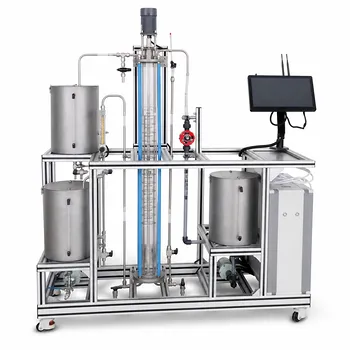
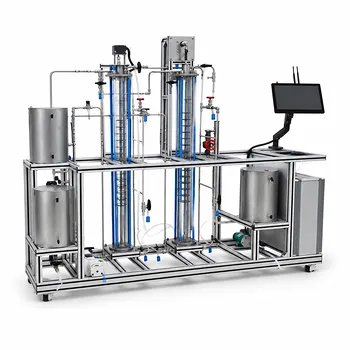
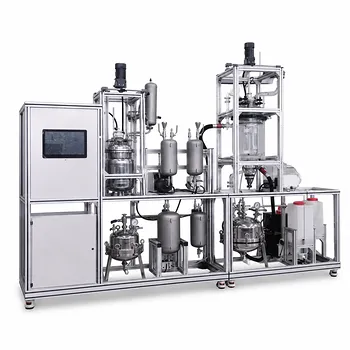
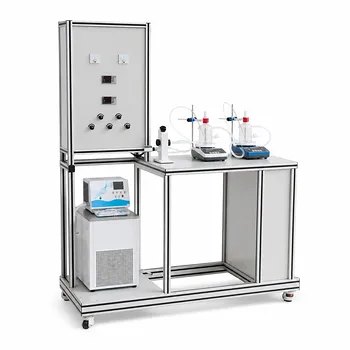
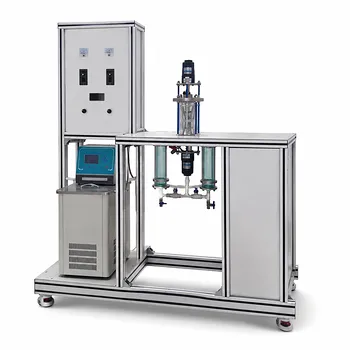
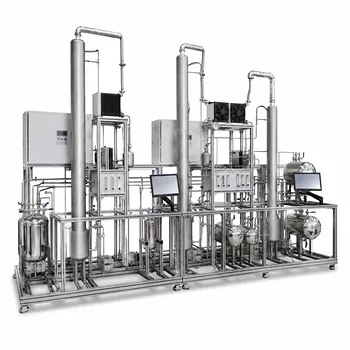
Predicting multicomponent liquid-liquid equilibria (LLE) is inherently more difficult than predicting vapor-liquid equilibria (VLE) because the liquid phase is where the most delicate and composition-sensitive molecular interactions live. While the vapor phase is relatively forgiving—ideal or easily corrected with robust equations of state—the liquid phase in extraction systems often involves strong hydrogen bonding, extreme polarity differences, and highly non-ideal mixing that standard models struggle to capture. For anyone operating a liquid-liquid extraction pilot plant, this means that textbook shortcuts that work beautifully for distillation simply fail for LLE, and success depends on direct, high-quality experimental data.
Despite decades of model development, the central challenge remains: liquid-phase intermolecular forces in multicomponent mixtures are far more complex than those in the vapor phase, so LLE predictions are significantly less reliable than VLE predictions. The practical consequence is that pilot-scale extraction work must be grounded in measured equilibria, not just theoretical estimates, to set correct solvent-to-feed ratios and stage counts.
Why the Liquid Phase is a Thermodynamic Minefield
The Sensitivity of Molecular Interactions
In vapor-liquid equilibria, the vapor phase often behaves near-ideally, and the main non-ideality is captured in the liquid-phase activity coefficients or a single equation of state. For multicomponent VLE, binary interaction parameters can be carried over with remarkable success—engineers routinely build reliable distillation simulations from binary VLE data alone.
Liquid-liquid extraction flips this logic on its head. Multicomponent LLE occurs entirely within two condensed phases where molecules are in intimate, constant contact. Hydrogen bonding, dipole-dipole forces, and polarization effects become highly dependent on the concentration of every species present. A tiny change in composition can shift a system from a single liquid phase to two immiscible phases, and prediction models must capture that sensitive tipping point.
Asymmetric Mixtures Amplify the Problem
Many extraction pilot plants deal with asymmetric mixtures—combining polar and nonpolar components, such as water-organic solvent pairs. These systems push activity coefficients to extreme values. Standard equations of state (like cubic EOS) that work well for nonpolar VLE often fail to represent such strong liquid-phase non-idealities within an order of magnitude.
Specialized local-composition models (e.g., NRTL, UNIQUAC) are required, but even these need carefully regressed parameters from experimental LLE data. The primary reference underscores this: “LLE predictions have a much less favorable accuracy rate,” which directly impacts the ability to calculate stage efficiency or solvent usage in a pilot column.
The Failure of Binary Data for Multicomponent LLE
A Tale of Two Equilibria
The supplementary references drive home a critical difference: binary data is highly successful at predicting multicomponent VLE, but it often breaks down for multicomponent LLE. In distillation pilot plants, an engineer might validate VLE models by checking binary y-x or T-x-y plots and then confidently extend the model to ternary or higher mixtures.
For LLE, multi-body interactions cannot be extrapolated from binary pairs alone. A water-ethanol-toluene system, for example, involves molecular clusters and solvation effects that emerge only when all three components coexist. Relying solely on binary water-ethanol and ethanol-toluene data ignores these emergent phenomena, leading to grossly inaccurate phase splits and distribution coefficients.
The Practical Consequence for Pilot Plant Operators
The supplementary references explicitly advise that when teaching or researching with extraction pilot plants, students must perform direct experimental verification of multicomponent LLE. There is no safe shortcut. Attempting to model a liquid-liquid extraction column using only binary parameters can yield a predicted number of stages that is dangerously low or a solvent rate that is insufficient, causing product loss or off-specification output.
The Stark Reality of LLE Model Accuracy
Why Most Predictions Are Wrong
While nonelectrolyte VLE can be estimated reliably with standard equations of state and binary regression, LLE predictions remain stubbornly error-prone. Group contribution methods like UNIFAC or ASOG can provide first guesses, but they frequently misplace the plait point or misrepresent the size of the two-phase region for real industrial solvents. The primary reference stresses a “much less favorable accuracy rate” for LLE, and that is the reason pilot-plant research must include a dedicated LLE measurement step.
The Cost of Unverified Models
Imagine running a pilot extraction unit where the thermodynamic model says 5 theoretical stages will suffice. If the model understates the required stages because it poorly predicts the liquid-liquid distribution, the pilot column will leak solute into the raffinate. That mistake can propagate to full-scale design, leading to a multimillion-dollar separation train that never meets purity targets. Thus, understanding the difficulty of LLE prediction is not an academic exercise—it is a core risk management practice.
Understanding the Trade-offs: Speed vs. Certainty
The Allure of Predictive Models
There is a strong temptation to use predictive thermodynamic packages to save time and cost. For VLE, this approach is often justifiable because the models are mature and the required binary parameters are abundant. For LLE, that same approach becomes a high-risk gamble.
The Burden of Experimental Data
Obtaining experimental LLE data for a multicomponent system is labor-intensive. It requires accurate cloud-point measurements, tie-line determinations, and careful analytical verification. Yet, the only reliable path to setting a solvent-to-feed ratio and determining true stage efficiency is measured data, not estimates. This is a deliberate trade-off: accept more upfront experimental work to secure a pilot plant that generates dependable scale-up parameters.
A Balanced Approach
Savvy operators often use a hybrid strategy. They apply a model like NRTL or UNIQUAC first, then use a limited set of multicomponent LLE measurements to regress the model parameters, anchoring the prediction to reality. This leverages the power of thermodynamics without falling into the trap of blind prediction. It also teaches future engineers how to handle the gap between software and experiment—a skill the supplementary references highlight as essential for safe, efficient plant design.
Making the Right Choice for Your Pilot Plant Program
Your path depends on whether you prioritize speed, deep design data, or educational value. Adapt your strategy accordingly.
- If your primary focus is rapid process scouting: Use a group contribution method to screen potential solvents, but never scale up without at least one critical multicomponent LLE measurement for your final solvent candidate.
- If your primary focus is high-fidelity design data for scale-up: Invest in direct experimental measurement of multicomponent tie lines and use them to regress model parameters. This yields the only safe basis for calculating solvent ratios and stage requirements.
- If your primary focus is training future engineers: Make the LLE measurement a pedagogical centerpiece. Require students to compare predictive models with experimental data, quantify the discrepancy, and explain why liquid-phase non-ideality defeats simple extrapolation from binary VLE behavior.
The core lesson of every extraction pilot plant is the same: in the liquid phase, molecular interactions are king. Treating LLE as a mere extension of VLE is the quickest route to failure, but respecting its unique complexity turns a difficult prediction problem into a manageable, data-driven engineering process.
Summary Table:
| Feature | Vapor-Liquid Equilibria (VLE) | Liquid-Liquid Equilibria (LLE) |
|---|---|---|
| Phase State | One vapor phase, one liquid phase | Two condensed liquid phases in constant contact |
| Molecular Interactions | Simpler; vapor phase is often near-ideal | Highly complex (hydrogen bonding, polar/nonpolar interactions) |
| Binary Data Reliability | Highly successful at predicting multicomponent VLE | Frequently fails; binary data ignores ternary phase behaviors |
| Model Accuracy | High predictability using standard EOS models | Poor accuracy; requires direct experimental regression |
| Pilot Plant Risk | Low; distillation columns scale up reliably | High; incorrect LLE leads to stage count and solvent errors |
Bridge the Gap Between Theory and Experiment with LABPARK
Are you looking to scale up your separation processes or train the next generation of process engineers? Relying solely on software predictions for complex chemical systems like LLE can lead to costly design errors.
LABPARK provides advanced Educational and Vocational Unit Operations Pilot Plants in chemical engineering, bioprocess & biotech, and environmental & water treatment tailored for universities, research institutes, and enterprises. Empower your team with the physical pilot scale tools needed to gather accurate, real-world experimental data.
Contact LABPARK today to find the perfect pilot plant solution for your lab!
Related Products
- Educational Rotary Disc Liquid-Liquid Extraction Pilot Plant
- Comprehensive Liquid-Liquid Extraction Pilot Plant for Engineering Education
- Gallium and Indium Selective Extraction Educational Pilot Plant
- Ternary Liquid-Liquid Equilibrium Educational Pilot Plant
- Liquid-Liquid Mass Transfer Coefficient Determination Educational Pilot Plant
People Also Ask
- How do density and IFT affect liquid-liquid extraction pilot plants? Optimize Column Performance
- How are ternary phase diagrams and LLE data applied in extraction experiments? Optimize Pilot Plant Scale-up
- In a liquid-liquid extraction pilot plant, how is a ternary-phase diagram utilized to determine solvent feed requirements?
- How Do Selectivity & Distribution Coefficients Influence LLE Pilot Plant Solvent Choice?
- How to Validate BIPs for LLE Pilot Plants? Steps to Align Simulations with Reality