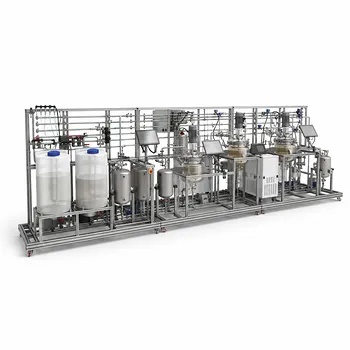
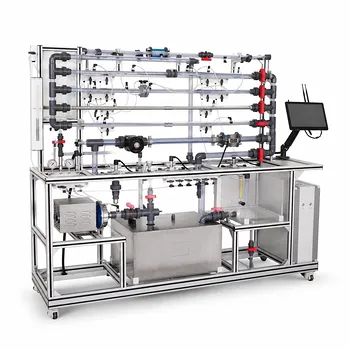
You can’t learn to navigate a city by only staring at a map. Similarly, students cannot truly understand a Process and Instrumentation Diagram (P&ID) or a control loop by merely studying the drawing. Educational unit operations pilot plants act as the physical, living version of that drawing. By walking a piping line on a pilot plant and comparing it directly to the P&ID, operating a real control valve, and then watching the impact on a live pressure or flow trend, the abstract symbols on paper transform into concrete, sensory experiences that embed loop control logic deep in the student’s intuition.
P&IDs are a language; pilot plants are the conversation. They let vocational trainees trace physical hardware back to schematic symbols, then configure actual PID loops to maintain level, flow, or temperature. This physical immersion closes the critical gap between recognizing a control loop on a diagram and making it work safely in the real world.
From Paper to Pipes: How Pilot Plants Bring P&IDs to Life
A P&ID is a dense symbolic road map. Understanding it requires more than memorizing circles and dashed lines; it demands spatial and functional comprehension.
Tracing the Physical Reality of Schematic Lines
The primary leap happens when a student can walk from a line on paper to a pipe in front of them. A pilot plant allows exactly this. A trainee can place their hand on a pipe segment that corresponds to a bold line on the P&ID, then follow it to the next vessel or instrument.
This physical trace makes the distinction between process lines, utility lines, and signal lines immediately obvious. It turns the abstract difference between a pneumatic signal (a dashed line) and an electrical signal (a dashed line with a different convention) into a visible cable or tube run.
Decoding Vessel and Instrument Symbols
On a drawing, a tank is a circle and a control valve is a bow-tie with an actuator. On a pilot plant, you see the actual jacketed reactor or the diaphragm actuator. This side-by-side comparison makes the symbology second nature.
When a student can point to a pressure transmitter on the skid and immediately locate its tag on the DCS screen, the tag numbering logic (e.g., PT-101) becomes a meaningful system rather than a random code. They learn that a loop number groups related elements, a concept that is purely theoretical without a physical counterpart.
Mastering Loop Control: From Concept to Real-World Stability
Understanding loop control is not about tuning a PID equation. It’s about developing a feel for how a process responds to an upset and how to bring it back to setpoint gracefully.
Configuring and Tuning Actual PID Loops
By using a pilot plant integrated with a PLC-SCADA or DCS, students go far beyond simulation. They open real valve positioners, alter PID gains, and witness the physical response. A Kc set too high will cause a real level to oscillate and overflow a tank; an integral time set too short will make a real flow loop hunt erratically.
This direct feedback is visceral and unforgettable. It teaches the critical lesson that a control loop is not just mathematics—it’s a physical system with inertia, dead time, and real-world consequences.
Witnessing Cause-and-Effect in a Controlled Environment
A P&ID shows a loop’s components. A pilot plant reveals its behavior. Students can intentionally disturb a system—close a manual bypass valve, simulate a feed pump trip—and then watch how the automatic control system reacts.
They see the chain reaction: a flow drop lowers the level, the level controller opens the outlet valve, and the valve’s position feedback confirms the loop’s integrity. This hands-on interaction directly explains why a P&ID must show both the control loop and its associated alarm and interlock logic for process safety.
Integrating Advanced PAT and Data Acquisition
Modern pilot plants often include Process Analytical Technology (PAT) tools. Vocational trainees can program real-time monitoring dashboards and connect inline temperature or pH sensors to loop controllers. This mirrors modern pharmaceutical and chemical manufacturing, where control strategies are built around continuous process verification rather than end-product testing. Learning to interpret these live data streams in the context of a P&ID prepares them for an industry that is increasingly paperless.
Building the Intuition That Simulations Alone Cannot Deliver
While dynamic simulation software is a powerful tool, it remains a mathematical model. Pilot plants introduce the non-ideal realities that make process control genuinely challenging.
Experiencing Real-World Constraints
A simulation will never have a sticky control valve, a fouled heat exchanger, or a wandering instrument calibration. On a pilot plant, students encounter these imperfections. They learn that the perfect logic on a P&ID must be robust enough to handle a valve that responds with more dead time than the datasheet promised. This physical verification of the gap between theory and reality is a foundational lesson in control strategy design.
Validating the “Design Intent” of the P&ID
Every P&ID is drawn with a specific control philosophy in mind. A pilot plant lets students test that philosophy. Does the selected control valve size actually provide good rangeability? Does the sensor location truly give a representative measurement without excessive noise? By physically validating these design choices, students move from being passive readers of P&IDs to critical, questioning engineers.
Understanding the Trade-offs of Pilot Plant Training
While pilot plants are essential, they are not a perfect mirror of full-scale operations. Acknowledging these limitations builds trust and provides a more complete picture.
- Scale-Dependent Dynamics: A 50-liter reactor’s thermal response is vastly different from a 50,000-liter one. The control loop tuning parameters may not scale directly, and certain safety-critical systems (like large relief devices) are often simulated or absent.
- Simplified Safety Interlocks: Actual plant P&IDs are dense with Safety Instrumented System (SIS) logic. Pilot plants usually prioritize operational learning over full safety system complexity.
- Cost and Availability: Access may be limited. However, even a single well-designed session offers a learning multiplier that months of classroom instruction cannot replicate.
- Focus on Single Unit Operations: Pilot skids are often organized modularly. This is excellent for deep learning of one loop, but it may underrepresent the complex interactions of multiple cascaded loops across a full flowsheet.
Making the Right Choice for Your Learning Goal
The way you use a pilot plant should align with what you need to master. Below are goal-oriented approaches for vocational trainees and their instructors.
If your primary focus is decoding P&IDs accurately: Spend the majority of your time doing “line walks”—physically tracing every line, valve, and instrument on the plant and marking it on a clean P&ID. Cross-reference the tag names with the DCS screen. This builds an unshakable mental map.
If your primary focus is mastering loop stability and tuning: Start with a stable process, then deliberately introduce a disturbance (like adding a simulated spare pump). Observe the controller’s response in real-time, adjust one tuning constant at a time, and log the physical result (overshoot, settling time, offset). This process-based feedback is irreplaceable.
If your primary focus is troubleshooting and process safety mindset: Work with an instructor to introduce a hidden fault (a partially closed isolation valve, a fogged sight glass). Use the P&ID and the live data to logically isolate the problem. This practice builds the diagnostic reasoning that separates a trained operator from a rote procedure-follower.
A pilot plant turns a flat diagram into a living, breathing process—and it is only in that living environment that the true, predictive understanding of P&IDs and loop control is forged.
Summary Table:
| Learning Goal | Hands-on Pilot Plant Activity | Key Educational Benefit |
|---|---|---|
| P&ID Decoding | Walking physical pipelines and matching tags to the DCS. | Translates abstract symbols into concrete spatial and functional reality. |
| Loop Control & Tuning | Configuring PID gains and observing level, flow, or temp changes. | Demonstrates real-world process inertia, dead time, and oscillation. |
| Troubleshooting | Simulating faults like sticky valves or line blockages. | Develops diagnostic thinking and safety-critical operational intuition. |
| Modern Automation | Programming real-time PAT tools and SCADA dashboards. | Prepares students for data-driven, paperless industrial environments. |
Bring Process Control and P&ID Concepts to Life with LABPARK
Are you looking to bridge the gap between classroom theory and real-world industrial operations?
LABPARK provides state-of-the-art Educational and Vocational Unit Operations Pilot Plants in chemical engineering, bioprocess & biotech, and environmental & water treatment. Designed specifically for universities, research institutes, and enterprises, our pilot skids empower students to configure control loops, perform line walks, and build the critical troubleshooting skills required by modern industry.
Ready to transform your laboratory training? Contact LABPARK today to explore our custom pilot plant solutions.
Related Products
- General Purpose Cosmetics Production Unit Operations Training Pilot Plant
- Multi Pump Fluid Transport Process Piping Unit Operations Training Pilot Plant
- Natural Product Extraction Unit Operations Training Pilot Plant
- Multi-Functional Drying Educational Unit Operations Pilot Plant
- 100L Continuous Loop Hydrogenation Educational Unit Operations Pilot Plant
People Also Ask
- Why is the chemical plant startup schedule crucial? De-risk scale-up with pilot plants.
- How do deviations in estimating latent heat impact pilot plant thermal systems? Avoid hardware mis-sizing.
- When to transition from PID to adaptive control in pilot plants? Key process indicators.
- Why Compare Predicted and Experimental Excess Enthalpy? Key to Accurate Pilot Plant Scale-up
- Why Use PTFE & Hastelloy in Chemical Pilot Plants? Prevent Corrosion & Ensure Safety