No, these ions do not interfere. The precipitation and complexation constants for silver with sulfide and cyanide are orders of magnitude more favorable than with thiosulfate, thiocyanate, or chloride. This means the silver nitrate reacts preferentially—and exclusively—with sulfide and cyanide until they are fully consumed, rendering the titration result accurate regardless of the presence of those other ions.
Core takeaway: Silver sulfide (Ksp ≈ 10⁻⁵¹) and the dicyanoargentate complex (Kstab ≈ 10⁻²¹) are so overwhelmingly stable that they outcompete any potential reaction with thiosulfate, thiocyanate, or chloride. The titration of sulfide and cyanide therefore remains selective and interference-free under normal pilot-plant conditions.
Understanding the Underlying Chemistry
In water treatment pilot plants, you need to trust that your analytical method reports only the analyte of interest. The silver nitrate titration is a classic choice for sulfide and cyanide because the chemistry is brutally selective when conditions are right.
The Extreme Stability Gap
The selectivity comes down to simple numbers. Silver sulfide precipitates with a solubility product around 1.0 × 10⁻⁵¹. The dicyanoargentate complex, [Ag(CN)₂]⁻, has a stability constant near 1.0 × 10⁻²¹. Compare these to the solubility products of silver thiocyanate (1.0 × 10⁻¹²) and silver chloride (1.7 × 10⁻¹⁰). The gap is enormous—more than 30 orders of magnitude.
When silver ions are added to the sample, they rapidly seek out the sulfide and cyanide because forming those products releases far more free energy. Silver simply won’t “notice” the chloride or thiocyanate until every last trace of sulfide and cyanide has reacted.
How the Titration Mechanism Reinforces Selectivity
During the titration, you add silver nitrate dropwise. The silver ions immediately react with free sulfide to form the black Ag₂S precipitate or with cyanide to form the soluble [Ag(CN)₂]⁻ complex. The indicator—often an amperometric electrode or another specific endpoint detector—only responds once a tiny excess of free silver appears.
Because the silver-sulfide and silver-cyanide products are so much more stable, free silver ions remain at spectacularly low concentrations until the equivalence point is passed. Thiosulfate, thiocyanate, and chloride simply do not get a chance to react. Their interactions with silver would only begin at silver concentrations that are far higher than what is available during the analytically meaningful part of the titration.
Where the Real Interferences Hide
While the three ions you asked about pose no threat, it would be a mistake to assume the titration is immune to all interferences. True analytical reliability in a pilot plant requires handling other chemical and physical factors.
Species That Can Falsely Consume Silver
Some compounds reduce the effective silver ions available for your target analytes. Sulfite, often present in boiler feedwater or as an oxygen scavenger, directly interferes by reducing silver ions or forming silver complexes. It can be eliminated by pre-treating the sample with dilute hydrogen peroxide before analysis.
Ferrocyanide is another notorious interferent. It precipitates with silver and consumes the titrant. If your water source or pilot plant involves cooling water treated with cyanide-based inhibitors, ferrocyanide can be present, making direct titration without separation unreliable.
The Overlooked Influence of pH and Oxidation
Sulfide exists in equilibrium between H₂S, HS⁻, and S²⁻ depending on pH. If the sample pH is too low, sulfide can escape as hydrogen sulfide gas before the titration even begins. Similarly, cyanide can be protonated to volatile HCN, causing analyte loss. Maintaining the sample in a moderately alkaline range is critical.
Dissolved oxygen or oxidizing agents can convert sulfide to sulfate or other non-titratable forms. Always analyze samples promptly and avoid vigorous aeration during handling.
A Contrast with the Mohr Method for Chloride
Your supplementary training materials mention the Mohr method, where chromate indicator is used to titrate chloride with silver nitrate. In that context, sulfide and ferrocyanide are severe interferences because they precipitate or complex silver before chloride does. This is the exact reverse of your current situation. The enormous stability differences work to your advantage when sulfide and cyanide are the analytes, but they sabotage the method when chloride is the target. This contrast beautifully illustrates how interference is relative to the thermodynamics of the specific analyte.
Making the Right Choice for Your Pilot Plant Analysis
The absence of interference from thiosulfate, thiocyanate, and chloride does not mean you can skip all sample preparation. Match your procedure to your specific analytical goal.
- If your primary focus is total sulfide concentration: Keep the sample alkaline, avoid oxidation, and titrate immediately after sampling. Silver nitrate will respond only to sulfide as long as cyanide is absent or accounted for separately.
- If your primary focus is free cyanide: Ensure no heavy metals are present that could form stronger cyanide complexes. The silver titration will selectively quantify cyanide even in the presence of moderate chloride or thiocyanate, but you may need distillation if sulfides are abundant and could foul electrodes.
- If you suspect significant thiosulfate in the sample: While it won’t interfere with the titration, it could indicate upstream process issues (e.g., incomplete sulfur oxidation). Use a separate ion chromatography method to track it without confusing it with your target analytes.
The silver nitrate titration for sulfide and cyanide is a rugged, selective tool exactly because the chemistry is so one-sided. Trust it—but verify with proper sample handling and a clear understanding of the few species that can genuinely disrupt it.
Summary Table:
| Ion / Species | Interference Status | Reaction Chemistry / Constant | Key Impact on Titration |
|---|---|---|---|
| Sulfide (Target) | No (Analyte) | Ksp ≈ $1.0 \times 10^{-51}$ | Reacts preferentially; forms black $Ag_2S$ precipitate. |
| Cyanide (Target) | No (Analyte) | Kstab ≈ $1.0 \times 10^{-21}$ | Reacts preferentially; forms stable $[Ag(CN)_2]^-$ complex. |
| Thiosulfate | No | Highly soluble complex | Outcompeted by sulfide/cyanide; does not interfere. |
| Thiocyanate | No | Ksp ≈ $1.0 \times 10^{-12}$ | Outcompeted by sulfide/cyanide; does not interfere. |
| Chloride | No | Ksp ≈ $1.7 \times 10^{-10}$ | Outcompeted by sulfide/cyanide; does not interfere. |
| Sulfite | Yes | Reducer / complexing agent | Falsely consumes silver; requires peroxide pre-treatment. |
| Ferrocyanide | Yes | Precipitation | Falsely consumes silver; requires separation if present. |
Enhance Your Chemical Engineering and Water Treatment Lab Training
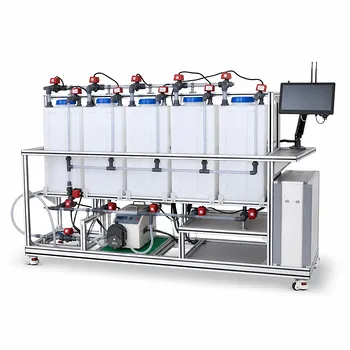
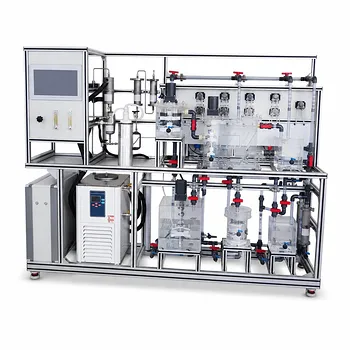
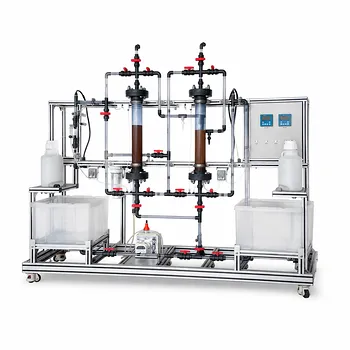
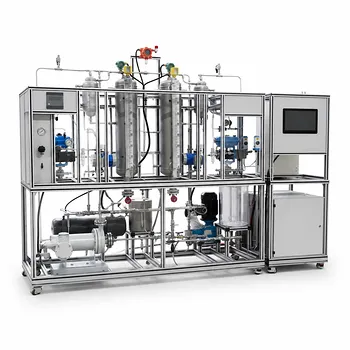
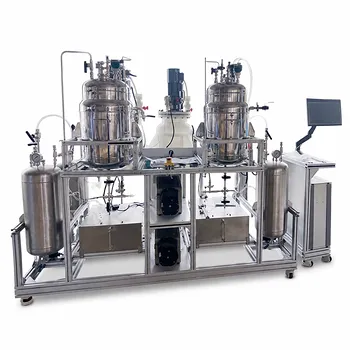
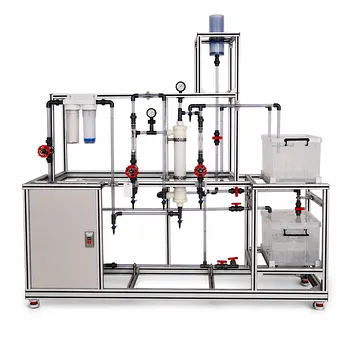
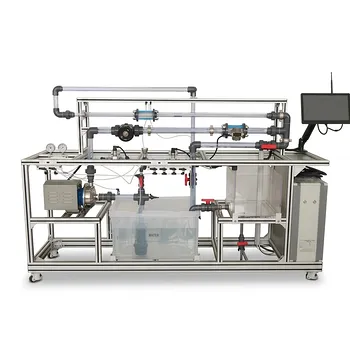
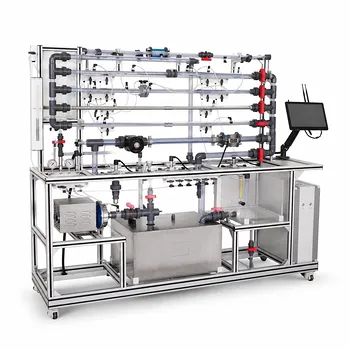
Accurate analytical chemistry is critical when operating pilot-scale systems. LABPARK provides premium Educational and Vocational Unit Operations Pilot Plants across chemical engineering, bioprocess & biotech, and environmental & water treatment.
Tailored for universities, research institutes, and enterprises, our pilot plants bridge the gap between classroom theory and industrial reality.
Ready to upgrade your laboratory capabilities? Contact LABPARK today to explore our customizable pilot plant solutions!
Related Products
- Electrochemical Water Treatment Educational Unit Operations Pilot Plant
- Thermal Desorption Exhaust Gas and Tail Water Treatment Educational Pilot Plant
- Ion Exchange Water Purification Educational Pilot Plant for Engineering Unit Operations
- Alkaline Membrane Water Electrolysis Educational Pilot Plant Unit Operations Training System
- Water Electrolysis Hydrogen Production and Storage Educational Pilot Plant
People Also Ask
- What design features do educational electrochemical pilot plants utilize to manage gas liberation and water loss?
- How can unit operations pilot plants show lead-acid concentration vs state of charge? Real-time monitoring guide.
- How do educational electrochemical pilot plants scale up electrolysis? Master industrial engineering.
- How to Estimate Sulfate in Water Treatment Pilot Plant Deposits: Gravimetric Guide
- How can foaming be managed during steam generation experiments in water treatment unit operations pilot plants? Tips