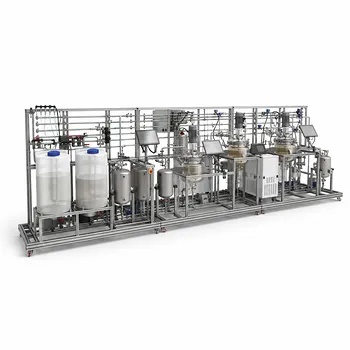
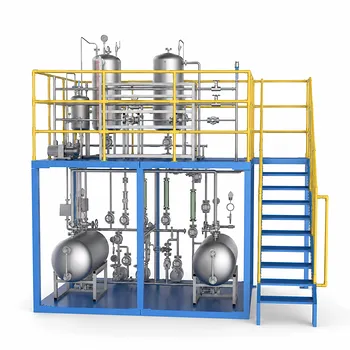
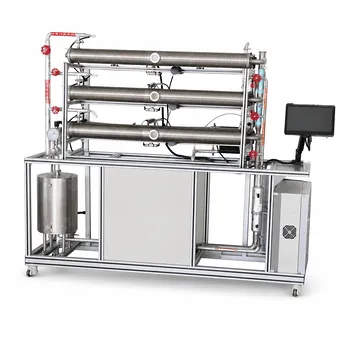
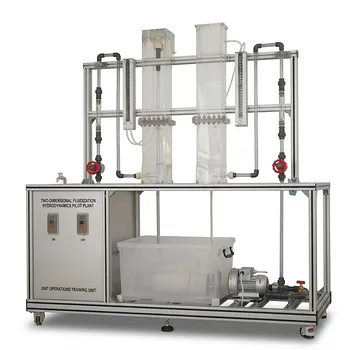
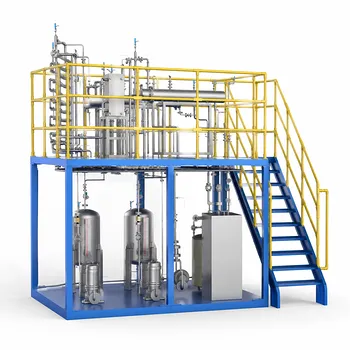
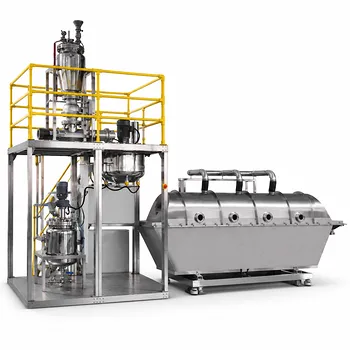
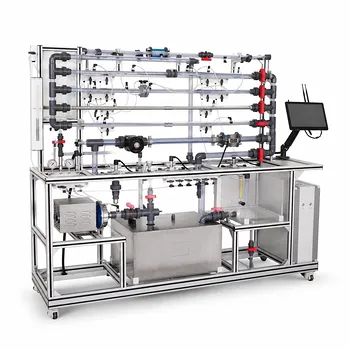
Here is the definitive reality: unit operations pilot plants are the essential translator between the abstract language of sustainability metrics and the physical reality of pharmaceutical manufacturing. They take classroom concepts—like atom economy, E-factors, and theoretical energy balances—and transform them into visceral, hands-on challenges where a student sees exactly how a 5% yield loss or an extra hour of drying time completely undermines both the economic viability and the environmental footprint of a process.
The core value of the pilot plant is not just scale-up; it is failure in a controlled environment. It is the only place where a future engineer can learn that a process isn't just unsustainable on a spreadsheet—it’s unsustainable because of a specific fouling problem in a heat exchanger, a hidden mass transfer limitation in a crystallizer, or a scheduling bottleneck that doubles idle energy consumption. This physical confrontation is what bridges the gap.
The Theory-Practice Chasm in Pharma
The leap from a textbook sustainability principle to a production-ready pharmaceutical process is enormous. Traditional education often leaves this chasm unaddressed.
Why Benchtop Labs Fail to Teach Sustainability
In a university lab, synthesizing a few grams often uses vast excesses of solvent or reagents, because removing them is trivial. The environmental cost seems like an afterthought.
A pilot plant changes this brutally. Students cannot just dump 50 liters of solvent. They must perform a solvent recovery distillation, which consumes energy. They see immediately that recyclability isn't free—it’s a trade-off between material avoidance and energy consumption.
The Flaw of Purely Theoretical Design
Thermodynamic models predict equilibrium yields, but students on a pilot plant learn that equilibrium is never reached. They confront the stark difference between a reaction's theoretical potential and the actual yield limited by mixing, heat transfer, and kinetics.
This forces a critical shift. Sustainability is no longer a calculated input-output ratio. It becomes a physical fight to make the molecules actually meet under the right conditions, in the minimum time, with the least energy.
How Pilot Plants Transform Abstract Ideas into Tangible Results
When a student physically operates a process train, the abstract goals of “reducing environmental impact” and “ensuring economic viability” become a series of concrete, measurable engineering decisions.
The Brutal Economics of Yield at Scale
A reaction with a 95% yield sounds excellent in theory. In a pilot plant, that 5% loss represents hundreds of grams of valuable, complex intermediate going to waste in each single batch.
Students internalize this by performing the mass balance. They see the unreacted material, the degradation products in the mother liquor, and the sheer volume of solvent needed to flush the system. The connection between reaction selectivity and waste generation becomes undeniable.
Physically Confronting Energy and Material Consumption
The primary reference highlights optimizing energy and material use. A pilot plant makes this tangible. Students physically trace steam lines, measure cooling water flow, and calculate the specific energy demand for a unit operation.
They can ask: "What if we isolate the product by centrifugation instead of filtration?" They physically measure the residual moisture and subsequent drying time. They see how a seemingly minor change upstream profoundly impacts the downstream energy footprint.
Bridging Mathematical Models With Physical Truths
Supplementary references stress that models require empirical validation. Students learn this by breaking a model. They record a temperature profile that doesn't match the simulation because the model ignored wall heat loss.
This is a revelation. They learn that sustainability predictions are only as good as the physical assumptions. A "sustainable" process on a computer is a fantasy until you measure the real heat transfer coefficient and account for fouling in your energy balance.
Solving the Production Scheduling Puzzle
Sustainability isn't just chemistry; it’s time management. A process step with a long idle time—where a reactor sits idle while waiting for a Nutsche filter to be cleaned—wastes massive amounts of energy and resource time.
By running consecutive batches and tracking occupancy, students identify this bottleneck firsthand. They learn that optimizing sustainability might mean adding an auxiliary unit operation to reduce idle time, directly linking scheduling to resource efficiency.
Understanding the Trade-offs
No technology is a panacea. Trusting an advisor means understanding the limitations, and educational pilot plants have distinct boundaries.
The Illusion of Regulatory Reality
A key limitation is that most educational pilot plants do not operate under full Good Manufacturing Practices (cGMP). The strict real-time documentation, cleaning validation, and material traceability required in pharma are often absent.
This means students learn the unit operation but might miss the 15% of total processing time spent on quality oversight. This oversight, while not a chemical transformation, is a huge factor in a process's practical economic sustainability.
The "Toy Problem" Risk of Equipment Flexibility
Pilot plants are designed for rapid reconfiguration. Supplementary references contrast this with the standardized, parallel operations of real manufacturing. A student might design a clever sequential process that is a nightmare to control in a rigid, 24/7 commercial plant.
The very flexibility that makes learning possible can mask the rigorous standardization that drives true long-term manufacturing efficiency. A great pilot-scale process is not automatically a commercially viable one.
Making the Right Choice for Your Curriculum
To maximize the bridge between theory and practice, educational programs must tailor pilot plant use to specific learning outcomes.
- If your primary focus is building deep intuition for design: Use the plant for model validation. Force students to predict an outcome using first principles, then run the experiment. Analyze the raw, often messy, differences.
- If your primary focus is teaching holistic process optimization: Assign a goal to reduce the E-factor of a multi-step synthesis by 20%. Let students fight with solvent recovery, scheduling, and down-stream processing to achieve it.
- If your primary focus is preparing students for industrial troubleshooting: Introduce controlled faults. Deliberately foul a heat exchanger or alter an impeller speed. This teaches students to diagnose process deviations from physical symptoms, connecting a pressure drop to a sustainability problem.
The ultimate lesson is that process sustainability is not a static theoretical property; it is a dynamic physical outcome, and the pilot plant is the only classroom where this truth is genuinely revealed.
Summary Table:
| Theoretical Concept | Practical Pilot Plant Reality | Educational Learning Outcome |
|---|---|---|
| High Yield (e.g., 95%) | Real-world waste, impurities, and separation challenges | Understanding mass balance and actual selectivity |
| Theoretical Energy Models | Heat loss, equipment fouling, and real-time efficiency drops | Learning empirical validation of thermodynamic models |
| Solvent Recyclability | Energy-intensive distillation and recovery trade-offs | Balancing material savings against energy consumption |
| Linear Scheduling | Batch bottlenecks and idle equipment time | Optimizing process flow and resource management |
Bring Industrial Reality to Your Classroom
Bridging the gap between textbook theory and practical pharmaceutical manufacturing is the key to training the next generation of engineers. LABPARK offers high-quality Educational and Vocational Unit Operations Pilot Plants across chemical engineering, bioprocess & biotech, and environmental & water treatment.
We help universities, research institutes, and enterprises build hands-on training labs that simulate real-world challenges, from energy optimization to scale-up troubleshooting.
Ready to upgrade your laboratory? Contact our experts today to find the ideal pilot plant solution for your curriculum!
Related Products
- General Purpose Cosmetics Production Unit Operations Training Pilot Plant
- Multi Pump Fluid Transport Process Piping Unit Operations Training Pilot Plant
- Multi-Functional Drying Educational Unit Operations Pilot Plant
- Fixed-Bed Chemical Reaction and Gas Dust Tar Removal Unit Operations Pilot Plant
- 100L Continuous Loop Hydrogenation Educational Unit Operations Pilot Plant
People Also Ask
- How do deviations in estimating latent heat impact pilot plant thermal systems? Avoid hardware mis-sizing.
- Why is the chemical plant startup schedule crucial? De-risk scale-up with pilot plants.
- When to transition from PID to adaptive control in pilot plants? Key process indicators.
- Why Compare Predicted and Experimental Excess Enthalpy? Key to Accurate Pilot Plant Scale-up
- How to study gasification in pilot plants? Compare exit gas composition & efficiency