Selecting a thermodynamic model for a pilot plant is not a menu-click exercise; it is an engineering diagnosis.
For distillation and absorption units processing non-ideal, polar mixtures—such as alcohols, aldehydes, and water—the correct strategy is a dual-equation approach. Use a modified cubic equation of state (e.g., Soave-Redlich-Kwong or Prausnitz-Chueh Redlich-Kwong) to capture vapor-phase non-ideality and fugacity, while selecting a local-composition activity coefficient model—Wilson, NRTL, or UNIQUAC—for the liquid phase. When experimental VLE data are missing, fill the gap with the UNIFAC group contribution method or by interpolating from chemically similar binary pairs. Finally, always regress model binary parameters against pilot-plant-condition VLE data (at the operating pressure) and validate against trusted databases like DIPPR or DECHEMA to ensure the simulation faithfully replicates the physical column.
The real objective is to systematically close the gap between simulation and pilot-plant reality. This demands more than picking a model name—it requires a multi-equation framework, rigorous data regression, and relentless validation against experimental physical property databases.
The Dual-Equation Framework: Vapor and Liquid Non-Ideality
Why a Single Model Often Fails for Polar Mixtures
Classic cubic equations of state alone cannot accurately describe the liquid-phase interactions of highly polar or associating molecules like water and ethanol. For these systems, the liquid phase exhibits strong non-ideality that must be handled separately with activity coefficient equations.
A single-model approach that tries to force an EOS to handle both phases often leads to large deviations in separation predictions. The proven industrial method is to model the vapor phase with a modified EOS and the liquid phase with an activity coefficient model, allowing each phase’s behavior to be captured by the physics most appropriate for it.
Choosing the Right Vapor-Phase Equation of State
For the vapor phase in distillation and absorption, modified versions of the Redlich-Kwong equation—such as the Soave-Redlich-Kwong (SRK) or Prausnitz-Chueh Redlich-Kwong—are standard. These modifications introduce temperature-dependent parameters that better handle vapor-phase fugacity, especially under the moderate pressures typical of pilot plants.
The choice of vapor model has a secondary, albeit important, effect on the overall calculation. Prioritize the model that your process simulator pairs most seamlessly with your selected liquid-phase activity coefficient framework.
Selecting the Liquid-Phase Activity Coefficient Model
Wilson, NRTL, and UNIQUAC: When to Use Each
For fully miscible polar systems, the Wilson equation is a highly effective first choice. It represents multicomponent VLE using only binary interaction parameters, making it straightforward—for example, in mixtures like acetaldehyde-ethanol.
The UNIQUAC model extends this capability to systems with large molecular size differences. It also requires only binary parameters and is widely used for multicomponent VLE and LLE predictions in complex, polar mixtures.
The Critical Question: Will Your System Phase-Split?
The standard Wilson equation has a critical limitation: it cannot predict liquid-liquid phase separation. If your process involves any phase-splitting—such as liquid-liquid extraction or heterogeneous azeotropic distillation—you must switch to the NRTL equation.
NRTL includes a third non-randomness parameter (shape factor), which allows it to accurately model liquid-phase immiscibility. Before finalizing any model, confirm whether your pilot plant chemistry involves even trace immiscibility; choosing Wilson for such a system will lead to fundamentally incorrect liquid-phase predictions.
Bridging the Gap: Filling Missing Data and Regressing Parameters
Using UNIFAC When Experimental Data is Absent
When binary VLE data is unavailable, the UNIFAC group contribution method can estimate activity coefficients based on a molecule’s functional groups. This predictive approach is powerful for screening or initial design, but it is no substitute for experimental data in pilot-plant operation.
Regressing Binary Parameters to Match Pilot Plant Conditions
The most reliable way to align simulation with your pilot column is to regress binary interaction parameters directly from experimental VLE data at the unit’s operating pressure. Export measured activity coefficients into your simulator, specify the NRTL (or Wilson) model, and run an isobaric regression across the mixture’s boiling range.
This process yields parameters tailored to the exact temperature and pressure of your pilot plant. It dramatically reduces the discrepancy between simulated temperature profiles, reflux ratios, and what you actually observe in the column.
Handling Liquid-Liquid Equilibrium (LLE) Parameter Fitting
For extraction or LLE processes, relying solely on VLE data is highly inaccurate. The correct procedure is to first fit parameters to binary VLE and LLE data, then optimize them against multicomponent LLE experimental results.
This combined VLE‑LLE regression strategy forces the model to respect distribution coefficients. Only then will simulated extraction stage efficiencies and solvent usage match the physical pilot plant.
Validation and Refinement for Operational Accuracy
Cross-checking with Physical Property Databases
Even after regression, always validate your tuned model against curated physical property databases like DIPPR or DECHEMA. A significant mismatch between predicted and database values indicates that the regression data may contain errors or that the mixture exhibits complex interactions not captured by simple binary parameters.
Discrepancies in simulation vs. pilot plant performance often trace back to incorrect default binary parameters in simulator databanks. Adjusting those parameters with targeted experimental data—especially for the key binary pairs that define the separation—resolves most prediction failures.
Component Selection: Avoiding Convergence Failures
The quality of your thermodynamic model can be sabotaged by poor component list preparation. To prevent convergence failures, especially in columns with recycle streams, limit your component list to fewer than 40 species.
Include all products with purity specifications, all key feed contaminants, and even trace side-reaction products if they affect separation or accumulate in recycles. For complex petroleum-like fractions, use pseudo-components grouped by boiling range (e.g., matching an ASTM D86 curve) to represent the distillation profile without overwhelming the simulation.
Understanding the Trade-offs and Common Pitfalls
Every choice carries trade-offs that directly impact pilot plant success. Wilson’s simplicity and reliance on only binary parameters makes it extremely attractive for fully miscible systems, but it fails catastrophically once a second liquid phase appears.
NRTL overcomes the phase-split limitation, yet its additional non-randomness parameter demands more experimental data for reliable regression; using default unregressed parameters can introduce errors just as large as the wrong model choice. Similarly, the tempting ease of pure UNIFAC predictions often degrades accuracy for specific pilot-plant chemistries—treat it as a starting point, not a finish line.
Over‑loading the component list to “be safe” will cause convergence nightmares, while omitting a trace contaminant that builds up in a recycle can make your entire simulation worthless. Finally, blindly trusting simulator default binary parameters without validation is the single most common reason pilot-plant data deviates from the simulation.
Making the Right Choice for Your Pilot Plant
The path forward depends on your system’s characteristics and your operational priorities. Use these goal‑oriented guidelines to select and tune your thermodynamic package.
- If your primary focus is a fully miscible polar mixture (e.g., alcohol/aldehyde/water without phase‑split): Start with the Wilson equation for the liquid phase and a modified SRK for the vapor. Regress binary parameters from isobaric VLE data at pilot plant pressure.
- If your primary focus is a system that exhibits or might exhibit liquid‑liquid immiscibility (extraction, heterogeneous azeotropic distillation): Use the NRTL equation for the liquid phase. Fit parameters using both binary VLE/LLE data and multicomponent LLE experiments—never rely on VLE data alone.
- If your primary focus is a process with no experimental VLE or LLE data available: Employ UNIFAC for initial screening, but plan for a short pilot campaign to generate the critical binary VLE data. Then regress the parameters to achieve high‑fidelity predictions.
- If your primary focus is reliable scale‑up predictions: Limit component count below 40, use pseudo‑components for complex feeds, and validate all regressed parameters against DIPPR or DECHEMA databases. Refine any parameter that causes the simulation to deviate from verified physical property data.
Treat thermodynamic model selection as a living, data‑driven calibration task rather than a one‑time software setting, and you will transform your pilot plant simulations from rough estimates into precise engineering tools.
Summary Table:
| System / Process Type | Recommended Vapor Model | Recommended Liquid Model | Key Consideration & Limitations |
|---|---|---|---|
| Fully Miscible Polar Mixtures | Modified SRK / PR | Wilson | Simple binary parameters; cannot predict phase splits. |
| Liquid-Liquid Immiscibility (LLE/Extraction) | Modified SRK / PR | NRTL or UNIQUAC | Requires fitting both VLE and LLE binary parameters. |
| No Experimental VLE/LLE Data Available | Modified SRK / PR | UNIFAC | Group contribution estimation; use only for initial screening. |
| Complex / Petroleum Fractions | Modified SRK / PR | Pseudo-components | Group by boiling range; limit total components to <40. |
Align Your Simulations with Real-World Performance
Designing and operating a high-fidelity pilot plant requires both rigorous thermodynamic modeling and precision-engineered physical systems.
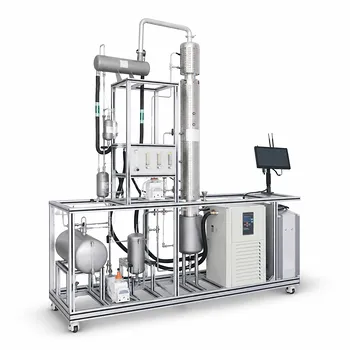
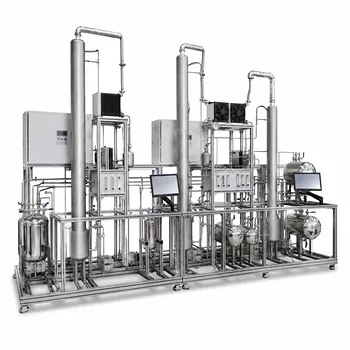
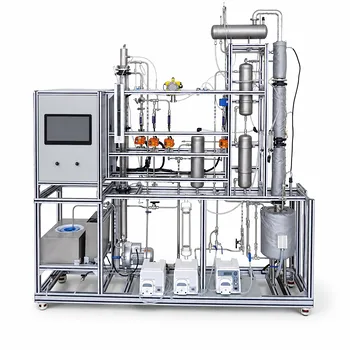
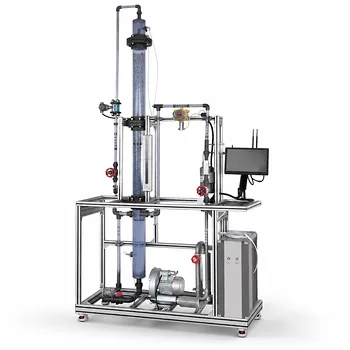
LABPARK provides state-of-the-art Educational and Vocational Unit Operations Pilot Plants in chemical engineering, bioprocess & biotech, and environmental & water treatment. Specifically tailored for universities, research institutes, and enterprises, our distillation and absorption pilot plants are built to help you successfully validate your simulations and scale up with confidence.
Ready to elevate your chemical engineering labs and research capabilities? Contact LABPARK today to consult with our technical experts!
Related Products
- Electrolyte Distillation Purification and Formulation Educational Pilot Plant
- Continuous Sieve-Plate Distillation Pilot Plant for Unit Operations Laboratory Education
- Absorption and Desorption Educational Unit Operations Pilot Plant
- Multi-Modal Distillation Unit Operations Training Pilot Plant
- Green Anhydrous Ethanol Purification Extractive Distillation Unit Operations Training Pilot Plant
People Also Ask
- Why does simple distillation yield higher efficiency than flash distillation? Key thermodynamic differences.
- How to Integrate Spectroscopy in Distillation Pilot Plants for Advanced Process Control
- Why is the acentric factor important in pilot plants? Fluid property prediction.
- How to Verify Distillation Boundary Lines & Composition Regions with Pilot Plants
- How does double temperature difference control improve distillation pilot plants? Stabilize purity.