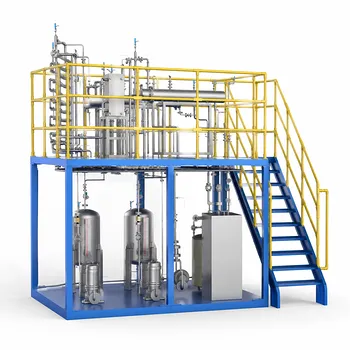
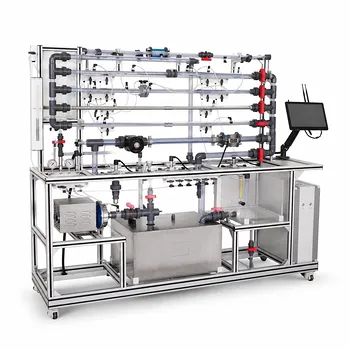
The decision is dictated entirely by time. For continuous unit operations pilot plants—think steady-state distillation columns or gas absorption units—you apply differential balances, which analyze instantaneous rates (mass per unit time). For batch-operated pilot plants, like batch reactors or dryers, you use integral balances, which capture the total change between a defined start and end point. This single rule eliminates confusion and ensures your experimental data matches the underlying process dynamics.
For mass balance experiments on unit operations pilot plants, the choice between differential and integral balances is not a subjective preference—it’s a direct consequence of your system’s operating mode. Continuous, steady-state units demand rate-focused differential balances; transient batch systems require cumulative integral balances. Misapplying these leads to meaningless numbers.
Understanding the Operating Mode: The Root of the Decision
Unit operations pilot plants mirror industrial reality, but your balance framework must align with how mass flows through the system. The first question to ask is: Is the process running at a constant state, or does everything change with time?
When Differential Balances Are Essential
A differential balance describes the system at an instant. It works with rates—mass per unit time, like grams per second or kilograms per hour—and is the only correct tool when the process is continuous and operating at steady state.
In a continuous distillation column pilot plant, for example, the feed rate, distillate flow, and bottom product composition remain constant over hours. There is no accumulation. Here, you write balances like:
[ \text{Input rate} - \text{Output rate} + \text{Generation rate} = 0 ]
You measure flow rates, not total quantities, and your balance is inherently differential. This approach lets you instantly spot inefficiencies, size equipment, and optimize throughput.
When Integral Balances Come Into Play
An integral balance looks at the window between ( t_0 ) and ( t_f ). It deals with cumulative amounts—total mass or moles—and is mandatory for batch or semi-batch operations where conditions evolve over time.
In a batch reactor pilot plant, you charge the vessel with reactants, run the reaction, and then empty it at the end. The concentration and temperature profile inside changes continuously. You cannot define a single steady-state rate that holds for the whole batch. Instead, you write:
[ \text{Initial mass in} - \text{Final mass out} + \text{Total generated} = \text{Accumulation} ]
The balance is integrated over the batch cycle, giving you total yield, conversion, or loss. This directly connects to what you’ll recover from the vessel, which is what matters for product purity and economic evaluation.
Establishing the Calculation Basis Before You Write a Single Equation
Choosing differential vs. integral is the first step. The second is picking the right basis—the reference frame that makes your numbers concrete and reproducible.
Basis for Batch Pilot Plants
For batch systems, set the basis as one complete batch, a specific charge of raw materials, or a target product yield. This ensures you’re comparing total inputs to total outputs over a reproducible cycle. If you use a time basis for a batch, you’ll implicitly average a transient process, masking critical start-up and end-of-run effects.
Basis for Continuous Steady-State Pilot Plants
For continuous units, define the basis as a unit of time (per hour, per minute) or a unit of feed mass/mole (e.g., per 1 kg of feed). A time basis is preferred because it directly yields production rates and utility demands. If steam or cooling water use is your focus, a per-time basis makes sizing calculations trivial.
Composition Dictates Mass vs. Molar Basis
A secondary but vital decision: mass or moles?
- If the feed composition is known exactly, a molar basis simplifies stoichiometry and reaction balances.
- With ill-defined mixtures (crude feeds, biomass, polymers), use a mass basis (or volume if density is reliably known).
- For gas systems, a volume basis at a standard temperature and pressure is normal.
Choosing the basis early prevents unit conversion errors that can derail an entire lab session.
Understanding the Trade-offs and Common Pitfalls
Even with the correct differential or integral framework, students often stumble on subtle points that make data unusable. Awareness of these pitfalls is what separates a textbook exercise from a defendable experimental mass balance.
Assuming Steady State When It Doesn’t Exist
The most frequent error is applying a differential balance to a process that hasn’t reached steady state. If your continuous distillation column is still warming up, the overhead composition is climbing. A rate-based balance during that period is wrong—accumulation is not zero. Always verify steady-state criteria (constant temperature, pressure, and composition at multiple points) for at least three residence times before taking data.
Ignoring Hold-up and Accumulation in Integral Balances
For a batch system, forgetting to account for material left in the reactor, piping, or sampling ports breaks the balance. Integral balances must measure everything that went in and everything that came out, including residues, samples, and vent losses. The sum of all outputs must explain the difference from the initial charge.
Mixing Rate and Cumulative Data in the Same Analysis
Taking a total mass of distillate collected over 4 hours and dividing by time does not give you an accurate instantaneous differential balance unless the rate was truly constant. In batch distillations, the top product rate changes dramatically. Use differential balances only with online, real-time flowrate data; use integral balances only with totalized collected masses.
Overlooking the Link to Kinetic Evaluation
When the pilot plant involves reaction engineering, the balance method connects directly to kinetic analysis. The differential method of kinetic data analysis (finding ( dC_A/dt ) from concentration-time data) aligns with differential mass balances on a continuous stirred tank reactor. The integral method (plotting integrated rate laws) aligns with batch integral balances. Confusing these can lead to incorrect rate constants.
Making the Right Choice for Your Experimental Goal
Before you turn a single valve, align your balance approach with what you intend to learn from the pilot plant.
- If your primary focus is optimizing throughput in a continuous unit: Use a differential balance on a time basis. Measure all in and out flow rates at steady state, and the balance will immediately reveal losses or capacity bottlenecks.
- If your primary focus is determining total recovery or yield from a batch cycle: Use an integral balance over the full batch. Weigh initial charges and all collected products; this will give you the definitive mass closure and process efficiency.
- If your primary focus is extracting kinetic data for reactor design: Match the balance type to the reaction method—integral balances for batch integral kinetic analysis, differential balances for continuous CSTR differential analysis—and sample concentrations at precisely timed intervals.
- If your primary focus is thermal sizing (heating/cooling loads): Apply the energy balance analog: ( Q = \Delta U ) (integral, batch) or ( Q = \Delta H ) (differential, continuous), and choose your mass basis accordingly.
Understanding the rhythm of your pilot plant—steady or transient—gives you the intellectual clarity to turn raw measurements into reliable process knowledge.
Summary Table:
| Feature | Differential Balance | Integral Balance |
|---|---|---|
| Operating Mode | Continuous & Steady-State | Batch & Semi-Batch (Transient) |
| Primary Metric | Flow rates (e.g., kg/h, g/s) | Cumulative mass/moles (e.g., kg, mol) |
| Key Equation Basis | Per unit of time or feed | Per complete batch or total raw feed |
| Typical Applications | Distillation columns, gas absorption | Batch reactors, batch dryers |
| Common Pitfalls | Applying before reaching steady state | Ignoring hold-ups, residue, and vent losses |
Elevate Your Engineering Labs with LABPARK
Bridging the gap between textbook theory and industrial application requires reliable, high-precision training equipment. LABPARK designs and manufactures premium Educational and Vocational Unit Operations Pilot Plants in:
- Chemical Engineering (Distillation, extraction, absorption, and reaction kinetics)
- Bioprocess & Biotechnology (Bioreactors, fermentation, and downstream processing)
- Environmental & Water Treatment (Filtration, membrane separation, and wastewater treatment)
Specifically engineered for universities, research institutes, and enterprises, our pilot plants deliver the steady-state stability, data accuracy, and safety features needed for successful mass and energy balance experiments.
Ready to upgrade your laboratory capabilities?
Contact LABPARK today to consult with our technical experts and get a customized quote for your facility.
Related Products
- General Purpose Cosmetics Production Unit Operations Training Pilot Plant
- Multi-Functional Drying Educational Unit Operations Pilot Plant
- Multi Pump Fluid Transport Process Piping Unit Operations Training Pilot Plant
- Fixed-Bed Chemical Reaction and Gas Dust Tar Removal Unit Operations Pilot Plant
- 100L Continuous Loop Hydrogenation Educational Unit Operations Pilot Plant
People Also Ask
- Why is the chemical plant startup schedule crucial? De-risk scale-up with pilot plants.
- How do deviations in estimating latent heat impact pilot plant thermal systems? Avoid hardware mis-sizing.
- When to transition from PID to adaptive control in pilot plants? Key process indicators.
- Why Compare Predicted and Experimental Excess Enthalpy? Key to Accurate Pilot Plant Scale-up
- Why Use PTFE & Hastelloy in Chemical Pilot Plants? Prevent Corrosion & Ensure Safety