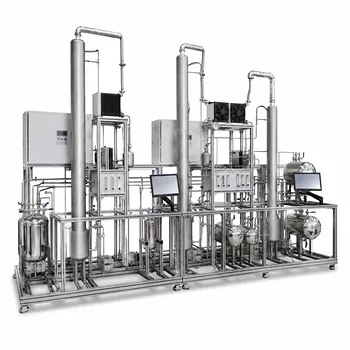
When dealing with shear-sensitive or toxic materials in a chemical engineering pilot plant, the dryer selection process must first answer two critical questions: how fragile is the particle, and how hazardous is the exposure? For materials that easily fracture, such as needle-like crystals, you need a dryer that imparts minimal mechanical energy—tumble dryers or static tray dryers are the primary choices. For potent or toxic compounds where operator safety is paramount, the priority shifts entirely to containment, driving you toward closed, often agitated systems like conical dryers, filter dryers, or fluid bed dryers, even if they introduce a degree of shear. The entire value of a well-equipped unit operations pilot plant is that it lets students and researchers deliberately confront the tension between these priorities and observe the resulting trade-offs in product quality and cycle time.
Material properties and hazard level dictate the starting point: gentle motion for shear-sensitive solids, total isolation for toxic ones. The most instructive pilot plants provide multiple dryer types so that the inherent compromise between particle integrity, containment, and process speed can be turned into a measurable learning outcome, not avoided.
Decoding the Material: Shear Sensitivity vs. Toxicity
The physical nature of your material and its hazard profile are not merely checkboxes—they define entirely different dryer selection hierarchies. Understanding each requirement in isolation is the foundation for making a choice when both are present.
The Mechanics of Shear-Sensitive Solids
Shear sensitivity means the solid particles are prone to breakup under impingement or intense agitation. Needle-like crystals, for example, can lose their desired aspect ratio, shifting the particle size distribution and lowering bulk density.
In a pilot plant, you want to teach that preserving the original particle characteristics often comes at the expense of speed. The slow, rolling action of a tumble dryer or the complete stillness of a static tray dryer applies far less stress than the scraping paddles of a filter dryer or the rotating cone of a conical dryer. These low-shear options keep the crystal shape intact, which is vital when the solid’s functionality depends on its morphology.
The Absolute Priority of Containment
When a material is toxic or highly potent, the risk to the operator overrides nearly every other process consideration. Open systems like tray dryers are instantly disqualified because discharging and cleaning would present unacceptable exposure.
The selection logic becomes simple: the dryer must be a fully enclosed vessel. Closed systems—conical dryers, filter dryers, and fluid bed dryers with appropriate dust containment—are the only viable starting points. The educational value here is demonstrating how safety constraints reshape the processing window, often forcing a shift toward equipment that would not have been the first choice for a benign material.
Matching Dryer Technologies to Your Pilot Plant Goals
With the material constraints clear, you can map specific dryer types to the outcomes you want your students or researchers to observe. A pilot plant should not be a single-answer solution but a platform for comparison.
Gentle Motion: Tumble and Tray Dryers
For shear-sensitive solids where toxicity is not a concern, the choice is straightforward. A tumble dryer provides gentle, low-shear movement that maintains particle integrity while still achieving reasonable mixing and heat transfer. A static tray dryer removes mechanical agitation entirely, making it the ultimate guardian of crystal shape.
These units are excellent for teaching drying kinetics because they allow an undisturbed, clear view of the drying curve. However, the trade-off is immediately evident: drying times are often much longer than in agitated systems because the lack of active mixing creates a thicker, static bed that resists heat and mass transfer.
Contained Agitation: Conical and Filter Dryers
For potent compounds, the conical (rotary cone) dryer and the filter dryer become the default teaching tools. Both are enclosed, preventing operator exposure during loading, drying, and discharge. The critical lesson is that the same mechanical agitation that provides containment also dramatically reduces drying cycle time by continuously renewing the surface area and disrupting the bed.
However, this introduces a conflict: the scrapers or rotating elements that speed up drying also apply shear. For a material that is both toxic and fragile, the instructor can demonstrate how process parameters—such as lowering the agitator speed—can partially mitigate particle breakage while still maintaining an acceptable cycle time and full containment.
The Fluid Bed as a Dual-Capability Platform
A fluidized bed dryer occupies a unique middle ground. It can be fully enclosed to handle toxic materials, and for many free-flowing solids, the gentle fluidization offers a far lower shear environment than a mechanically stirred vessel. The pilot-scale fluid bed is also ideal for demonstrating high heat and mass transfer rates and short drying times.
It is not a universal solution. The technology works best for particles roughly between 0.03 mm and 6 mm. Extremely fine powders risk gas channeling, and very large particles require velocities that can damage fragile structures. Yet for the right particle size, a fluid bed allows you to satisfy the containment requirement while demonstrating a process that is inherently less abrasive than a conical or filter dryer.
Understanding the Trade-offs
No single dryer in a pilot plant will perfectly optimize for both shear sensitivity and toxicity simultaneously. The power of the pilot plant comes from forcing users to confront these tensions head-on.
The Conflict Between Particle Integrity and Cycle Speed
Agitation is the culprit. It slices through thermal gradients, shortens the drying time, and, in the case of toxic materials, is often built into the only systems that offer full containment. The unavoidable cost is particle attrition. A conical dryer run at high speed will degrade shear-sensitive crystals, yet the same speed may be necessary to meet a required drying time target. The pilot plant makes this quantification possible: students can vary the agitation rate, measure the resulting particle size distribution, and plot it directly against the drying time, learning that every hour saved has a quantifiable physical cost.
Safety vs. Simplicity in Educational Settings
Static tray and tumble dryers are mechanically simpler and visually demonstrative, making them appealing for fundamental heat and mass transfer labs. Yet using them with any level of toxic material is a safety non-starter. In a teaching pilot plant, the experiment design often forces a choice: use a benign surrogate in the low-shear dryer to illustrate a principle, or conduct the real toxic-material experiment in a fully enclosed, more complex dryer. This dual-track approach teaches that industrial process development always involves substituting, simulating, or accepting a budget for containment that the glassware-scale lab never requires.
Scale-Up Realities
A pilot-scale dryer selection made purely to protect a fragile powder can lead to a dead end in manufacturing if the corresponding large-scale technology is either non-existent or prohibitively expensive. Tumble dryers, for instance, have clear scale-up paths, while a static tray dryer, though gentle, is often limited to small batches. By including multiple technologies in the pilot plant, instructors can force students to consider not just the immediate drying result but also whether the chosen approach would remain viable at the next scale, a discipline that separates academic exercises from industrial readiness.
How to Structure Your Pilot Plant Selection for Maximum Learning
The goal is not to find one perfect dryer but to build a decision framework. Use these focus-driven strategies to guide equipment choice and experimental design.
- If your primary focus is demonstrating the impact of shear on product quality: Select a tumble dryer or static tray dryer as your baseline. Compare the resulting particle size distribution directly against a run in an agitated conical dryer at different speeds to quantify the exact cost of agitation.
- If your primary focus is operator safety with potent compounds: Restrict all work to fully enclosed systems like conical, filter, or fluid bed dryers. Then, within that spectrum, compare how varying agitation intensity or fluidization velocity alters the drying rate to teach the process window concept.
- If your primary focus is teaching the complete trade-off spectrum: Design a multi-station pilot lab where non-toxic, shear-sensitive material is run in a tumble dryer, a simulated toxic material is run in a conical dryer, and the resulting drying curves, particle integrity data, and safety protocols are evaluated side by side.
- If your primary focus is time efficiency under containment: Prioritize the enclosed system that offers the highest heat transfer, typically an agitated filter dryer or fluid bed. Then, challenge students to measure the attrition and justify whether the shorter cycle justifies the loss in particle size.
A chemical engineering pilot plant does its best work when it refuses to hand students a single, correct answer, instead forcing them to measure, justify, and live with the engineered compromise that defines all unit operations.
Summary Table:
| Dryer Type | Shear Level | Containment | Best Use Case |
|---|---|---|---|
| Static Tray / Tumble | Low | Open / Low | Fragile, non-toxic materials preserving crystal morphology |
| Conical / Filter | Medium to High | Fully Enclosed | Toxic or potent compounds requiring active agitation |
| Fluid Bed | Low to Medium | Enclosed | Enclosed, fast drying of mid-sized free-flowing solids |
Optimize Your Unit Operations Lab with LABPARK
Are you looking to provide hands-on experience in balancing safety, process speed, and product quality? LABPARK designs and supplies advanced Educational and Vocational Unit Operations Pilot Plants in chemical engineering, bioprocess & biotech, and environmental & water treatment.
We help universities, research institutes, and enterprises build flexible, safe, and highly educational testing environments. Contact LABPARK today to find the perfect pilot plant solution for your facility!
Related Products
- Multi-Functional Drying Educational Unit Operations Pilot Plant
- Natural Product Extraction Unit Operations Training Pilot Plant
- Multi-Reactor Educational Pilot Plant for Reaction Engineering Unit Operations
- Multi-Modal Distillation Unit Operations Training Pilot Plant
- Ethyl Acetate Synthesis Unit Operations Pilot Plant for Practical Training
People Also Ask
- Why Use PTFE & Hastelloy in Chemical Pilot Plants? Prevent Corrosion & Ensure Safety
- How to study gasification in pilot plants? Compare exit gas composition & efficiency
- Why is the chemical plant startup schedule crucial? De-risk scale-up with pilot plants.
- How do deviations in estimating latent heat impact pilot plant thermal systems? Avoid hardware mis-sizing.
- When to transition from PID to adaptive control in pilot plants? Key process indicators.