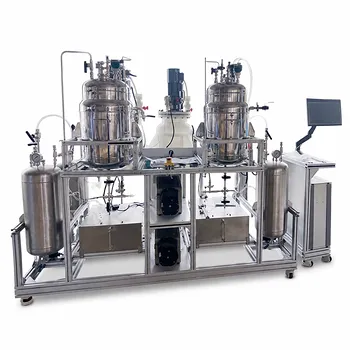
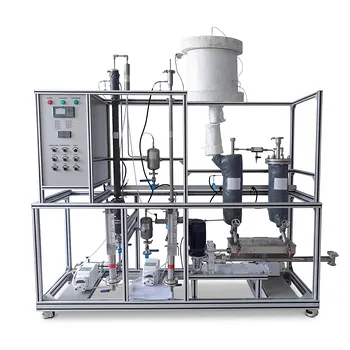
A well-designed pyrolysis pilot plant is not a one-temperature machine. It’s a dynamic system engineered to operate safely and repeatably across three distinct temperature bands: low-temperature retorting (500–600°C), medium-temperature retorting (700–900°C), and high-temperature retorting (900–1100°C). Accommodating these ranges requires more than a powerful furnace; it demands a reactor with precision heating control, materials that stay inert at extreme heat, and a fully integrated downstream separation train that can handle the drastically different oils, gases, and chars each temperature zone produces.
The Core Takeaway Versatility in a pyrolysis pilot plant is built on three integrated pillars: a reactor assembly capable of spanning 500–1100°C through advanced heating and insulation, a PID-controlled thermal loop that holds each zone with tight accuracy, and a flexible gas-handling and fractionation system that adapts to the shift from tar-rich low-temperature products to gas-rich high-temperature streams. Only by engineering all three together does the plant become a true research and teaching tool that reveals how temperature drives yield and composition.
The Core Challenge of Thermal Versatility
A single-temperature oven cannot teach the chemistry of pyrolysis. The reactor must move between regimes because product slates, reaction rates, and material stresses all change with every 100°C step. Designing for that spectrum is the primary challenge.
Why Three Temperature Zones Demand Different Designs
Low-temperature pyrolysis (500–600°C) favors tar and semi-coke production—roughly 10% tar yield—and can operate with less aggressive heating.
High-temperature retorting (900–1100°C) shifts the economics entirely. It maximizes coke oven gas volume, often delivering around 20% of the total product mass as a hydrogen- and methane-rich stream, while tar yields drop drastically.
Between them, medium-temperature processing (700–900°C) creates a transitional product slate that helps students map kinetic pathways. A fixed, single-zone heater cannot reproduce these profiles; the plant needs a responsive, programmable thermal core.
Engineering the Reactor for a Broad Thermal Spectrum
The heart of the pilot plant is the retort itself. It must be chemically inert, thermally robust, and paired with a heating system that can climb from 500°C to 1100°C without overshoot or cold spots.
Selecting the Right Heating Technology
Modern pilot units rely on electric heating elements or induction furnaces governed by digital PID controllers. Electric resistance heaters are simpler and cost-effective for low-to-medium ranges, while induction offers faster ramping and superior uniformity at the highest temperatures. A well-tuned PID loop prevents the temperature spikes that create occluded gases and uneven char, making real-time feedback loops non-negotiable for composition control.
Material Selection and Insulation for Extreme Heat
At 1100°C, standard stainless steels lose structural integrity and may catalyze unwanted side reactions. Reactor vessels must use high-nickel alloys or ceramic-lined chambers to stay inert. High-performance insulation—such as ceramic fiber boards—sandwiched around the heating zone keeps the external shell cool and energy consumption predictable, even during multi-hour high-temperature runs.
Downstream Processing: How Temperature Changes Your Separation Train
Different temperatures produce different chemical families. A static separation system fails as the product mix shifts from heavy tars to light gases.
Condensing and Fractionating Tars at Low vs. High Heat
Low-temperature runs generate substantial coal tar that must be condensed and fractionated into market-relevant cuts: light oil, phenol oil, wash oil. The pilot plant therefore needs a controlled cooling and collection system—air-cooled or water-jacketed condensers with multiple knockout pots.
When operating at 900°C and above, the liquid yield plummets and permanent gases dominate. The downstream train must instead prioritize high-efficiency scrubbing and gas analysis over heavy-liquid collection, often bypassing fractionation columns to focus on gas holders and online detectors.
Real-Time Analysis for Composition Control
Relying on manual sampling—once the norm in open-hearth studies—undermines the value of a modern pilot facility. Integrated online gas chromatographs, pH sensors, and conductivity meters feed data directly into acquisition systems. This lets operators monitor hydrogen, methane, and other gaseous components instantaneously, adjust reagent flow rates, and validate that each temperature zone delivers the expected product purity and composition.
Understanding the Trade-offs
Versatility carries real costs and risks that must be managed.
- Capital and maintenance complexity: Multi-zone heating, dual cooling trains, and high-alloy materials drive up the initial investment and require specialized spare parts.
- Safety at the extremes: Moving from 500°C to 1100°C changes the hazard profile. At the high end, thermal expansion can stress seals, and hydrogen-rich gas streams demand leak-tight handling and explosion-proof design.
- Control system calibration: A PID loop tuned for 600°C may perform poorly at 1000°C. Multi-range control often requires gain scheduling or multiple PID profiles to maintain accuracy without constant manual retuning.
- Cross-contamination of product lines: If the same separation equipment is used for low- and high-temperature runs without complete cleaning, heavy tar residues can foul high-temperature gas paths, corrupting subsequent experiments.
Making the Right Choice for Your Goal
Design the accommodation strategy around the primary learning or research objective, not the maximum possible temperature.
- If your primary focus is teaching fundamental pyrolysis chemistry: Choose a plant that excels at low- and medium-temperature operation (500–900°C) with a simple, robust tar collection system. This keeps costs down while clearly illustrating tar vs. char formation.
- If your primary focus is researching coke oven gas and hydrogen-rich streams: Prioritise high-temperature capability (900–1100°C) and invest in the online gas analysis and induction heating that give you precise control over methane and hydrogen yields.
- If your primary focus is a full-spectrum R&D curriculum: Go for a master plant with a multi-zone electric furnace, interchangeable alloy/ceramic liners, and a modular downstream block that lets you switch between tar fractionation and gas scrubbing rapidly. Accept the higher complexity as the price of completeness.
A pilot plant that truly accommodates different temperature ranges becomes more than a piece of hardware—it becomes a programmable reaction menu that lets users explore the entire landscape from semi-coke to syngas, one precisely controlled degree at a time.
Summary Table:
| Temperature Range | Target Products | Critical Engineering Needs |
|---|---|---|
| Low (500–600°C) | Tar, semi-coke | Air/water-cooled condensers, basic PID |
| Medium (700–900°C) | Transitional gas & liquids | Gain scheduling PID, multi-stage fractionation |
| High (900–1100°C) | Hydrogen- & methane-rich gas | High-nickel alloys/ceramics, gas scrubbers, online GC |
Scale Your Thermal Research with LABPARK Pilot Plants
Designing a multi-temperature pyrolysis system requires precision engineering from the reactor core to the separation train. LABPARK provides premium Educational and Vocational Unit Operations Pilot Plants in chemical engineering, bioprocess & biotech, and environmental & water treatment tailored for universities, research institutes, and enterprises.
Our versatile systems empower your researchers and students to study complex chemical kinetics safely and accurately. Let us help you configure the ideal pilot plant for your curriculum or R&D goals—contact LABPARK today to discuss your project requirements!
Related Products
- Solid Waste Pyrolysis and Refining Educational Pilot Plant for Unit Operations
- Polymerization Granulation and Pellet Processing Educational Unit Operations Pilot Plant
- Electrolytic Hydrogen Production Educational Unit Operations Pilot Plant
- Electrolyte Distillation Purification and Formulation Educational Pilot Plant
- Continuous Batch Extractive Distillation Educational Pilot Plant
People Also Ask
- How do educational unit operations pilot plants bridge theory and design? Bridge the Engineering Gap
- How do educational unit operations pilot plants address safety and waste management when scaling up?
- When to transition from PID to adaptive control in pilot plants? Key process indicators.
- Why is the chemical plant startup schedule crucial? De-risk scale-up with pilot plants.
- Why Compare Predicted and Experimental Excess Enthalpy? Key to Accurate Pilot Plant Scale-up