Distillation under vacuum transforms process control, but it also creates a critical measurement puzzle. To calculate absolute pressure from a vacuum gauge reading, operators must measure the local atmospheric pressure and subtract the displayed vacuum degree. The formula is Absolute Pressure = Atmospheric Pressure – Vacuum Degree. This conversion is non-negotiable because chemical boiling points and vapor-liquid equilibrium depend strictly on absolute pressure, not on the relative vacuum reading. Without it, your process drifts with the weather and your data becomes impossible to reproduce.
Core Takeaway: In a vacuum distillation pilot plant, what your gauge shows as “vacuum” is actually a difference—how much you’ve pulled below the surrounding atmosphere. To lock in the true boiling point of your mixture and get consistent separation across any location or day, you must convert that vacuum degree into absolute pressure by measuring the local atmospheric pressure. Absolute pressure is the only reference that makes your process thermodynamically repeatable.
The Hidden Variable: Why Vacuum Degree Alone Isn’t Enough
Vacuum gauges are easy to read, but they hide the real story. They report a vacuum degree—the gap between atmospheric pressure and what’s inside your column. Because atmospheric pressure changes with altitude, weather, and even room ventilation, that gap shifts even when the absolute conditions inside the column are identical.
The Pressure Reference That Governs Boiling Points
Absolute pressure is the total force per area measured against a perfect vacuum. It’s the pressure that appears in Antoine equations and determines the bubble and dew points of your mixture. Gauge pressure, on the other hand, always uses the local ambient air as its zero. Under vacuum operations, a gauge set to measure “pressure” will read negative values, so instruments are often scaled to show a positive vacuum degree: Vacuum Degree = Atmospheric Pressure – Absolute Pressure.
Every distillation separation is a thermodynamic negotiation between temperature and pressure. If you monitor only the vacuum degree, you’re unknowingly allowing ambient air pressure to tweak your boiling points. That directly affects product purity, cut points, and the integrity of your mass and energy balance data.
The Atmospheric Drift Problem
Sea‑level atmospheric pressure hovers around 760 mm Hg (101.3 kPa). At an altitude of 1,500 meters, it can drop to 635 mm Hg. A vacuum gauge that reads “600 mm Hg vacuum” on a stormy day at the coast translates to an absolute pressure of 160 mm Hg. The same gauge reading at a high‑altitude pilot plant on a clear day might represent only 35 mm Hg absolute—a four‑fold difference that would dramatically alter boiling points and could cause thermal degradation or flooding. Relying on the raw gauge number makes your process fundamentally non‑transferable.
Calculating Absolute Pressure from Vacuum Gauge Readings
The conversion is simple arithmetic, but execution demands discipline. You need two numbers: the local atmospheric pressure and the reading from your vacuum gauge.
The Core Formula
Use this relationship every time you collect a data point: Absolute Pressure = Atmospheric Pressure – Vacuum Degree
If your vacuum gauge reads in units of “inches of mercury vacuum” or “mmHg vacuum,” that’s the vacuum degree. You must subtract it from the current atmospheric pressure (in identical units). The result is your absolute operating pressure.
Measuring Local Atmospheric Pressure
A high‑quality absolute pressure sensor or a precision barometer placed near the pilot plant—but outside the process line—gives you the most accurate reading. Never assume a standard value like 760 mm Hg unless you’re at sea level and the weather is perfectly calm. Many modern data acquisition systems can log ambient pressure simultaneously with process variables, making the conversion automatic.
A Practical Conversion Example
Your column’s analog vacuum gauge reads 650 mm Hg vacuum. A digital barometer next to the panel shows today’s atmospheric pressure is 755 mm Hg. Absolute pressure = 755 – 650 = 105 mm Hg absolute.
That 105 mm Hg is the number that controls your boiling point. If tomorrow the barometer drops to 740 mm Hg and you don’t adjust, the same 650 mm Hg gauge reading would correspond to only 90 mm Hg absolute—a 14% reduction that could push your bottom product into thermal decomposition.
Monitoring Strategies for Reliable Operation
Your monitoring approach can be as simple as daily log sheets or fully automated, but the principle stays the same: always bring the measurement back to absolute pressure.
Direct Absolute Pressure Transmitters
The most straightforward solution is to install an absolute pressure transmitter directly on the column overhead or vacuum line. These instruments measure against an internal sealed vacuum reference, so their output is true absolute pressure regardless of atmospheric changes. You don’t need to convert anything. This is the gold standard for reproducible pilot‑plant research because it removes human error from the conversion step.
Logging Atmospheric Pressure for Manual Conversion
If your plant uses traditional vacuum gauges, make it a standard operating procedure to record local atmospheric pressure at every sampling interval. Write it next to the vacuum reading in the log sheet, and calculate absolute pressure before adjusting any heat input or reflux ratio. Some teams mount a dedicated digital absolute pressure gauge on the panel solely as an ambient reference.
Calibration and Sensor Placement
Calibrate both your vacuum gauge and your atmospheric reference on a regular schedule. Even a small zero drift in a bourdon‑tube vacuum gauge can shift your calculated absolute pressure by tens of mm Hg. Place pressure taps close to the top of the column where the temperature is lowest, and use impulse lines that slope downward to prevent condensate traps. A flooded impulse line will show a pressure drop that doesn’t exist, corrupting your vacuum reading and the subsequent conversion.
The Risks of Ignoring the Difference (Trade‑offs and Pitfalls)
Choosing to operate only by vacuum degree seems simpler, but the hidden costs pile up quickly.
- Process drift: Fluctuating weather causes unpredictable shifts in column temperatures, forcing operators to constantly chase setpoints.
- Non‑reproducible data: A vacuum degree of 700 mm Hg in one location is thermodynamically different from the same reading in another. Results become meaningless for scale‑up or publication.
- Thermal degradation: Relying on vacuum degree alone can inadvertently let absolute pressure rise above the threshold where heat‑sensitive materials decompose. For mixtures requiring boiling points below 40 °C, a small miscalculation can destroy the product.
- Wrong column geometry: Pilot‑plant design depends on vapor density. Higher absolute pressure increases vapor density and can mask flooding issues; lower pressure reduces density and can lead to premature entrainment. Designing or operating a column based on vacuum degree rather than absolute pressure risks misjudging the required diameter.
Absolute pressure monitoring does add cost—absolute transmitters are more expensive than simple vacuum gauges—and requires one extra calibration step. But for any research or scale‑up activity that values consistency, that investment pays for itself the moment you try to reproduce yesterday’s run.
Making the Right Choice for Your Pilot Plant Goal
The best measurement strategy depends on what you’re trying to achieve. Match your approach to your primary focus.
- If your primary focus is experimental reproducibility: Remove atmospheric variability entirely by using a direct absolute pressure transmitter. Log absolute pressure as part of your permanent data set and never rely on manual vacuum‑to‑absolute conversions during the run.
- If your primary focus is cost minimization or teaching fundamentals: Use a well‑calibrated analog vacuum gauge and require operators to record local atmospheric pressure at every data point. Build the conversion into a simple spreadsheet or a display panel that shows both values side by side.
- If your primary focus is process safety with heat‑sensitive mixtures: Always specify the absolute pressure setpoint in your start‑up procedure (e.g., “maintain 50 mm Hg absolute”), not a vacuum degree. This prevents accidental excursions that could ignite decomposition reactions.
- If your primary focus is scale‑up to production: Document the absolute pressure history meticulously. The production plant will be at a different altitude and will use absolute pressure controls; your pilot data must be in the same reference frame to be useful.
Measure what the molecules feel, not what the gauge subtracts. When you make absolute pressure the foundation of your vacuum distillation monitoring, you turn a tricky manual correction into a single, repeatable truth.
Summary Table:
| Parameter | Reference Point | Weather/Altitude Impact | Distillation Role |
|---|---|---|---|
| Absolute Pressure | Perfect vacuum (0 pressure) | None (Constant reference) | Governs true boiling points & vapor density |
| Vacuum Degree | Local atmospheric pressure | Varies with ambient pressure shifts | Measures relative pull below atmosphere |
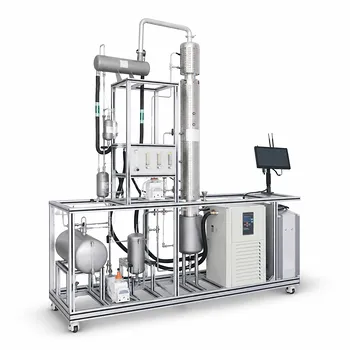
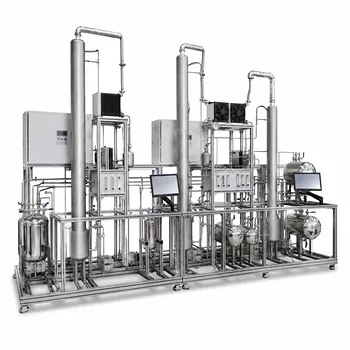
Optimize your laboratory and scale-up processes with precision. LABPARK provides premium Educational and Vocational Unit Operations Pilot Plants in chemical engineering, bioprocess & biotech, and environmental & water treatment. Designed specifically for universities, research institutes, and enterprises, our systems ensure accurate pressure control and repeatable experimental data. Ready to upgrade your distillation setup? Contact LABPARK today to consult with our engineering experts!
Related Products
- Multi-Functional Special Distillation Educational Pilot Plant
- Continuous Sieve-Plate Distillation Pilot Plant for Unit Operations Laboratory Education
- Continuous Batch Extractive Distillation Educational Pilot Plant
- Multi-Modal Distillation Unit Operations Training Pilot Plant
- Green Anhydrous Ethanol Purification Extractive Distillation Unit Operations Training Pilot Plant
People Also Ask
- Why does simple distillation yield higher efficiency than flash distillation? Key thermodynamic differences.
- How does double temperature difference control improve distillation pilot plants? Stabilize purity.
- How to Integrate Spectroscopy in Distillation Pilot Plants for Advanced Process Control
- How to Verify Distillation Boundary Lines & Composition Regions with Pilot Plants
- Why is the acentric factor important in pilot plants? Fluid property prediction.