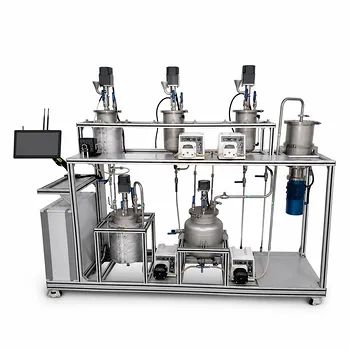
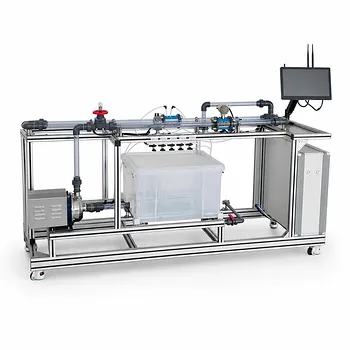
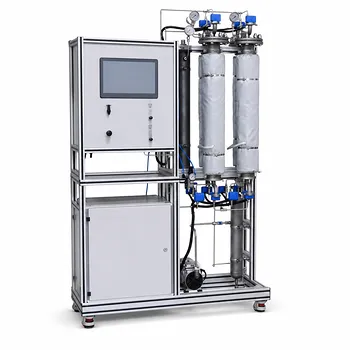
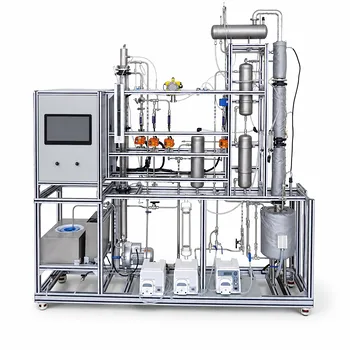
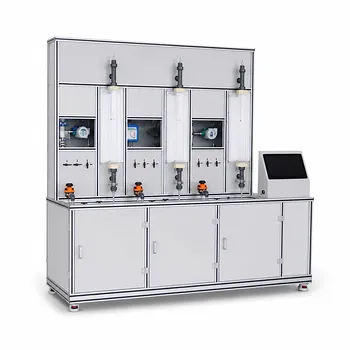
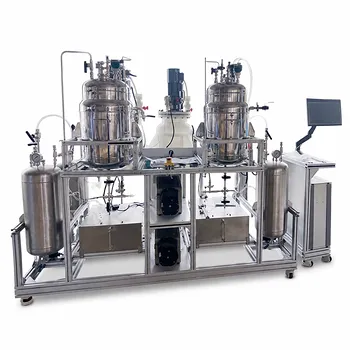
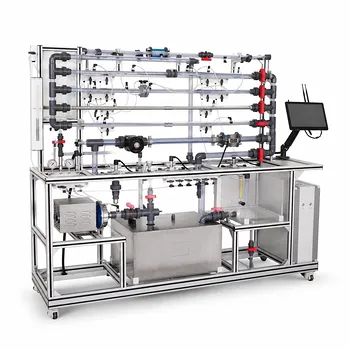
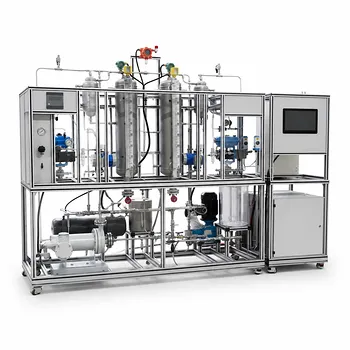
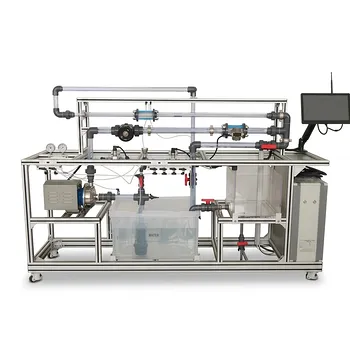
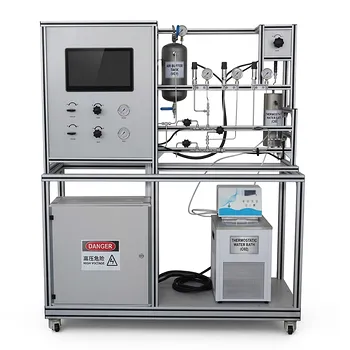
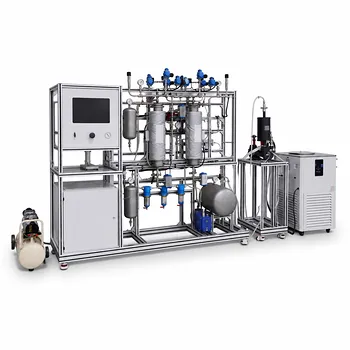
The most powerful lesson a pilot plant teaches comes not from confirming a rule of thumb, but from watching it fail. Educational unit operations pilot plants are the critical tool for teaching students that heuristics are not design laws. They achieve this by forcing a direct, physical confrontation between a simplified estimation (like assuming a constant heat transfer coefficient) and the complex, often unforgiving, reality measured in the lab. The plant's raw data exposes the hidden boundary conditions of these rules, transforming a student's blind trust in a shortcut into a cautious, evidence-based engineering judgment.
The core educational goal is not to discard rules of thumb, but to calibrate a student's instinct for when they apply and when they fail. Pilot plants systematically reveal that a heuristic is merely a starting point, not a final answer, by demonstrating how real-world non-idealities like flow restrictions, non-uniform mixing, and ambient heat loss invalidate idealized assumptions.
Bridging the Chasm Between Theory and Reality
Chemical engineering education is built on elegant mathematical models. Pilot plants serve as the indispensable, often humbling, bridge to the messy physical world. They directly address the "deep need" to cultivate engineers who can critically evaluate any information, whether it comes from a textbook, a simulation, or a senior colleague.
Exposing the Hidden Assumptions in Every Heuristic
Every rule of thumb is a model with strict, often unstated, boundary conditions. A pilot plant makes these invisible lines visible.
- A student using the heuristic that "steam's latent heat is ~2000 kJ/kg" for an energy balance will see a discrepancy when they measure condensate flow and temperature change on a real shell-and-tube heat exchanger.
- The error forces them to investigate. They must account for heat loss to ambient air, condensate subcooling, or non-condensable gases—factors the rule of thumb completely ignores.
- This creates a powerful, memorable lesson: a heuristic is a starting point for estimation, not a final value for detailed design. The pilot plant reveals the penalty for ignoring this distinction.
Confronting the Physical Limits of "Optimal" Designs
A textbook might state that a distillation column's optimal length-to-diameter ratio is a fixed number. A pilot-scale distillation column proves otherwise, often dramatically.
When students try to push a column to its theoretical maximum, they physically encounter downcomer flooding and entrainment. They see the pressure drop skyrocket before a calculated "optimum" throughput is reached. They also learn that structural and installation constraints—like ceiling height in the lab for lifting column sections—are just as real as fluid dynamics. The "optimal" design becomes a compromise between mass transfer kinetics, hydraulics, and the rigid physical world.
The Pedagogy of Controlled Failure
The safe, small-scale environment of a pilot plant is an ideal place for students to learn from failure. This is where they develop an engineer's most valuable skill: diagnosing the discrepancy between prediction and performance.
From Heuristic Heat Transfer to Rigorous Measurement
A common heuristic assumes an overall heat transfer coefficient (U-value) based only on the fluids involved. A pilot-scale reactor with a heating jacket exposes this assumption's fragility.
Students can run an exothermic reaction and compare the cooling duty predicted by the heuristic with the actual performance. The prediction will almost always be wrong. They must then systematically diagnose the source of the error. Is it fouling on the heat transfer surface? Is the agitation speed insufficient, creating a stagnant film boundary layer? This process shifts their mindset from a passive user of data to an active investigator of performance-limiting mechanisms.
The Danger of "Vessel Volume Times Three"
Critical safety heuristics, like sizing a relief system based on a vessel's volume, teach a dangerous lesson in isolation. A pilot-scale crystallization experiment reveals a deeper truth.
Students can run a crystallization and use proven models to calculate the yield. A simplistic heuristic might ignore the unexpected release of latent heat during rapid crystal growth, leading to a temperature spike and secondary nucleation. This direct experience teaches that a design's safety is not guaranteed by a single heuristic. It requires a dynamic understanding of the process, making pilot plants a primary tool for teaching inherently safer design principles through hands-on risk assessment.
The Pitfalls of Purely Mathematical Optimization
An economically "optimized" design on paper is often impossible to operate in practice. Pilot plants provide direct experience with this critical multi-objective trade-off.
A student might find a mathematical optimum for a batch reaction that requires perfect instantaneous mixing. Running this in a pilot plant quickly shows that a real agitator has physical limits, leading to concentration gradients that ruin yield and selectivity. This teaches them that a design must be evaluated for operability, controllability, and safety alongside economic metrics. The best mathematical solution is useless if it cannot be physically implemented or safely controlled.
Understanding the Trade-offs and Hidden Lessons
A pilot plant is not a perfect miniature of a full-scale plant. This limitation is itself a profound lesson in the dangers of heuristics, particularly those related to scale-up.
The Trap of "Linear Scale-up"
The most dangerous heuristic is the assumption of linear scalability. A pilot-scale reactor often performs radically differently than an industrial one due to its high surface-area-to-volume ratio.
A student may perfectly control a highly exothermic reaction in a small, glass-walled pilot reactor. Based on this "proof," a naive heuristic would suggest a geometrically similar but larger vessel will work identically. A well-designed curriculum forces them to calculate the catastrophic loss of heat transfer capacity in the larger vessel, where the heat-generating volume grows by the cube but the cooling surface area grows by the square. The pilot plant's very failure to mimic large-scale dynamics is the lesson.
When a Pilot Plant Distorts Your Perceptions
The physical material of a pilot plant changes outcomes, challenging the heuristic that "what you see is what you get."
A glass reactor allows visual observation, a powerful learning tool. However, its catalytic activity from the metal surface is zero, unlike a stainless-steel industrial vessel. Similarly, the near-perfect insulation achievable on a small pilot pipe is economically unviable on miles of plant piping. This teaches students that the data they collect is a function of the experimental apparatus itself, and they must critically assess all data before applying it to another context.
Making the Right Choice for Your Educational Goal
The way you use a pilot plant must align with the specific lesson you want to teach. It’s not a one-size-fits-all tool, but a flexible platform for targeted discovery.
- If your primary focus is teaching the fundamentals of fluid flow heuristics: Use a simple pipe flow loop with various valves, elbows, and a section packed with beads. Have students predict pressure drop using the velocity-squared rule and then measure the non-idealities caused by complex geometries.
- If your primary focus is on reaction engineering and scale-up pitfalls: Directly compare a batch reaction's yield and purity in a well-mixed glass reactor versus a less-ideal pilot system. Focus the analysis on the dimensionless numbers (like Reynolds or Sherwood) that maintain mixing similarity, not just geometric scale.
- If your primary focus is on safety and the limits of thermochemistry heuristics: Use an exothermic reaction in a reactor calorimeter. Challenge students to predict the maximum temperature rise using a simple heat of reaction calculation, then contrast it with real time data that shows the dynamic effects of heat loss and dosing rate.
- If your primary focus is on separations and "operable" design: Task students with achieving a specific separation in a distillation column. Force them to document the point where a design heuristic (like a F-factor limit) is physically breached by a hydraulic limit like flooding, defining the actual operating window.
A well-designed pilot plant exercise fundamentally transforms a student from a believer in rules into a critical evaluator of evidence.
Summary Table:
| Heuristic Assumption | Pilot Plant Reality | Key Learning |
|---|---|---|
| Constant U-value / Heat transfer | Fouling & boundary layers reduce efficiency | Heuristics are only estimation starting points |
| Linear reactor scale-up | Heat-generation scale vs. surface area limits | Scale-up is non-linear & geometrically limited |
| Volumetric relief sizing | Dynamic exothermic spikes during crystal growth | Safety requires transient thermodynamic analysis |
| Mathematical design optimum | Physical limits on agitators & flow hydraulics | Designs must balance operability with economics |
Bridge the Gap Between Theory and Reality with LABPARK
Help your students move beyond 'rules of thumb' and master real-world process engineering. LABPARK offers premium Educational and Vocational Unit Operations Pilot Plants in chemical engineering, bioprocess & biotech, and environmental & water treatment.
Engineered for universities, research institutes, and enterprises, our systems provide the hands-on, high-fidelity experience students need to build critical engineering judgment.
Ready to elevate your engineering lab? Contact us today to find the perfect pilot plant for your curriculum!
Related Products
- Multi-Reactor Educational Pilot Plant for Reaction Engineering Unit Operations
- High-Gravity Emulsification and Mass Transfer Educational Pilot Plant
- Multi-Functional Membrane Separation Educational Pilot Plant for Unit Operations Lab
- Orifice and Venturi Flowmeter Calibration Educational Pilot Plant for Fluid Mechanics Laboratory
- Micro-Scale Gas-Solid Catalytic Reaction Educational Pilot Plant
People Also Ask
- How do educational unit operations pilot plants address safety and waste management when scaling up?
- How do educational unit operations pilot plants bridge theory and design? Bridge the Engineering Gap
- Why Compare Predicted and Experimental Excess Enthalpy? Key to Accurate Pilot Plant Scale-up
- How to study gasification in pilot plants? Compare exit gas composition & efficiency
- Why Use PTFE & Hastelloy in Chemical Pilot Plants? Prevent Corrosion & Ensure Safety